Stocks crushed
Approximately $1.2 trillion in market value is gone after the House rejects the $700 billion bank bailout plan.



 |
| Biggest point-drop ever wipes out $1.2 trillion in market value. |

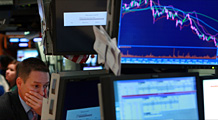



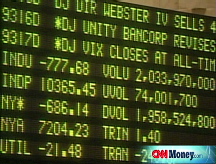
NEW YORK (CNNMoney.com) -- Stocks skidded Monday, with the Dow slumping nearly 778 points, in the biggest single-day point loss ever, after the House rejected the government's $700 billion bank bailout plan.
The day's loss knocked out approximately $1.2 trillion in market value, the first post-$1 trillion day ever, according to a drop in the Dow Jones Wilshire 5000, the broadest measure of the stock market.
The Dow Jones industrial average (INDU) lost 777.68, surpassing the 684.81 loss on Sept. 17, 2001 - the first trading day after the September 11 attacks. However the 7% decline does not rank among the top 10 percentage declines.
The Standard & Poor's 500 (SPX) index lost 8.8%, its seventh worst day ever on a percentage basis and the biggest one-day percentage drop since the crash of '87, when it lost 20.5%. The Nasdaq composite (COMP) fell 9.1%, its third worst day on a percentage basis and also its worst decline since the crash of '87.
Stocks tumbled ahead of the vote and the selling accelerated on fears that Congress would not be able come up with a fix for nearly frozen credit markets. The frozen markets mean banks are hoarding cash, making it difficult for businesses and individuals to get much-needed loans. (Full story)
"The stock market was definitely taken by surprise," said Drew Kanaly, chairman and CEO of Kanaly Trust Company, referring to the House vote. "If you watched the news stream over the weekend, it seemed like it was a done deal. But the money is being held hostage to the political process."
Stocks had fallen from the get-go Monday morning. In addition to expectations for the bailout, there was also news that troubled Wachovia had to sell its banking assets to Citigroup. A number of European banks also collapsed.
But the possibility that the House won't pass the bailout plan caused stock losses to accelerate.
"It's a huge disappointment," said Jack Ablin, chief investment officer at Harris Private Bank.
Although another version of the plan will likely go before Congress, investors are concerned that passing the bill could be a more drawn-out process.
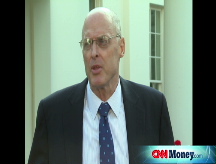
On Monday afternoon Treasury Secretary Henry Paulson said markets around the world are under great stress and that a plan needs to be passed as soon as possible.
"People do expect that there will be some plan put in place, but even before this vote, there was doubt as to whether it would be enough to avert the crisis," said Ken Kam, portfolio manager of the Marketocracy Masters 100 (MOFQX) fund.
Investors thought they would be debating whether the plan was good enough, he said, not whether the plan would even go through.
But the 'good enough' question remains in place.
"We are charting new territory in policy tools and implementation with this program and there's no guarantee that it will work," said Alan Gayle, senior investment strategist at RidgeWorth Investments.
"That a number of institutions haven't been able to last through the negotiations adds to the uncertainty," Gayle said, referring to Washington Mutual's failure on Friday and the buyout of Wachovia Monday.
Stocks are also extremely choppy and volatile as Wall Street moves to the end of the third quarter. Financial institutions and funds are expected to have their books settled before Wednesday, so there is a lot of last-minute scrambling, Gayle said.
Treasury prices rallied, sending yields lower, as investors sought safety in government debt.
Government rescue plan: Congress had supposedly reached a compromise on the $700 billion bank bailout plan Sunday, but the House voted against the bill Monday.
The bill is based around Treasury Secretary Henry Paulson's initial plan to buy up bad mortgage debt from banks as a means of getting them to lend to each other again. However, Congressional lawmakers added provisions to protect taxpayers and enable them to benefit if the companies do as well. (Full story)
But it was shot down, with lawmakers voting largely along party lines, with House Republicans mostly voting against it and House Democrats mostly voting for it.
Investors also remained skittish amid more bank turbulence - and banks continued to hoard cash.
Meanwhile, the Federal Reserve and other central banks around the world announced steps Monday to make billions available to troubled banks.
Wachovia: Citigroup is buying the company's bank assets in a $2.2 billion all-stock deal that will see the company hold onto its brokerage business and remain afloat, albeit in a smaller form.
The deal calls for Citigroup to absorb up to $42 billion in losses and the Federal Deposit Insurance Corp. to be responsible beyond that. Citigroup will give the FDIC $12 billion in preferred stock and warrants in exchange. (Full story)
Wachovia (WB, Fortune 500) shares began trading in the afternoon, plunging 81%. Citigroup (C, Fortune 500) fell almost 12%.
Last week, JPMorgan Chase (JPM, Fortune 500) bought Washington Mutual (WM, Fortune 500), after it suffered the largest failure ever of a U.S. bank. JPM shares fell 15% Monday.
On Monday, regional bank National City (NCC, Fortune 500) slumped 63% on worries that it might be next. Other regional banks dropped too. Bank of New York (BK, Fortune 500) fell 27%, Fifth Third Bancorp (FITB, Fortune 500) fell 43% and Regions Financial (RF, Fortune 500) fell 41%.
Big banks fell too, including Goldman Sachs (GS, Fortune 500), Merrill Lynch (MER, Fortune 500) and Bank of America (BAC, Fortune 500).
Market breadth was negative. On the New York Stock Exchange, losers beat winners 19 to 1 on volume of 2.05 billion shares. On the Nasdaq, decliners topped advancers by over five to one on volume of 2.88 billion shares.
Global markets: Worldwide markets struggled. Asian and European markets ended lower after three European banks fell apart.
Dutch-Belgian bank and insurance giant Fortis was given a $16.4 billion lifeline to avoid it collapsing. The British government nationalized battered U.K. bank Bradford & Bingley.
Germany's financial regulators and several banks stepped in Monday to throw a line of credit to Hypo Real Estate Holding AG in a multibillion-euro move aimed at shielding the No. 2 commercial property lender.
Credit markets: Businesses depend on the credit markets to function on a daily basis, and the absence of ready capital has threatened to stall the broader financial system.
Several measures of bank fears surged Monday, suggesting that despite the bailout, banks remain worried. However, as with stock markets, the freezing up could be an immediate knee-jerk reaction that is mitigated once Congress passes the bill.
Additionally, credit markets may have been more focused on Wachovia and the other distressed banks, than the bailout.
The Libor-OIS spread, one gauge that banks use to determine lending rates, rose to a record 2.2%.
Meanwhile, the TED spread hit a more than 26-year high of 3.58% before dipping back to 3.54%. The TED spread is the difference between what banks charge each other to borrow for three months and what the Treasury pays. When banks charge each other a higher premium than the U.S. government, that's a sign of fear.
The three-month Treasury bill, seen as the safest place to park money in the short term, fell to 0.34% from 0.83% late Friday. Earlier this month, the three-month bill fell to a 68-year low around 0% as panic gripped financial markets.
Long-term Treasury prices rose, lowering the yield on the benchmark 10-year note to 3.58% from 3.82% late Friday. Treasury prices and yields move in opposite directions.
Treasury prices have been rallying recently and yields tumbling as nervous stock market investors have looked for safer areas to move their cash.
Other stock movers: Apple (AAPL, Fortune 500) slumped almost 18% after RBC and Morgan Stanley analysts downgraded the stock to "neutral" from "buy" saying the consumer spending slowdown will hurt profits. (Full story)
A variety of other big tech stocks slumped, including Intel (INTC, Fortune 500), IBM (IBM, Fortune 500), Hewlett-Packard (HPQ, Fortune 500), Qualcomm (QCOM, Fortune 500), Cisco Systems (CSCO, Fortune 500), Dell (DELL, Fortune 500) and Applied Materials (AMAT, Fortune 500).
Among other movers, Circuit City (CC, Fortune 500) slipped 21% after it reported a wider-than-expected quarterly loss and withdrew its fiscal 2009 outlook due to tepid sales.
All 30 Dow components ended lower and all lost at least 3%.
Oil and gold: U.S. light crude oil for November delivery fell $10.52 to settle at $96.37 a barrel, in the second-biggest one-day plunge ever. (Full story)
Oil prices had plummeted over $55 after peaking at $147.27 a barrel on July 11, as investors bet that sluggish global growth will diminish oil demand. But prices have seesawed in the last few weeks as the financial crisis has intensified and investors sought to put their money into hard assets.
COMEX gold for December delivery rose $5.90 to $894.40 an ounce. Like oil, gold prices had also rallied during the biggest periods of unrest over the last few weeks
Other markets: In currency trading, the dollar gained against the euro and fell against the yen.
Gas prices fell for the 12th day in a row, according to a nationwide survey of credit card activity.