
G-7: 'Urgent action' needed
Officials from top economies vow to cooperate to contain financial crisis.




NEW YORK (CNNMoney.com) -- Finance ministers from the world's top economies pledged Friday to work together to stabilize global financial markets, but did not provide concrete plans to address the credit chaos sweeping the world.
"The G-7 agrees today that the current situation calls for urgent and exceptional action," the leaders, who are meeting in Washington D.C., said in a statement. "We commit to continue working together to stabilize financial markets and restore the flow of credit, to support global economic growth."
The plan of action includes:
- Take decisive action and use all available tools to prevent "important" institutions from failing.
- Take steps to unfreeze credit and money markets and ensure that banks and other institutions have broad access to liquidity and funding.
- Ensure that banks and other major financial intermediaries can raise enough capital from public and private sources to re-establish confidence and kick start lending to individuals and businesses.
- Ensure that each country's deposit insurance programs are strong and consistent to assure depositors their money is safe.
- Take action to restart the secondary markets for mortgages and other securitized assets.
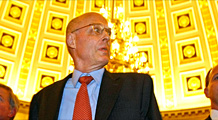
U.S. Treasury Secretary Henry Paulson said the group "finalized an aggressive action plan to address the turmoil in global markets and the stresses on our financial institutions."
The statement, however, didn't lay out any specific actions the G-7 will take, and that's what financial institutions and investors are waiting to see, experts said. The finance ministers must announce concrete steps by the end of the weekend if they want to soothe the roiling markets.
"The time for such statements is long past," said Eswar Prasad, economics professor at Cornell University and senior fellow at the Brookings Institution. "We need to see real action. But the markets are getting a little concerned that there aren't many arrows left in central banks' quivers at this stage."
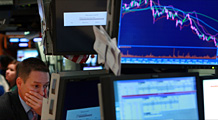
The Dow Jones industrial average fell over 1,874 points, or 18%, in its worst weekly decline ever on both a point and percentage basis. Wall Street lost roughly $2.4 trillion in market value during the week, according to losses in the Dow Jones Wilshire 5000, the broadest measure of the market.
Markets worldwide fared no better, with every major exchange losing ground Friday.
But even decisive action by the G-7 ministers won't calm the markets overnight, Paulson said.
"We'll have some volatility for a while," he said. "This is about confidence...we need to restore confidence."
A government guarantee that the banks won't fail is just about the only thing that might restore trust in the financial system, experts said. This can be done in a variety of ways, including injecting capital into the institutions or guaranteeing interbank lending, an idea floated by British officials earlier this week.
"What they should be saying is that the G-7 governments will put the full faith and credit of their nations behind the financial systems in order to remove the fear of financial institutions loaning to one another," said Lakshman Achuthan, managing director, Economic Cycle Research Institute.
The ministers need to announce a plan before the Asian markets reopen Monday lest more damage occurs, said Achuthan. Already, the delay has turned a mild recession in the United States into a more severe one.
Around the world, central banks this week have tried to contain the deepening global financial crisis. On Wednesday, a group of banks including the Federal Reserve coordinated interest rate cuts, hoping to lower banks' cost of borrowing and soothe nervous investors.
The Fed lowered its benchmark interest rate by a half-point to 1.5%. The European Central Bank, which had kept rates unchanged as the Fed engaged in a string of rate cuts over the last year, cut its rate by a half-point to 3.75% - its first cut in five years. The Bank of England also cut its rate by a half-point to 4.5%. The Swiss, Canadian and Swedish central banks also made cuts.
Some countries have also had to rescue their troubled institutions. The Dutch and Belgian governments took over Fortis, before selling pieces of it to BNP Paribas. The British are nationalizing mortgage lender Bradford & Bingley.
And some nations, including Ireland, France and Germany, have said that all bank deposits will be insured by their governments for the time being.
Meanwhile, the United States and United Kingdom are developing plans to inject capital into banks, which would entail acquiring stakes in the institutions.
"As we develop plans to purchase equity ... we are working to develop a standardized program that is open to a broad array of financial institutions," Paulson said.
Some experts say that a coordinated effort is needed to restore confidence and stability to markets.
"I hope the G-7 meeting will point toward coordinated actions to show that authorities are getting ahead of the curve," said Robert Zoellick, president of the World Bank, on Thursday. "Countries will take different actions, customized to their circumstances, yet the actions need to target the same basic problems."
That problem is a lack of confidence between financial institutions worried about their ability to safely trade and loan money to one another. These jitters prompted a near cut-off in credit needed to fund the day-to-day operations of businesses around the world.
"The G-7 countries can work through this crisis by dealing with bad assets, recapitalizing banks, and providing much needed liquidity," said Zoellick. "They need to work together to fix the financial, regulatory, and supervisory system that failed."
Each country, of course, will have to take steps to address its particular problems.
"I think that some people in the press and some in the markets are naive if they think that different countries with different financial systems - and different political systems, different laws - are going to come up with precisely the same policy to deal with the issues," Paulson said. 



