
Cap gains: Obama, McCain diverge
McCain wants to cut capital gains tax in half to 7.5% for two years. Obama wants to raise it to 20% for wealthier investors. Experts say neither move would have much impact.



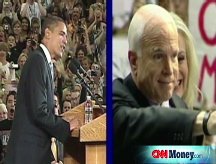
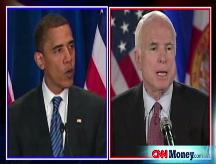
NEW YORK (CNNMoney.com) -- The gap between presidential candidates Barack Obama and John McCain is widening ... the capital gains tax gap, that is.
McCain, the Republican nominee, on Tuesday proposed reducing the tax on long-term capital gains to 7.5%, from its current 15%, for 2009 and 2010. The measure, which applies to assets held more than a year, would cost about $10 billion.
It's unclear whether any change would affect the markets. But McCain's goal is to lure investors back to stocks and drive share prices up. This would benefit not only those who would take advantage of the tax break, but all those with money in the market, his advisers say.
"In my administration, we will instead revive the market by attracting new investment," McCain said as he unveiled a $52 billion economic package aimed at helping people affected by the faltering economy and swooning stock market. "This vital measure will promote buying, raise asset values, help companies and shore up the pension plans for workers and retirees."
His Democratic opponent, meanwhile, has said he would raise the capital gains rate to 20% for couples making more than $250,000 and single filers with incomes greater than $200,000. Obama, who did not change his capital gains stance when he laid out his own economic crisis response Monday, would also eliminate capital gains tax on gains from investments in startup companies.
Obama's advisers attacked McCain's plan for giving more than two-thirds of the benefits to people making more than $1 million a year. They questioned the practical impact of such a measure when the S&P 500 index is down 32%.
"Nobody really has capital gains right now," Obama said. "If the idea is to cut capital gains taxes ... that probably is not going to be particularly useful in solving the financial crisis."
Most tax experts, however, said that the difference in the candidates' stances is of minimal importance.
For one thing, the jury is out on whether shareholders change their behavior based on shifts in the capital gains rate, said Clint Stretch, managing principal of tax policy at Deloitte in Washington. It would only make a difference to someone with the potential to have an extraordinary gain, such as the case of successful small business owner who is looking to sell.
Those making more than $1 million, who would get 66% of the benefit, would see their federal tax bill drop by $72,255, on average, while their average federal tax rate would fall by 2.3 percentage points, according to a Tax Policy Center analysis.
Meanwhile, those earning between $75,000 and $100,000, who would get 0.8% of the benefit, would see their taxes drop by $31, on average, but get no reduction on their tax rate, the analysis found.
If anything, slashing the capital gains tax for two years may prompt more people to sell by the end of 2010, injecting more volatility into the stock markets, experts said.
"What you're telling people is to invest today with plans to take the money out next year or the year after," said Roberton Williams, principal research associate at the Tax Policy Center in Washington. "That's not a good long-term policy and it's not good for the market in the long run. I don't see how it ensures people putting new money in the market."
There are better ways of boosting stock prices and stabilizing the economy, experts said. Instead of focusing on the markets, the candidates should look at the bigger picture.
"Both need to work on the credit markets, housing and getting banks to lend," said William Rutherford, president of Rutherford Investment Management in Portland, Ore. "That will do more for the economy. The market is a reflection of the economy."
For the candidates, changing the tax rate stems from their economic philosophies. McCain believes tax cuts stimulate growth, while Obama wants to shift the more of the tax burden from the middle class to the wealthy.
While adjusting the rate would impact the deficit - at a time when the federal government needs money - experts said the measures should be examined as part of the candidates' overall economic policies.
That said, Obama will have a tough time getting an increase in the capital gains rate through Congress if the economy remains weak, said Joel Slemrod, director of the University of Michigan's Office of Tax Policy Research. It's always harder to pass a tax increase during a recession.
Whoever wins will have to address the capital gains tax by the end of 2010, when the current 15% rate is set to expire. The rate will then revert back to 20%, where it stood before the Bush administration changed the tax laws in 2003. 



