
Bonds weigh bailout and recession
Treasury prices on the rise as investors weigh rising supply with woeful economy. Lending rates continue to fall to historic lows.



 |
| Click chart to view latest bond prices |
 |
| Click chart to view latest bond prices |
NEW YORK (CNNMoney.com) -- U.S. Treasury prices rose Wednesday as investors weighed the rising cost of the financial bailout with what appears to be a deep and prolonged economic recession.
Credit markets, however, got an encouraging boost as lending rates fell to historic lows, restoring some confidence in the embattled debt market.
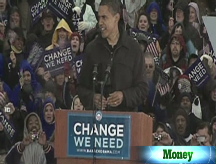
Treasurys initially fell, as investors welcomed the election of Democrat Barack Obama as the 44th U.S. president, and the expectation that tighter economic policies will be ushered in by the new administration.
"The victory was certainly a mandate, and that factored into bonds," said Cardillo. "There's no question we'll see new regulatory agencies develop, and financial regulations are going to get tougher."
But with the election result in the books, bonds turned higher in anticipation of further economic weakness ahead and an influx of more government funding to fight off a recession.
The government said Wednesday it will auction off $25 billion in new 3-year notes and $20 billion in 10-year notes next week. The auctions are part of the Treasury's plan to borrow $550 billion in the fourth quarter as it looks to fund the massive financial rescue costs.
Growing supply and optimism about the election held bonds back from rallying as stocks largely sold off on recession fears.
"The election result was very much anticipated. Now we'll have to wait and see what the plan is for the economy, and markets are getting a reality check," said Peter Cardillo, chief economist at Avalon Partners. "Supply will remain a problem for the bond market in the short term,"
The benchmark 10-year note rose 14/32 to 102-20/32, and its yield fell to 3.67% from 3.72% late Tuesday. Bond prices and yields move in opposite directions.
The 2-year note rose 2/32 to 100-9/32, and its yield fell to 1.35% from 1.37%.
That was encouraging news however, as the benchmark yield curve, the difference between the 2-year and the 10-year yield, fell to 2.32 percentage points Wednesday from 2.35 percentage points late Tuesday. The yield curve is a key measure of investor sentiment, with a higher curve indicating a weaker economic environment. The yield curve reached a near 5-year high Tuesday.
"The recent sharpening of the yield curve means the market is anticipating a long economic downturn to come," said Cardillo. "But the markets think the election is positive news to a certain degree."
The yield on the 2-year note has been falling faster than the 10-year yield in recent months, as investors worry about making long-term investments in an uncertain economic climate. Furthermore, the market has also been anticipating that more rate cuts will come, and the 2-year note is most susceptible to short-term monetary policy actions.
The 30-year bond rose 1-2/32 to 106-7/32, and its yield fell to 4.13% from 4.19%.
The yield on the 3-month bill fell to 0.4% from 0.47%. The yield on the 3-month Treasury bill is closely watched as an immediate reading on investor confidence. Investors and money-market funds shuffle money into and out of the 3-month bill frequently, as they assess risk in the rest of the marketplace. A lower yield indicates that investors are less optimistic.
Lending rates fell sharply again Wednesday, just a day after rates reached levels last seen before Wall Street's credit crisis erupted in mid-September with Lehman Brothers' bankruptcy.
The 3-month Libor rate dropped to 2.51% from 2.71% on Tuesday, according to Bloomberg.com, marking the rate's lowest point since Dec. 16, 2004.
The overnight Libor rate fell for the seventh-straight day, dropping to 0.32% from 0.38%, according to Dow Jones. It was overnight Libor's lowest level since the British Bankers' Association began calculating the rate in 1997.
Libor rates have been trending downward since mid-October, when the Fed took the unprecedented move to flood 13 central banks around the globe with unlimited amounts of dollars. Libor, the London Interbank Offered Rate, is a daily average of what 16 different banks charge other banks to lend dollars in the U.K.
Less than a month ago, 3-month Libor was at 4.82%, and the overnight rate was at an all-time high of 6.88%. Lower rates are a major boost for the strangled credit markets because more than $350 trillion in assets are tied to Libor.
A number of U.S. government programs aimed at easing funding concerns for banks and encouraging lending between financial institutions have also helped lower Libor rates. Such initiatives include lowering interest rates, injecting capital into banks and providing insurance on all non-interest bearing accounts.
Credit remains tight but two key indicators of risk sentiment showed that confidence is returning.
The Libor-OIS spread fell to 1.93 percentage points from 2.11 points on Tuesday. The spread measures the difference between actual borrowing costs and the expected official borrowing rate from the Fed. It is used as a gauge to determine how much cash is available for lending between banks. The bigger the spread, the less cash is available for lending.
Though the indicator has fallen from a high of 3.66 points set last month, it is still far above the 0.11 percentage points seen prior to Sept. 15.
Another indicator, the "TED spread," fell to 2.12 percentage points from 2.22 points on Tuesday. The TED spread measures the difference between the 3-month Libor and the 3-month Treasury bill, and is a key indicator of risk. The higher the spread, the less willing investors are to take risks.
The TED spread has fallen from an all-time high of 4.63 points set in mid-October. It was at 1.04 percentage points just days before Wall Street's crisis.
Did you vote for Obama? How do you think the new president will affect your wallet? What do you think Obama needs to do to fix the economy - both in the short run and the long term? What should be first on the new Congress's agenda? E-mail us your thoughts, including your name, photo and contact info; the best answers will be featured in an upcoming CNNMoney.com article. 



