


In saving the world, the Fed beats Treasury
A tale of two policies: the Fed has been fast and creative in dealing with the crisis from the start, while the Treasury has been slow and unfocused.
(Fortune) -- With a new year of recession-fighting upon us, it's a fitting time to do a performance evaluation of America's policymakers. How well did they handle a true crisis? The credit-market crisis that erupted in early September has been aptly described as a once-in-a-lifetime event that quickly reverberated through the global financial system, bringing it uncomfortably close to a complete meltdown. Along the way, it wreaked havoc with economic growth, throwing most of the industrialized economies into a deep recession.
Such a tumultuous environment calls for unusual and sometimes extreme measures by policymakers to cope with a unique set of complications. So how have America's twin pillars of economic policy, the Federal Reserve and the Treasury, fared in their response to contain the crisis? There is no single answer to that question -- in fact, there are two, because the quality of their response to the crisis could not have been more diverse.
The Fed, on balance, has shown forcefulness, imagination and steadfastness in dealing with the financial market turmoil, while the Treasury's response has been largely sluggish, unfocused, and woefully incoherent.
Looking first at the Fed's performance:
Fed chief Ben Bernanke's monetary policymakers deserve high marks for having worked methodically and tirelessly from the very beginning to contain multiple aspects of the crisis. It needs to be recognized that the most recent, headline-grabbing phase of the crisis since September was largely the culmination of a long process that started with the subprime mortgage debacle in the summer of 2007. That more moderate (at least, in hindsight) crisis caused severe strain in the financial system in late 2007, with interest-rate spreads widening sharply as the first cracks in major financial institutions started to appear.
The Fed's response was prompt and contained two major components. First, a gradual but persistent process of lowering short-term rates to cushion the emerging downside risks for the economy and, second, the establishment of a rapidly growing number of special lending facilities to accommodate the liquidity needs of a growing number of financial institutions. All in all, over 17 months the Fed cut its key interbank lending rate by 5¼ percentage points to practically zero and has taken a series of other innovative measures expanding the kinds of securities that it would accept as collateral in exchange for providing funds to any institution that would simply ask for them.
Along the way, the Fed took an active role in arranging for the orderly dissolution of Bear Stearns in the spring, as the financial crisis was building momentum, and later in the decision to let Lehman go bankrupt in September. In the first case, the Fed was criticized for going too far, putting nearly $30 billion of taxpayer money at risk, prompting former Fed chairman Paul Volcker to comment that the Fed had gone to the outer reaches of its legal authority. In the Lehman case, the Fed and Treasury were criticized for not going far enough, since allowing Lehman's collapse set off the worst phase of the global financial crisis.
In hindsight, the latter decision was arguably a misstep. Operating on the front lines in the midst of the worst global financial turmoil in decades is hardly a recipe for perfect decision-making. But the Fed was fighting the good fight, always in the trenches every step of the way, constantly pushing the limits of what monetary policy can do to cope with a highly destabilizing dynamic. While those actions haven't produced any dramatic results yet, it can be credibly argued that they have played a critical role in preventing a further erosion in the structure of the entire financial system.
And, then, there is Hank Paulson's Treasury...
The Treasury's role in addressing the buildup of financial-market disruptions since the onset of the subprime crisis in the summer of 2007 can be charitably characterized as curiously passive.
To begin with, as clear evidence was emerging that a large number of financial institutions had a potentially life-threatening exposure to toxic assets, the Treasury took no action for a full year to short-circuit the damage that was bound to result for the entire financial system, if unchecked. The Treasury showed an especially puzzling lack of effort to contain the deterioration of the mortgage-related assets on the financial institutions' balance sheets until September 2008.
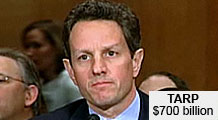
The $700 billion TARP program that was rushed through Congress at the beginning of October was followed by a complete lack of any additional information regarding the eagerly awaited mechanics of how it would be implemented. Then 5½ weeks later -- a near eternity in the midst of a major financial-market crisis -- the Treasury announced that the original idea of mopping up the banking system's toxic assets was cancelled and the new focus would be measures to stimulate consumer borrowing and lending. Then, silence fell again, and the details of such an undertaking remained embarrassingly sketchy.
In what was a final act of troubling passivity, the Treasury announced in early December that it would not ask Congress to release the second $350 billion installment of the original TARP amount until January, essentially leaving it to the next Administration.
An argument can be made that the Treasury's hands in the most recent phase of the crisis were tied by the inertia of the transition from one President to another. However, given the severity of the situation, any meaningful and coherent steps by the Treasury to stabilize the financial system would have almost certainly gained the tacit support of the incoming Administration.
By contrast, the Fed has tried furiously to use all of the tools in its possession, and then some, to protect the financial system and the economy from the risk of a major calamity. Although the results of its efforts are not in yet, the seeds are being sown every day with an ever-expanding array of measures, for an eventual economic recovery. But the effectiveness of its actions have been undercut by the lack of corresponding, consistent measures on the Treasury's part.
No one, not even its most vocal critics, can accuse the Fed for not having tried hard enough to stabilize markets and the economy in the midst of the financial crisis. One would be very hard pressed to argue the same about the Treasury.
It is truly a tale of two policies.
Anthony Karydakis is a former chief U.S economist for JP Morgan Asset Management and is currently teaching at New York University's Stern School of Business. 


-
 The retail giant tops the Fortune 500 for the second year in a row. Who else made the list? More
 -
 This group of companies is all about social networking to connect with their customers. More
 -
 The fight over the cholesterol medication is keeping a generic version from hitting the market. More
 -
 Bin Laden may be dead, but the terrorist group he led doesn't need his money. More
 -
 U.S. real estate might be a mess, but in other parts of the world, home prices are jumping. More
 -
 Libya's output is a fraction of global production, but it's crucial to the nation's economy. More
 -
 Once rates start to rise, things could get ugly fast for our neighbors to the north. More









