
Volcker: Regulate to prevent future crisis
Economists' group led by ex-Fed chief says more regulation needed in the financial sector, outlining several necessary reforms



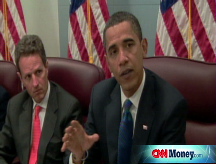
NEW YORK (CNNMoney.com) -- Financial markets must be made more transparent - with closer attention paid to risk management - in order to prevent another global economic collapse, according to a report released Thursday by a body of top economists led by former Federal Reserve Chairman Paul Volcker.
Volcker, the head of President-elect Barack Obama's special economic recovery advisory board, presided over the Fed from 1979 to 1987, a period of extreme financial unrest. He is known for raising interest rates to historic highs under the Carter and Reagan administrations in order to combat out-of-control inflation.
"The issue posed by the present crisis is crystal clear," said Volcker. "We [must] restore strong, competitive, innovative financial markets to support global economic growth without once again risking a breakdown in market functioning so severe as to put the world economies at risk."
The economists' group, named the Group of 30, called for tighter regulation of the financial sector, improving coordination between government and international regulators. They also suggest regulators be allowed to work independently from politics, as political and market pressures can compromise their goals.
Central banks should be strengthened, according to the report, but not just in times of crisis. It says the Fed and other central banks should promote and maintain financial stability even when the economy is at its strongest, since market participants often make their riskiest deals during those periods.
For instance, the current credit crisis stems from unscrupulous lending practices of banks and mortgage lenders during the peak of the housing boom, which passed through without stringent government regulation. Only when the housing market collapsed were the risky deals widely uncovered.
Regulators should pay particularly close attention to relatively new and largely unregulated financial instruments such as credit default swaps, collateralized debt obligations and over-the-counter derivatives, the group said. Many analysts have said that regulators have failed to keep up with the growing complexity of Wall Street investment techniques, leading to shady and mostly unnoticed dealings.
The report also said the United States should establish a regulator that deals exclusively with non-bank financial institutions and create a way of dealing with failed non-depository financial institutions. Currently the government will take over failed depository banks, guaranteeing a certain amount of deposits through a Federal Deposit Insurance Corporation's fund.
But the government needed to make up new rules to save other kinds of failing institutions, such as American International Group Inc. (AIG, Fortune 500), during the credit crisis.
Furthermore, the Group of 30 said the largest and most complex financial institutions should be subject to the most regulation and forbidden from engaging in activities that pose particularly high risk to the overall market.
With the financial markets tangled like a web, the biggest banks have become the most systemically important, hence the multi-billion dollar bailouts of Bear Stearns, Citigroup (C, Fortune 500) and American International Group (AIG, Fortune 500) in the past year.
Thursday's report was a follow-up to an earlier Group of 30 study released in October. That study found that a lack of appropriate and necessary banking regulation by governments around the globe led to the current worldwide economic crisis. 



