
Banks working to prevent foreclosures
Lenders intervened to help stop 239,000 foreclosures in December - 4th straight month above 200,000.



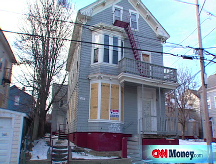
NEW YORK (CNNMoney.com) -- In a sign that banks are stepping up their efforts to combat foreclosures, lenders intervened to help prevent 239,000 foreclosures last month, according to a report released Thursday.
Hope Now, a coalition of lenders, investors in mortgage-backed securities and community advocacy groups, said that December marked the fourth consecutive month that its members had arranged more than 200,000 mortgage workouts.
For all of 2008, the number of interventions approached 2.3 million, Hope Now said.
More importantly the number of homes lost to foreclosure has been on the decline. In December, lenders repossessed 55,608 homes, down from 69,000 homes that were repossessed in November, and 77,000 in October. In 2008, a total of 917,964 homes were lost to foreclosure.
"The December results demonstrate that Hope Now members are moving aggressively to do what's needed to avoid preventable foreclosures," said Faith Schwartz, Hope Now's director.
She adds that says that fewer homes were lost to foreclosure in December thanks also to seasonal factors, since lenders tend to ease up on repossessions during the holidays, and to foreclosure moratoriums implemented recently by some lenders, including mortgage giants Fannie Mae (FNM, Fortune 500) and Freddie Mac (FRE, Fortune 500).
She also credited very low mortgage interest rates, with helping people refinance and stay in their homes. "That's very helpful for homeowners who have good credit and are not underwater," she said. "They can refinance into more affordable loans."
Still, other housing experts still see plenty of trouble ahead.
"There's an overwhelming preponderance of data that confirms that these voluntary loan modifications simply don't work," said Jim Carr, COO for the National Community Reinvestment Coalition, an advocacy group whose members do foreclosure-prevention counseling.
A recent report issued by the U.S. Comptroller of the Currency found that 53% of borrowers who had their mortgages modified in the first half of 2008 were already at least two months delinquent again.
"The redefault rate is growing, home prices are tumbling, repossessions may be down but the projections for future foreclosures are going through the roof," he said.
Carr pointed out that a Credit Suisse report forecasts that as many as 8 million homeowners could face foreclosure over the next five years.
"We're way beyond voluntary modifications now," he said. "This is an unemployment-induced foreclosure problem and it will swamp Hope Now's efforts. Their staff is working so hard, but it's not anything they can control."
When homeowners are unemployed it matters little whether their lenders modify their loans. Without any income they simply can't afford any mortgage.
The December statistics also revealed the changing face of troubled borrowers. Previously, most mortgage workouts reported by Hope Now involved subprime borrowers. In the second quarter of 2008, for example, 62% of the group's workouts involved subprime loans.
In December, that percentage had fallen to 54%, a proportion that is likely to drop further this year. More prime borrowers are running into mortgage payment problems as the economy declines. Unemployment is now the main driver behind mortgage delinquencies.
Meanwhile, the number of problems caused by unaffordable mortgages -- such as hybrid adjustable rate mortgages, the so-called "toxic" ARMs -- have declined, since many of these loans have already failed and lenders no longer issue them. 



