
New York - the next housing bust?
The city has fallen on hard economic times, and that could bring its high-priced housing market back down to Earth.



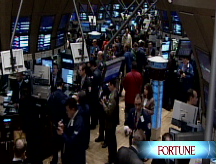
NEW YORK (CNNMoney.com) -- The Masters of the Universe have been dethroned. Now the question is just how much Wall Street's meltdown is going to hurt the city of New York and, by extension, its high-priced housing market.
Even in a city where $20 million townhouse listings don't raise an eyebrow, signs of trouble abound. Fourth quarter 2008 sales volume was down a whopping 40% from 2007 according to New York brokerage the Corcoran Group. And the average price of existing homes dropped 3.6% during the same period.
The S&P Case-Shiller Home Price Index showed a price decline of 8.6% for the New York metro area, including the city and the surrounding suburbs, for the 12 months ending November 30.
New York's economy runs on Wall Street money, and after the failure of Lehman Brothers and the sales of both Merrill Lynch and Bear Stearns, there isn't nearly as much of it as there used to be.
After the financial markets imploded, the New York real estate market "stopped dead," said Dottie Herman, CEO of broker Prudential Douglas Elliman. "If you think you're going to lose your job, you're not going to buy. [We're] a long way off from the past couple of years."
Whereas bidding wars were once commonplace, city apartments are now languishing on the market.
Leonard Steinberg, a Prudential Douglas-Elliman agent who handles many high end listings, has been trying to move a $1.2 million condo located in the Chelsea part of town for more than a year. The home was originally priced at $1.4 million.
And the city's economic conditions are only getting worse. On Friday, New York City Mayor Michael Bloomberg announced $1 billion worth of budget cuts as Gotham steels itself against a rapidly dwindling tax base. Its coffers are expected to dwindle by a stunning $4.1 billion for fiscal 2009, which ends June 30, thanks to the economic turmoil.
Perhaps it's no surprise then that Goldman Sachs recently issued a report predicting that New York City's normally-stratospheric prices will fall as much as 44%.
And investors betting on derivatives based on the Case-Shiller Home Price Index aren't much more optimistic. They're betting that New York prices will tumble over 21% over the next 4 years.
Jobs are the obvious problem. Some 65,000 payroll jobs were lost in the last three months of 2008 alone, according to the city Comptroller's office. New York's unemployment rate jumped to 7.4% in December, up from 6.3% in November.
Jonathan Miller, president of Miller Samuel, a premier appraisal firm in the city, said that financial market turmoil could hit home prices harder in New York than anywhere else.
"It's more exposed than other metro areas to financial industry job losses," Miller said.
And Wall Street types who are lucky enough to hang onto their jobs have seen their 2008 bonuses slashed by 44% compared with 2007 levels.
If New York City does somehow manage to dodge the real estate bullet that's crippled so many other metro areas nationwide, it may be thanks to some of the market's unique qualities.
"We didn't have the rampant speculation that many places had," said Miller, who cited cities like Phoenix and Las Vegas. Most New York buildings require buyers to run their finances by a coop board for approval, and to put down at least 20%.
And, by virtue of its limited size, the city didn't experience the kind of rampant overbuilding that places like the Sun Belt saw.
Additionally, the city is benefiting from the overall trend toward urban living that should help maintain demand for housing. "Our findings indicate that upper-middle and high-income households have increasingly chosen to reside in the city, said city Comptroller William Thompson, "suggesting that our city may be more resilient to this economic downturn than in 1990 when companies and families were fleeing New York."
All that, however, only helps so much. Any time you subtract billions of dollars from a local economy there will be vast ripple effects. Restaurants, retail putfits and of course, real estate will all suffer.
Said Miller: "We're going to have to go through more pain before things get better." 



