
TARP revised: On verge of new bailout
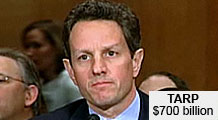
Treasury Secretary Tim Geithner is set Tuesday to unveil the eagerly-awaited announcement of the TARP overhaul.



NEW YORK (CNNMoney.com) -- The Obama administration's long-anticipated overhaul of the banking bailout is finally near.
Treasury Secretary Tim Geithner is scheduled to detail a financial system rescue plan on Tuesday in an 11 a.m. speech in Washington, D.C.
"This is a challenge more complex than any our financial system has ever faced, requiring new systems and persistent attention to solve," Geithner is expected to say Tuesday, according to excerpts of prepared remarks released by the Treasury Department. "But the president, the Treasury and the entire administration are committed to see it through because we know how directly the future of our economy depends on it."
Details are still not certain. But in a press conference Monday night, President Obama promised that Geithner would provide "very clear and specific plans" for loosening up credit markets.
According to prepared remarks, Geithner plans to say the new plan will "cost money, involve risk, and take time," but will be "guided by the principles of transparency and accountability."
"We have to both jumpstart job creation and private investment, and we must get credit flowing again to businesses and families."
The Troubled Asset Relief Program, or TARP, was created last fall to shore up the deteriorating finances of the nation's banks.
The President added that some funds would be directed toward helping homeowners facing foreclosure, and that there would be conditions on banks that receive bailout money - though Obama declined to say whether there would be lending requirements.
These principles would restore market confidence, the President said, and attract private investment, an important element that will determine if the government will need to allocate more money to TARP.
So far, the government has used the first half of $700 billion in TARP funds to inject capital into more than 300 banks, to make additional large investments in AIG (AIG, Fortune 500), Bank of America (BAC, Fortune 500), Citigroup (C, Fortune 500), and to lend money to General Motors (GM, Fortune 500) and Chrysler.
Now Geithner needs a plan for the second slice of $350 billion.
The strategy thus far has come under attack for a number of reasons.
It is not clear how the Treasury Department decides which banks get loans. Banks are hoarding their new funds, rather than making loans. Direct investments and loans do not address the core problem of establishing transparent pricing for the so-called toxic assets rotting on bank balance sheets. And there has not been enough attention given to stemming the tide of foreclosures, a key mandate of the TARP legislation.
"The actions we took were absolutely essential, but they were inadequate," Geithner is expected to say. "The force of government support was not comprehensive or quick enough to withstand the deepening pressure brought on by the financial crisis."
Though it was not yet certain what alternatives Geithner would pursue, these are the options under review.
'Bad Bank': The prospects for the creation of a so-called "bad bank" have gone back and forth in recent days. A government-funded "bad bank" would buy toxic assets from bank balance sheets. But there are many hurdles.
For example, how much would the government pay for those assets -- pay too much, the taxpayer takes a hit; pay too little, and the banks do. Plus, many analysts believe that to be truly effective, a "bad bank" would need far more money than is available.
However, it now appears that Treasury may use private sector money for the bulk of the financing. Speaking on "Fox News Sunday," top White House economic aide Larry Summers said Geithner believes he can bring "substantial private capital" to the plan.
Insuring assets: The Treasury Department has already done this for Citigroup and Bank of America. Here's how the Citi arrangement -- announced last fall -- works, for example: Citi is on the hook for the first $29 billion in losses on the covered assets, which includes mostly loans backed by residential and commercial mortgages. Citi covers 10% of losses above that amount, with the government shouldering the rest.
In a bailout scheme announced last month, the United Kingdom used the same approach.
Such a plan helps ease the pain on banks, but will not force the banks to fully recognize the extent to which assets their holding have lost value -- an important step in the recovery process.
Fed financing for private investors: Though government assistance is needed, few think the government should take the lead in pricing assets and controlling banks. That's a job best done by private investors, such as hedge funds. But with credit markets frozen, these investors can't get financing to buy toxic assets -- this is where the Federal Reserve may step in.
The Fed announced the Term Asset-Backed Securities Loan Facility (TALF) last fall as a vehicle to lend money for the purchase of an array of securities backed by consumer loans like credit-cards and student loans. The Fed could expand the TALF to jumpstart the private market for bad real estate loans.
One question mark hanging over this concept is how willing the banks will be to sell toxic assets at the market prices. If the newly established market prices are below the prices at which the banks have marked the assets on their balance sheets, the banks could face more writedowns -- which could force the government to pour in even more capital.
Debt/equity swaps: Geithner could also require that debt holders in banks needing assistance "swap" their stake for stock. Existing shareholders would be wiped out and current creditors would give up some of their debt claims in exchange for ownership of the restructured firm. In addition to being fairer, swapping debt for equity would reduce the amount of debt weighing on the economy.
More bank injections: This idea isn't dead yet. Banks still need capital, and the TARP fund still has some cash. Treasury may make more direct investments, though they would surely come with more strings attached, such as a requirement that banks boost lending, for example.
Stemming foreclosures: President Obama has said he wants to set aside between $50 billion and $100 billion to address the foreclosure crisis. How the money will be spent is unclear. FDIC chair Sheila Bair has advocated a plan that would capping monthly payments at 31% of the borrowers' gross income, and have the government share losses with lenders should homeowners that get help end up re-defaulting.
In an interview with CNN this weekend, Obama's housing secretary, Shaun Donovan, stressed that limiting foreclosures will be key to solving the crisis in the housing market and broader economy. 



