
Organic growth: How Amy's Kitchen got started
Rachel and Andy Berliner of Amy's Kitchen built a leading frozen-food brand by catering to busy vegetarians.



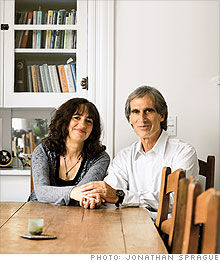 |
| Rachel and Andy Berliner, founders of Amy's Kitchen |

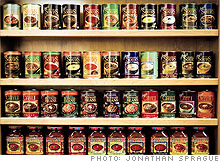 |
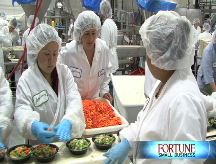
| Launched with a tofu potpie, Amy's Kitchen now offers 140 vegetarian products. |
(Fortune Small Business) -- Like many busy couples, Andy and Rachel Berliner turned to frozen dinners when home cooking wasn't on the agenda. One night in 1987 they came up with a better idea. The result: organic powerhouse Amy's Kitchen.
Based in Petaluma, Calif., Amy's leads the nation in prepared organic food sales and boasted 2008 revenues of $240 million. With Andy, now 61, as CEO and Rachel, 55, as head of marketing, the 1,600-employee company sells 140 vegetarian products, such as frozen black-bean tamales, in chains that include Kroger (KR, Fortune 500), Safeway (SWY, Fortune 500) and Whole Foods (WFMI, Fortune 500). The couple's daughter, Amy - born the same year as the company that bears her name - is training to join the family business. And it all began with a humble potpie.
RACHEL: My parents raised their own organic vegetables. Andy's first business was Magic Mountain, an organic tea company, which he sold in 1981. We were already committed to a healthy vegetarian lifestyle when I got pregnant with our daughter in 1987. Near the end of my pregnancy, I pulled a muscle and couldn't stand long enough to cook or shop, so Andy went to the local health-food store for some frozen meals...
ANDY: ...and they tasted like cardboard.
RACHEL: We had been talking about how to put our child through college and provide her with a certain standard of living, and we knew we wanted to do that by running our own business. We just didn't know what type it would be.
At the time potpies were the most popular frozen meal, so we decided to bake our own. My mother suggested that since we were launching the company to support our daughter, we should name it after her.
My mom, who's an amazing cook, came up with a vegetable and tofu potpie recipe. We spent hours in the kitchen, testing the recipe and then making about 100 pies by hand so we could debut them at a San Francisco health-food show in March 1988. The first day of the show, a handful of natural-food stores signed up for orders. But then we had to figure out how to fill them!
We asked an organic bakery near our home in Northern California to bake the pies for us, and we set up a makeshift office in one of the bakery's kitchens. We found local suppliers of organic vegetables, which were scarce back then. After about a month of searching, we made arrangements to buy veggies in bulk from a few independent California growers as well as Cascadian Farm, a Washington company that sells frozen organic produce. (Cascadian was independent at the time, but General Mills (GIS, Fortune 500) bought it in 1999.)
ANDY: To launch Amy's, we borrowed against Rachel's car, and I sold a watch and some gold coins. That raised about $20,000, enough to get us going. When we ran through that money and went for a line of credit, almost every bank turned us down. Only our local bank finally approved us, for $20,000. I learned later that when the loan officer reviewed our application, he was so impressed with our product that he predicted we would be the bank's largest customer someday. He was right, and we still bank with them.
A few months after our launch, we had too many orders and our bakery couldn't keep up. Its owners gave us 30 days' notice to find another site. We couldn't locate one that used quality organic ingredients, so we worked out a deal with that first bakery to let us cook potpies in the kitchen that we'd been using as an office. Then we ran a help-wanted ad in a local paper, which brought in five bakers, three of whom are still with us. Rachel, her mother and I all cooked together, with me carrying Amy around.
We could make just a few hundred pies a day by hand, and we had problems distributing ingredients evenly among the pies. I called the engineering department at Swanson - one of the nation's oldest frozen-dinner brands - and asked how they made potpies. I told them who we were and what we were doing, and they didn't feel threatened - it's not like I was asking for recipes!
Swanson's solution to the problem was a complex mechanical system, but the company helped us think about the process and the equipment needed. We couldn't afford a system like theirs, so we hired two extra employees for the assembly line. And when we finally bought a used pie machine from a dessert company, our output immediately increased to about 2,400 pies a day.
Our first real disaster hit in year two. Our freezer died, and our inventory started to thaw. When we checked our pies, only the tops had defrosted; they didn't look soggy or freezer-burned. We went ahead and shipped them. A few weeks later, distributors from all over the country were complaining about moldy potpies. The tops had turned completely black! Fortunately, the pies hadn't reached stores yet, but we had to throw away our entire stock. Thank God it was early enough in the life of the company that our total inventory was only 100,000 potpies. I think 200,000 would have killed us.
We had been pitching regular supermarkets for years, but it wasn't until big chains such as Kroger started carrying frozen health foods in the late 1990s that our business really took off. Sales grew 73% in 1998, to $32 million, after King Soopers in Denver and other grocers started placing orders with us.
We expect to be a billion-dollar company in five years. We're introducing about two new products annually, and we're looking to open an East Coast distribution center that will help reduce shipping costs.
Our daughter Amy, who's a junior at Stanford, will have the opportunity to take over. We've been approached a few times to sell, but we always say no. We want this to remain a family business, one that supports our values and pays Amy's tuition. 
Watch the video: Behind the scenes at Amy's Kitchen
Bear Naked ambition: The inside start-up story
Pastry parlay: From Au Bon Pain to Panera
Mothers Work: A feminist revolution

-
 The Cheesecake Factory created smaller portions to survive the downturn. Play
 -
 A breeder of award-winning marijuana seeds is following the money and heading to the U.S. More
 -
 Most small businesses die within five years, but Amish businesses have a survival rate north of 90%. More
 -
 The 10 most popular franchise brands over the past decade -- and their failure rates. More
 -
 These firms are the last left in America making iconic products now in their twilight. More








 My dream is to launch my own business someday. Now that it's time to choose a major, I'm debating if I should major in entrepreneurial studies or major in engineering to acquire a set of skills first. Is majoring in entrepreneurship a good choice? More

 When it comes to in-flight pampering, the amenity kits offered by these 10 airlines are the ultimate in luxury More
 From a text therapy platform to apps that push you reminders to breathe, these self-care startups offer help on a daily basis or in times of need. More
 From Uber's flying cars to the Hyperloop, these are some of the neatest transportation concepts in the works today. More
 More Small Business


