
Winning stocks in a losing decade
Yes, the major market indexes are at their lowest levels in a dozen years. But many stocks have bucked the bearish trend.



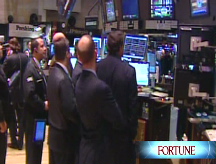
 |
| After recovering from the 2000-2002 bear market, all of the past decade's gains in the S&P 500 and Dow have been erased in a little more than a year. |
NEW YORK (CNNMoney.com) -- In case you haven't heard, the Dow closed Monday at its lowest level since April 1997.
It's tempting to take that news and go cry in your beer (if not something stronger). But looking at the Dow -- or even the broader S&P 500, which closed at its lowest point since October 1996 Monday -- hardly tells the whole story about how the market has done in the past decade.
Yes, if you had the misfortune of investing in an index fund, more than a decade's worth of investments have been wiped out. But the myopic focus on just how market indexes have done does some a disservice.
That's because even in a brutal bear market such as this, some investors have been able to make money by buying strong companies -- firms that have not made stupid mistakes and now expect a government handout to make them all go away.
In fact, shares of more than 200 companies in the S&P 500 are up during the past 10 years through Monday's close -- a time when the overall S&P 500 has plummeted more than 40%
And some of these companies are large, widely held firms with staggering returns. Shares of auto parts retailer AutoZone (AZO, Fortune 500), which posted a better-than-expected fiscal second-quarter profit Tuesday despite the many problems facing the automotive industry, are up 300% in the past decade.
Shares of wireless chipset maker Qualcomm (QCOM, Fortune 500) are up more than 600% in the past ten years while shares of Apple (AAPL, Fortune 500) have skyrocketed more than 900%. And biotech Gilead Sciences (GILD), the market leader in developing drugs to combat the HIV virus, has soared more than 1,600%.
Money managers who have been able to largely escape the carnage said that the key to investing in either a bull or bear market is to stick with top-notch companies with healthy balance sheets. After all, the binge on credit at both the consumer and corporate level is a leading cause of this downturn.
"It's been a challenging time. But our focus on quality has always been there -- companies that have very little debt, produce a lot of cash, have a competitive advantage and high profit margins," said Kent Gasaway, co-manager of the Buffalo Small Cap fund, a fund that has a ten-year annualized return of 10.2%, according to fund tracker Morningstar.
Gasaway said another way his fund has held up better than peers during the recent recession is by investing in so-called countercyclical companies, firms that actually do reasonably well in a downturn.
Along those lines, three of the fund's top ten holdings are in private education companies, which have benefited from higher enrollment in what has been a poor job market. The fund's top two holdings are Corinthian Colleges (COCO) and ITT Educational Services (ESI). The fund also owns DeVry (DV).
Rick Aster, portfolio manager with the Meridian Value fund, which has an annualized return of 8.1% over the past ten years, also said he's stayed away from companies with questionable fundamentals.
"We don't invest in bubbles or companies really doing well that everybody likes," said Aster. "We steered clear of housing stocks and financials for the most part."
Instead, Aster said a key to his fund's solid track record is looking for companies in turnaround situations, stocks that may have been beaten up but have the right strategies in place to rebound. That strategy has served him well with some long-time holdings in the healthcare sector, such as drug maker Abbott Laboratories.
More recently, Aster said he and his team have picked up shares of children's clothing retailer Carter's (CRI), which stumbled after buying rival OshKosh B'Gosh in 2005 but has bounced back recently thanks to healthy sales growth.
Aster even said there is one financial firm he's willing to take a gamble on: JPMorgan Chase (JPM, Fortune 500).
"Banks have been killed but we believe at this point that JPMorgan Chase has the best opportunity to continue to take market share since it is in the strongest financial condition," he said.
Now I don't think people should mistake these money managers' long-term bullish tone as a sign that they, or I for that matter, think the market has finally bottomed. I have unfortunately called a couple of false bottoms in the past year, as have many investing professionals. Trying to predict the short term is a recipe for failure and I'm giving up attempting to do so.
And it's understandable that a lot of average investors have good reason to be wary of stocks and Wall Street right now. Many banks have betrayed the public trust. The Bernie Madoff and R. Allen Stanford scandals are reminders of what can happen when greed goes unchecked and regulators look the other way in a bull market.
But the entire stock market is not one big Ponzi scheme. The best way to achieve solid long-term financial returns historically has been through investing in leading companies, not sticking your money in gold, Treasury bonds or your mattress.
"If you are young, this feels terrible, but it's the best thing to happen to you since there are bargains all over the place," said Gasaway. "We're buying companies we've never owned before that we always coveted but used to be too expensive." 



