


Cisco aims to serve
The networking titan thinks it can take on IBM, HP, and Dell selling servers. The ball is in CEO John Chambers' court.
 |
| Cisco CEO John Chambers needs to try new things to keep his company growing while corporate technology budgets shrink. |


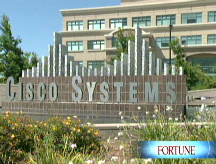
(Fortune Magazine) -- It is the buzz of the tech world: Cisco Systems may soon try selling servers, those heavy-duty computers that companies use to run critical back-office applications. The prospect of router giant Cisco's entering the already crowded $55-billion-a-year server market is intriguing (imagine if LeBron James decided to try his hand at football) but also has the potential to disappoint. (Remember Michael Jordan's ill-fated effort to play professional baseball?)
With his server gambit, Cisco (CSCO, Fortune 500) CEO John Chambers appears to be targeting a very specific niche: the trendy "virtualization" segment of the server business, which is expected to grow 43% this year to $2.7 billion worldwide, according to research from Gartner. Virtualization basically is a way to make servers more efficient. Using specialized software, one computer with a hard drive and a network connection can act like several smaller computers and hard drives on different networks. When everything goes right, more work gets done with less hardware and electricity. Multiply that effect in a data center with thousands of servers, and you can see why corporate customers like it, especially in times of cutting costs. Computer maker Dell (DELL, Fortune 500), for example, believes it can cut its information technology budget 10% this year without sacrificing productivity.
Of course, Cisco isn't the only company angling for a piece of the virtualization action. Dell is trumpeting its own cost savings as a way of selling its servers - bundled with virtualization software - to customers. Hewlett-Packard (HPQ, Fortune 500) and IBM (IBM, Fortune 500) also offer servers bundled with technology from VMware, the leading maker of virtualization software. Microsoft (MSFT, Fortune 500), meanwhile, has launched a product to compete with VMware (VMW).
Chambers' move into servers and virtualization means Cisco, for years a nonthreatening provider of "plumbing" for corporate and telecom networks, will find itself competing with companies it once considered partners. HP and IBM sometimes sell or install Cisco equipment as part of their services operations. "These megacompanies are spreading out into each other's territories in very real ways," says Bob Beauchamp, CEO of BMC Software, which makes products that help companies manage their information technology.
But Chambers has little choice but to try new things. Cisco, with more than $39 billion a year in annual sales, is seeing cash-strapped customers delay purchases by squeezing productivity out of existing equipment. Cisco's product orders sank 20% in January compared with the year before, for example. Since budgets are tight, one good way to deliver the growth shareholders demand is to steal some business from the server guys.
So how will Cisco's virtualization play differ from what every other server maker is offering? Cisco is saying very little on the matter (indeed, the company hasn't formally announced that it is entering the server business). Padmasree Warrior, the company's chief technology officer, suggested in a recent interview that virtualization is a Trojan horse for Cisco to get deeper into companies' data centers - those computer rooms that house rows of servers running corporate applications.
Cisco's aim, Warrior says, is to virtualize the whole data center by providing software that can manage real servers and virtual ones at the same time, plus the jumble of virtual storage and network connections (Cisco's area of expertise). In a nod toward that strategy, Cisco in September announced the Nexus 1000V, its first piece of virtual networking equipment. That's right - the Nexus 1000V doesn't physically exist; it's software that pretends to be a switch.
Still, Cisco isn't exactly known for its software prowess, and analysts widely believe the company will bundle its servers with applications from VMware, which is exactly what all its would-be competitors are doing. (Cisco owns 2% of VMware - storage giant EMC owns another 85% - prompting speculation that Cisco may ultimately acquire EMC as a way to get its hands on VMware.)
Chambers says virtualization is one of his big priorities for 2009, along with globalization, video growth, customer relationships, and Web 2.0. With its strong position among corporate information technology departments - Cisco has 61% of the router market - the company surely will be able to get an audience for its servers. But if he aims to beat HP, Dell, and IBM on their home court, Chambers is going to have to serve up something truly groundbreaking. 


-
 The retail giant tops the Fortune 500 for the second year in a row. Who else made the list? More
 -
 This group of companies is all about social networking to connect with their customers. More
 -
 The fight over the cholesterol medication is keeping a generic version from hitting the market. More
 -
 Bin Laden may be dead, but the terrorist group he led doesn't need his money. More
 -
 U.S. real estate might be a mess, but in other parts of the world, home prices are jumping. More
 -
 Libya's output is a fraction of global production, but it's crucial to the nation's economy. More
 -
 Once rates start to rise, things could get ugly fast for our neighbors to the north. More









