
3 banks fail - 20 so far this year
The FDIC estimates that the cost of the three failures will run in excess of $200 million. One bank was not able to find a buyer, two others were.



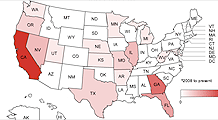
NEW YORK (CNNMoney.com) -- Bank regulators closed three banks Friday, marking the 18th, 19th and 20th failures this year.
The FDIC estimates that the combined cost of the bank failures to its deposit insurance fund will be approximately $207 million.
The announcements mark the ninth week in the past ten that bank failures have been reported.
FirstCity Bank, based in Stockbridge, Ga., with $297 million of assets and $278 million of deposits as of March 18, was closed by state regulators, according to the Federal Deposit Insurance Corp., which was named the receiver.
The FDIC, unable to find a bank to take the assets of FirstCity, said on Monday it will mail the bank's former customers checks to cover insured funds.
A message on First City's Web site said that "an assuming bank could not be located."
According to an FDIC representative, the assets of the failed bank in Georgia were not attractive to buyers. "There was no franchise value," wrote David Barr, spokesperson for the FDIC, in an email. "More than half the deposits were out of area and the assets were highly concentrated in development loans. We had interest until they saw the deposit and asset makeup."
Direct deposits from the federal government - like Social Security and veterans payments - to First City account holders will go directly to SunTrust Bank.
First City customers with brokered deposits need to be in touch with their brokers. The FDIC will reimburse insured, brokered deposits after the brokers provide the FDIC with the appropriate documentation.
The FDIC fully insures individual accounts up to $250,000 through the end of 2009. When the bank was closed down, the failed bank had about $778,000 in deposits that exceeded the insurance limits, according to the FDIC, although that total could fluctuate as the FDIC hears from the customers.
The FDIC estimates the bank failure will cost its fund approximately $100 million.
Starting Monday, depositors of Stockbridge, Ga.-based bank can go to the FDIC Web site, http://www2.fdic.gov/dip/Index.asp, to obtain the status of their account. A customer can enter his or her bank account number into the field on that site to get an update.
Teambank National Association of Paola, Kan., and Colorado National Bank of Colorado Springs, Colo., were closed later on Friday by the Office of the Comptroller of the Currency.
The FDIC was named the receiver for both banks. The FDIC entered into a purchase and assumption agreement with Herring Bank of Amarillo, Texas, to assume all of the deposits of Colorado National and with Great Southern Bank of Springfield, Mo., to assume all of the deposits of Teambank.
The four offices of Colorado National will reopen as branches of Herring Bank and the 17 offices of Teambank will reopen as branches of Great Southern Bank on Saturday. Depositors of the failed banks will automatically become depositors of the purchasing banks.
As of the end of 2008, Colorado National had total assets of $123.5 million and total deposits of $82.7 million. Herring Bank purchased approximately $117.3 million in assets at a discount of $4.2 million, and will pay a 1% premium on deposits. The FDIC will hold the rest of the assets to dispose of later.
The FDIC estimates that the cost to the Deposit Insurance Fund of the failed Colorado National Bank will be $9 million.
At the end of 2008, Teambank had total assets of $669.8 million and total deposits of $492.8 million. The Great Southern bank will assume $474 million in deposits and the FDIC will pay out $18.8 million to the broker and agreed to purchase $656.5 million in assets at a discount of $100 million, and pay a 1% premium on deposits. The FDIC will retain the rest of the failed banks' assets.
The FDIC estimates that the cost to the Deposit Insurance Fund of the failed Teambank will be $98 million.
Over the weekend, depositors of both failed banks can access their money by writing checks or using ATM or debit cards. Checks drawn on the bank will continue to be processed. Loan customers should continue to make their payments as usual.
Banks have been hit hard by risky, mortgage based assets during the mortgage meltdown. The Troubled Asset Relief Program, a $700 billion rescue, was enacted last fall to recapitalize the struggling banking system and encourage lending.
Even as smaller, regional banks tumble, the government has made it a priority to prop up major financial institutions like Citigroup (C, Fortune 500) and Bank of America.
Friday, Federal Reserve Chairman Ben Bernanke defended the distribution of bailout cash to big financial companies in a speech before a group of community bankers in Phoenix, Ariz. "I do not think we have had a realistic alternative to preventing such failures," he said.
In all of 2008, 25 banks failed. Sheila Bair, chairman of the FDIC, said Friday that she expected bank failures to cost about $65 billion over the next five years.
Talkback: Do you have health insurance? Are you satisfied with your coverage? If you do not have health insurance, how do you pay for health care? E-mail your story to realstories@cnnmoney.com and you could be part of an upcoming article. For the CNNMoney.com Comment Policy, click here. 



