Coming soon: Your personal electric-use tracker
A Colorado startup hopes to revolutionize the staid electricity business.



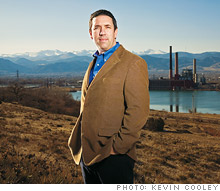 |
| Tendril co-founder Adrian Tuck |


BOULDER, Colo. (Fortune Small Business) -- Adrian Tuck wants to help America change the way it shops for energy. If the power companies ran grocery stores, he says, "you would walk down the aisle and there would be no prices on anything. You'd fill your cart, get home, and 45 days later you'd get a bill that had one single number on it."
Corollary: Many of us would cut back on our monthly kilowatt spending spree if we could see our money draining away minute by minute. That's why the startup Tuck co-founded with entrepreneur Tim Enwall, called Tendril, has spent four years and $20 million developing a computerized system that helps consumers track their electricity use.
About the same size as a four-by-six-inch photo frame, Tendril's device sits on a kitchen counter and remains in constant contact with your electricity meter via a wireless chip. You can program in your monthly power budget, and the system will even send you a text message when you are about to overshoot.
"It's really all about information," says Tuck, 37.
Empower consumers to spend less on electricity? Once upon a time that would have been a tough sell in the power industry. But with electricity demand increasingly outstripping supply, a smart grid computerized at every step for maximum efficiency is in the best interests of electricity suppliers.
Tendril is currently in talks with representatives from 29 utilities across the country. Nine of them are testing Tendril's hardware and software. What's driving the interest? Three words: smart grid subsidies. The federal stimulus package includes $11 billion for smart grid energy development. The projects are two-pronged: New high-power electricity lines will go up around the country, and each segment of the grid will have computers monitoring power consumption for maximum efficiency.
Local utility companies would administer all this work, and the utilities have agreed to pony up billions of dollars to get the job done right. "Everyone recognizes that we need to do something different about the way we consume energy," says Tony Erickson, global utilities director at EDS, a consulting arm of Hewlett-Packard (HPQ, Fortune 500) that helps utilities with smart grid plans.
Tendril is not alone; several competitors make software that enables two-way communication between your house and the power company. Greenbox in San Bruno, Calif. and GridPoint in Arlington, Va. both sell operating systems for smart grids with online portals for consumers. GridPoint, funded to the tune of $220 million by investors such as Goldman Sachs (GS, Fortune 500), landed Duke Energy (DUK, Fortune 500) and Xcel Energy (XEL, Fortune 500) as its first customers.
Tendril's newest competitor is the mighty Google (GOOG, Fortune 500). In February the search giant held a smart grid summit and unveiled its PowerMeter, an online system that processes and displays information about residential electricity usage. Google, which is testing the system with power companies, plans to offer real-time consumption information free to consumers.
Tendril has one significant advantage over its competitors: It's the only service consumers can use without going online via computer or phone, and is therefore ideal for the elderly. Homeowners, if they so desire, can roam around the house with their Tendril devices, turning lights and TVs on and off and seeing how the results affect their power consumption. Tendril also offers "smart thermostats," programmable to meet any budget. In March, Tendril released an iPhone application based on its software that would power down a user's lights as he or she drives away from home, phone in hand.
"Tendril is unique," says Larry Gelbien, vice president of engineering at Boston power utility NSTAR, who is considering various technologies, including Tendril's, for his company's smart grid program. "Changing people's behavior is critical, and I really think Tendril is on the right track," he says.
Tendril's business model calls for utilities to buy its devices at $100 a pop and then give them to residential customers for free or at a discount. The utilities would pay Tendril a monthly fee of a dollar per customer to operate the network.
"Tendril has a firm grip on how they're going to sell into the market," says Patti Harper-Slaboszewicz, senior director at UtiliPoint International, a consulting firm based in Albuquerque. Eventually she expects to see Tendril devices sold in big-box stores.
The 40 employees at Tendril's Boulder office seem as excited as its funky lime-green decor. Tuck predicts $100 million in revenues by 2011, up from $1 million last year. He predicts that this year alone his device will be installed in hundreds of thousands of homes. His optimism is justified by his phone log.
"Everyone takes my calls," Tuck says, smiling. "I'm in entrepreneurial heaven." 

-
 The Cheesecake Factory created smaller portions to survive the downturn. Play
 -
 A breeder of award-winning marijuana seeds is following the money and heading to the U.S. More
 -
 Most small businesses die within five years, but Amish businesses have a survival rate north of 90%. More
 -
 The 10 most popular franchise brands over the past decade -- and their failure rates. More
 -
 These firms are the last left in America making iconic products now in their twilight. More