
Three more banks fail
Silverton Bank closes, costing the Deposit Insurance Fund an estimated $1.4 billion. Smaller New Jersey and Utah banks also shutter.



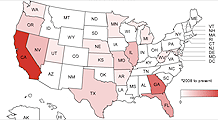

NEW YORK (CNNMoney.com) -- Three more banks shut their doors Friday, according to the federal government, bringing the total number of failures up to 32 in 2009.
The first failure was a wholesale banking operator that served 1,400 other lenders across the country and was the fifth biggest bank failure during the current recession in terms of assets.
Georgia "bankers' bank": The Federal Deposit Insurance Corp. said in a statement that it created a bridge bank to take over the operations of Silverton Bank, National Bank, headquartered in Atlanta.
Unlike the other 30 banks that have failed so far in 2009, Silverton Bank did not take deposits directly from the general public or make loans to consumers. Instead, it was a "bankers' bank," offering a wide variety of services, such as foreign wire transfers, as well as clearing and cash management, to other banks.
Silverton was cooperatively owned by community banks throughout the Southeast and was heavily invested in loans to real estate developments in Florida, Georgia, and other parts of the Southeast, according to Christopher Marinac, managing principal of financial firm FIG Partners LLC based out of Atlanta, Ga.
When real estate values sank in the current downturn, the assets backing those properties also lost their value. The Southeast has seen numerous regional banks topple as the housing bubble burst.
At the time of its closing, Silverton Bank had approximately $4.1 billion in assets and $3.3 billion in deposits, all of which are expected to be within the FDIC's insurance limits.
The FDIC estimates that the cost to the Deposit Insurance Fund will be $1.3 billion, making it the fourth costliest bank failure since the start of the recession. "It is a bigger hit to the insurance fund than they have seen in the last couple weeks," Marinac said. "This is a bigger issue than we have seen in awhile."
Silverton served banks in 44 states and operated six regional offices. The FDIC created a bridge bank to take over the assets of the institution and has contracted The Independent Bankers Bank, out of Irving, Texas, to assist. The FDIC does not expect to see any significant impact to the bank's clients, at least in the near term.
However, the bridge bank only plans to be operational for 60 days, with a possible 30-day extension. When the bridge bank services terminate, the banks that were serviced by the cooperatively owned bank will have to go out and find another institution to take care of those services.
"There is no clear cut answer on a situation like this," said Marinac. "This is a little bit more complex and therefore there are more uncertainties about how this will unfold."
Thus far, the FDIC has not been able to find another wholesale bank to agree to take over Silverton's operations. The FDIC will attempt to sell off the assets, but it could pose a challenge to find a buyer for risky commercial loans. However, the FDIC could try to find a buyer by discounting the debt. "Everything has a price," said Marinac.
New Jersey: State regulators shut down Citizens Community Bank Friday night, and named the FDIC as the receiver. The Ridgewood, N.J.- based bank had total assets of approximately $45.1 million and total deposits of $43.7 million as of Dec. 31.
North Jersey Community Bank, of Englewood Cliffs, N.J., has agreed to assume all of the deposits of the failed bank. The failed bank's single office will reopen Monday as the North Jersey Community Bank.
North Jersey Community Bank paid a premium of 0.67% to acquire all of the deposits of the failed bank and has agreed to purchase approximately $11.5 million in assets. The FDIC will hold onto the rest of the assets to dispose of later.
The FDIC will continue to fully insure individual accounts up to $250,000 through the end of 2009.
Utah: On Friday evening the FDIC also became the receiver of America West Bank, after the Utah regulators closed the institution. The Layton, Utah-based bank had total assets of approximately $299.4 million and total deposits of $284.1 million as of Dec. 31.
Cache Valley Bank, based in Logan, Utah, is assuming all deposits, paying discounted price of $352,000. It also agreed to buy nearly $11 million worth of America West's assets and took a 30-day option to purchase loans at book value. The FDIC estimates that the cost to the Deposit Insurance Fund will be $119.4 million.
America West's three branches will reopen Monday as Cache Valley Bank outposts.
Checking accounts, debit cards still work: Through the weekend, depositors of both Citizens Community Bank and America West Bank can access their money by writing checks or using ATM or debit cards. Checks drawn on either of the failed banks will continue to be processed, and the FDIC said loan customers should continue to make their payments as usual.
Local banks have been shutting down in droves as the recession has made it harder for customers and businesses to pay their loans. Nearly every Friday so far this year, at least one bank has failed. Last week, four regional banks were shuttered.
Even as the government has committed unprecedented amounts of money to increase liquidity and jumpstart the economy, the pace of bank failures has accelerated. In all of 2008, 25 banks failed, compared with 2009's 31 banks.
It is not only smaller, regional banks that have felt the pressure of the recession. The nation's largest banks have also been hit by rising default rates and a decline in business spending.
Among the big banks that have received government aid, Citigroup (C, Fortune 500) and Bank of America (BAC, Fortune 500) have each received $45 billion in funds from the government's Troubled Asset Relief Program, or TARP.
In order to assess the health of the nation's financial industry, the Obama administration has unveiled details of its plan to conduct "stress tests" on 19 of the nation's largest banks.
The assessment of the bank's health was expected to be made public May 4, but an announcement from the Treasury Department Friday indicated that results would be delayed until May 7.
Market watchers are anxiously awaiting the results of the stress tests, which have been designed to assess the banks' preparedness to weather further downturns in the economy, including further increases in unemployment and decreases in home prices.
--CNNMoney's David Ellis contributed to this report. 



