
Bernanke: Economy to turn up in '09
Federal Reserve chairman says recovery will begin later this year, but there will be several more bumps in the road.



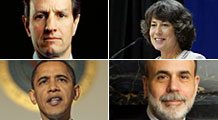
NEW YORK (CNNMoney.com) -- Federal Reserve Chairman Ben Bernanke said Tuesday that the U.S. economy is stabilizing and will begin to rebound later this year, but the recovery will be slow and cautious.
At a hearing of the Joint Economic Committee of Congress, Bernanke said consumer sentiment, the housing market and spending have begun to show signs of life.
But he expects the economy will continue to shed jobs and credit will remain tight for some time. He said the recent frugality trend will continue due to deflated household wealth, and business spending will be slow to bounce back as well.
"We continue to expect economic activity to bottom out, then to turn up later this year," said Bernanke in prepared testimony. "Even after a recovery gets under way ... we expect that the recovery will only gradually gain momentum and that economic slack will diminish slowly."
Bernanke said the recent gross domestic product report, which showed the economy contracted by 6.1% in the first quarter, was disappointing. But he said the economic contraction will "moderate considerably in the near term and recover later this year," as businesses look to replace their liquidated inventories.
The Fed chief said he was encouraged by the recent rally in bank stocks, led higher by some positive earnings in the first quarter, but "substantial concerns about the banking industry remain."
Banks critical to recovery: Bernanke said his economic forecast hinges on a "gradual repair" of the financial system: If banks and financial conditions relapse, the economic recovery could be even more drawn out.
But Bernanke and some members of the committee believe that the regulator's actions, combined with those of the Treasury Department and the Federal Deposit Insurance Corp., have done much to help make an economic recovery possible.
"The Federal Reserve has taken an extraordinary series of measures to preserve financial stability and to restore the proper functioning of key credit markets," said the committee's chairwoman, Rep. Carolyn Maloney, D-N.Y., in prepared remarks. "How far we have come in restoring normal functioning to the financial system, and what remains to be done are key questions."
The Fed and other bank regulators have been looking at the performance of a wide variety of assets owned by banks as a "stress test" to determine whether some of the largest banks have enough capital to stay afloat if economic conditions worsen.
Asked why the results of the tests have been delayed until Thursday, Bernanke said, "It's a very complicated process, a very extensive and detailed exercise. We took the information back to banks, not to negotiate, but to work out communication problems."
Bank of America: Bernanke denied any wrongdoing involving the deal that resulted in Bank of America's purchase of Merrill Lynch late last year.
Documents released late last month by New York Attorney General Andrew Cuomo revealed that Bank of America (BAC, Fortune 500) Chief Executive Ken Lewis approached the Fed chief and former Treasury Secretary Henry Paulson about undoing the Merrill deal after discovering the scope of the losses on that firm's balance sheet.
Lewis has suggested he was pressured by regulators to stay mum about Merrill's losses.
"In no way, did I ever ask Mr. Lewis to fail to disclose necessary information," Bernanke testified. "The meetings where we met Mr. Lewis were attended by quite a few supervisory and legal staff ... who were, of course, very alert to make sure that everything that happened in the meeting met all necessary legal requirements."
Credit cards: As a bill that targets credit card rate hikes and fees is being debated in Congress, one of its biggest proponents accused Bernanke of doing a "disservice to consumers."
The bill, which would prevent credit-card issuers from hiking interest rates based on nonpayment of unrelated bills, faces a looming showdown in the Senate. It goes further than similar consumer protections that the Fed said it will implement in July 2010.
Sen. Charles Schumer, D-N.Y., asked Bernanke late last month to to freeze credit card interest rates tied to existing balances until the stricter rules -- either from Congress or from the Fed -- take effect. Bernanke this week refused.
Schumer called the move "unconscionable," but Bernanke said the move was carefully considered.
"We have here a quandary. We could move up the date when this is effective, but I ask you, is that good for consumers or not?" Bernanke said. "If we raise rates preemptively, I fear issuers' first response will be just to cut a lot of people off as issuers figure out how to restructure. That's the issue that I'm still grappling with."
Fed's exit strategy: Despite trillions of dollars in credit easing and stimulus programs undertaken by the government since last September, Bernanke said he believes inflation will remain subdued for the time being. But Republican members of the panel said they were concerned that the huge increase in the Fed's balance sheet will create an untenable situation by the end of the year.
"Has the pendulum swung too far, Mr. Bernanke? When will the Fed admit the current fiscal costs are simply unsustainable?" asked Rep. Kevin Brady, R-Texas. "The Fed expanded its balance sheet by 127%. What's the Fed's exit strategy?"
Bernanke responded that the Fed's credit facilities are priced in a way that they're not attractive to banks when the financial markets are "closer to normal." As a result, Bernanke testified, those short-term facilities have been shrinking on their own.
"That's a good sign," he said. "It means they're being replaced by private sector liquidity."
Last week, the Fed said that it believes the U.S. economy continues to grow worse, but the pace of decline has slowed and the outlook has improved. At the conclusion of its two-day meeting, the rate-setting Federal Open Markets Committee noted that financial market conditions have improved "modestly," since last month. As a result, it kept its interest rate target in a range between 0% and 0.25%. 



