
Why stimulus money goes unspent
Even after federal funds become available, states face hurdles in putting the money to work.



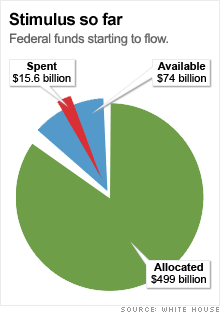
NEW YORK (CNNMoney.com) -- The federal government has made available more than $74 billion in stimulus funds, but the majority of that money has yet to hit the streets.
That's because states have to jump through hoops before they can claim the funds and put them to use. Some have to get approval from their legislatures before they can spend the money. Others must wait for municipalities and school districts to submit applications to state agencies before distributing the dollars.
These are some of the main reasons why states have drawn down only $15.6 billion of the $74 billion made available to them in the 11 weeks since President Obama signed the $787 billion recovery act. Nearly $14 million of that amount has gone to help states handle the crush of Medicaid expenses.
Still, many states are not waiting to get the checks in hand before putting the stimulus funds to use. They are reversing some of their deepest cuts to public services -- particularly for education and social services -- in anticipation of getting the funds.
States have a lot of money to spend. They, along with local governments, are charged with administering about $280 billion of stimulus funds over the next few years, according to the Government Accountability Office, which is tracking states' use of the money. About $49 billion will be doled out this fiscal year, which ends Sept. 30.
Of that amount, about 90% will be spent on health, transportation and education, primarily through the Medicaid, highway infrastructure and state fiscal stabilization for education programs.
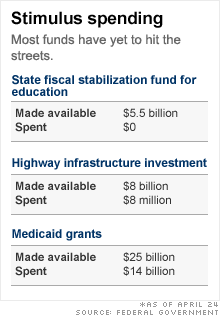
Other than for Medicaid, however, the majority of the money has yet to leave Washington. States have spent only $7.9 million in highway funds, about 10% of what's been made available, according to a federal Department of Transportation report from April 24. And they haven't claimed any of the $5.4 billion in state stabilization funds for education, though eight states have had their applications approved over the past two weeks.
Of course, in some cases, federal agencies dole out the funds over time. For road projects, states request reimbursement from the federal government as they pay the bills. So spending will always lag behind the dollars committed.
"Some outlays happen over years," said Lana Hurdle, the federal Department of Transportation's acting assistant secretary for budget and programs. "It's not something that happens over weeks. There's more than just one single bill per project."
States have even more work to do before they can claim other funds. Some programs, such as energy efficiency and law enforcement, require the states to apply for dollars. For others, such as job training for youths, states have to receive proposals from companies or social service agencies before they can award the money.
Some states need legislative approval before they can start spending their slice of the stimulus pie. This can be a time-consuming process.
Take Florida. State officials only received the okay to spend $1.35 billion in highway and bridge projects on April 15, when the legislative budget commission met. The state's transportation department also consulted with cities, counties and metropolitan planning organizations to pare down its initial list of $7 billion in infrastructure projects.
Since then, the state has committed $279 million for a dozen projects. The Sunshine State expects to receive bids in early June, and shovels should hit the ground in August.
"We had to wait until the legislative budget commission met to give us the spending authority," said Dick Kane, spokesman for the state transportation department.
The delay, however, has left Florida lagging behind some of its peers. Rhode Island, for instance, has already started work on its first infrastructure project. Mississippi had signed contracts for 10 projects as of April 1.
Even after federal agencies approve states' requests for funds, the money doesn't always hit the state accounts very quickly. This is particularly true in the case of the state fiscal stabilization funds, which will be used primarily for education.
California, for instance, was the first to be approved for the education money, aimed at preventing teacher layoffs and protecting education funding. It received the OK on April 17.
But the money has yet to flow into the Golden State's coffers. That's because California's 1,353 districts had to apply for the funds and certify that they would comply with the stimulus act's rules. The deadline was Monday.
Also, state education officials are waiting for legislative approval, which they should get shortly. The districts, which generally know how much they will receive, should get the funds within a few weeks.
"We're moving quickly to get all the funds out," said Hilary McLean, spokeswoman for the state's Department of Education.
In some cases, state and local officials aren't waiting for the money to be in their hands to make policy and budget decisions. Already, many are reversing some of their proposed spending cuts in anticipation of the stimulus dollars.
In Los Angeles, for instance, some 2,000 teachers will be able to keep their jobs because of anticipated stimulus funds.
Virginia, meanwhile, enacted a 2009-2010 budget that softens cuts to health care and education, while saving 7,100 state jobs, according to the Center on Budget and Policy Priorities, an advocacy group.
And Arizona is using the stimulus funds to reverse budget cuts that would have suspended child-care subsidies for low-income families, which would have affected as many as 20,000 children.
Stretching out the stimulus spending over coming months and years is not a bad thing, experts said. Since state economies often recover 12 to 18 months after the national economy, state officials will need to husband the federal funds over the next few years.
"It's better that it doesn't come out as a flash," said John Thomasian, director of the National Governors Association's Center for Best Practices. "You don't want a sugar high off of this." 



