Stress tests: Banks need $75 billion
Results of long-awaited bank stress tests reveal that 10 out of 19 banks tested need to raise new capital. Bank of America must raise $33.9 billion.



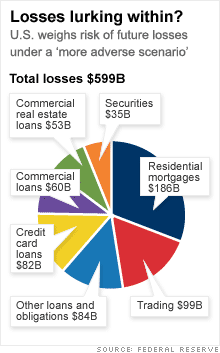

NEW YORK (CNNMoney.com) -- Ten of the nation's 19 largest banks will need to raise a total of $74.6 billion in capital, federal officials announced Thursday, bringing an end to relentless speculation about how much more money the nation's leading banks would need to withstand the recession.
More than two months after launching the so-called "stress test" program, leading regulators said that more than half of the banks tested would require capital to absorb additional losses if the economy weakens further.
Under the most severe economic scenario, regulators estimated losses could reach $599 billion for the group, the bulk of which coming from residential mortgages and other consumer loans such as credit cards.
Leading the list of companies that need more capital was Bank of America (BAC, Fortune 500), which faces a $33.9 billion shortfall. Following behind was Wells Fargo (WFC, Fortune 500) and struggling auto finance firm GMAC, which will need to raise $13.7 billion and $11.5 billion respectively.
Beleaguered banking giant Citigroup (C, Fortune 500), which has taken hold of approximately $50 billion in government aid to date, is being asked to raise $5 billion, regulators said. (See how much all the big banks need, as well as how much they could lose in the worst-case scenario.)
Five regional lenders -- PNC, Regions Financial, SunTrust, Fifth Third and KeyCorp will also be required to raise new capital. So will Wall Street investment bank Morgan Stanley (MS, Fortune 500), which regulators said would require $1.8 billion to shore up its capital position.
Goldman Sachs (GS, Fortune 500), JPMorgan Chase (JPM, Fortune 500), American Express (AXP, Fortune 500) and Bank of New York Mellon were among the nine banks that regulators said do not need to raise more capital. The others were Capital One Financial, BB&T, U.S. Bancorp, State Street and insurer MetLife.
The completion of the stress tests and the pending capital raises by some institutions will mean that "banks can get back to the business of banking," Treasury Secretary Tim Geithner said in a conference call with reporters Thursday.
"This transparent, conservatively designed test should result in a more efficient, stronger banking system," Geithner said.
Results of the tests, which were first made known to executives at participating banks nearly two weeks ago, have steadily surfaced in media reports in recent days.
Regulators were originally slated to release the results earlier this week, but pushed the announcement back after some banks disagreed with the government's findings.
Launched at a time when fears about the underlying health of the U.S. banking sector were boiling over, the program was largely geared towards identifying which institutions might need additional support.
At the same time, regulators wanted to ensure that banks did not face a capital shortfall and scale back on lending as a result, "sucking the oxygen out of [an economic] recovery," Geithner said Thursday.
Industry regulators, including the Office of Thrift Supervision and the Federal Deposit Insurance Corporation, looked at how banks' loan portfolios performed under two different economic scenarios, including an "adverse" situation, over the next two years.
Some critics have feared that the economic estimates used by regulators, including the unemployment rate hitting 10.3% by 2010, were perhaps not severe enough.
Economists, for example, are betting that the Labor Department will report Friday morning that the nation's unemployment rate, which has been spiraling higher in recent months, hit 8.9% during April.
Leading bank regulators, however, fired back Thursday, suggesting that the economic assumptions were "appropriately stressful" given banks' incoming revenue and their existing loan loss reserves.
Comptroller of the Currency John Dugan noted that in conducting the tests, he and fellow regulators assumed that banks' loss rates would hit 9.1% over two years -- a figure that would exceed losses recognized by major banks in any two-year period since 1921, a span that includes the Great Depression.
With the results of the tests now public, banks that need to raise new capital will have one month to tell regulators how they intend to do so and six months from that point to carry out their plans.
As it stands right now, banks appear to have a menu of options at their fingertips including the sale of certain businesses, ditching loans or securities through the government's Public-Private Investment Program (PPIP), or issuing new shares. Given the surge in bank stocks over the past two months, the last option may be an appealing option for some banks.
Fully aware of their "stress test" grade, several banks preempted Thursday's official announcement by regulators by announcing plans of their own to raise capital through stock offerings.
Wells Fargo said it would raise $6 billion through the sale of common stock. Morgan Stanley revealed plans to offer $2 billion in common stock in addition to $3 billion in debt not guaranteed by the FDIC.
If banks can't raise all the necessary capital in the next six months, the government is expected to convert preferred stock it already owns in these banks into common stock.
Even as many bank leaders appeared relieved that the tests were over and that they were deemed well capitalized, there were indications that executives at many of these financial institutions continue to remain frustrated with the government's oversight.
During a conference call with investors, Bank of America CEO Ken Lewis maintained that his company has no plans to convert any of the government preferred share stake into common stock, but rather is focused on paying back money from the Troubled Asset Relief Program, or TARP, as quickly as possible.
"The game plan is to get the government out of our bank as quickly as possible," said Lewis.
He added that Bank of America planned to address its capital shortfall through a combination of several joint ventures and the sale of its First Republic Bank and Columbia Management divisions. The bulk of the nearly $34 billion, however, would come through an equity raise.
One pressing question that continues to swirl around Bank of America and other hard-hit institutions is the fate of their management. Regulators said over the next month, the 19 banks are also supposed to review their executive teams to ensure that they have "sufficient expertise and ability to manage the risks presented by the current economic environment," regulators said Wednesday.
Last week, Lewis was ousted from his role as chairman of Bank of America by dissatisfied shareholders. The company also indicated Thursday that it was considering making other changes to the board including its current directors.
CNNMoney.com senior writer Jennifer Liberto and Fortune.com senior writer Colin Barr contributed to this report