
Bond market: Shaken and stirred
Long-term rates have shot up. The good news: It's a sign of an improving economy. The bad news: Your window to refinance may soon slam shut.




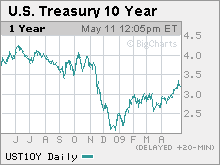 |
| Although long-term rates are still relatively low, some are concerned about the recent spike in rates during the past two months. Click on the chart for more bond rates. |
NEW YORK (CNNMoney.com) -- Want further proof that risk is no longer a four-letter word? Just take a look at what's going on in the bond market.
Since the Federal Reserve announced in mid-March that it would begin buying long-term Treasurys in order to keep their rate down, Treasury bonds and notes have fallen sharply, pushing yields on these securities much higher. (Bond prices and yields move in opposite directions.)
The yield on the benchmark U.S. 10-Year Treasury note is now about 3.2%, after hitting a year-to-date high of 3.29% on Friday. On March 18, the day the Fed unveiled its Treasury purchase plan, the 10-year yield was about 2.5%.
So what does this mean?
On the plus side, a period where both stocks and bond yields are on the rise is somewhat encouraging. That's because higher bond rates are typically a sign of an improving economy -- an environment where investors feel more comfortable with riskier investments that offer greater potential rewards.
If more investors buy into the notion that the economy is getting better, long-term yields could climb further since money managers may be willing to sell bonds and buy more stocks.
But there's a downside to higher yields. Many types of loans, including mortgages, have rates that are closely tied to yields on long-term Treasurys.
Given the fragile state of the economy right now, a further spike in bond yields could jeopardize the recovery by making it more expensive for borrowers to get new loans and homeowners to refinance mortgages. It's for that reason that the Fed decided to buy $300 billion in long-term Treasurys back in mid-March.
"There was a huge amount of refinancing in the past few months. That was a nice boost but chances are definitely fading away quite quickly," said Benji Bailey, a fixed income investment manager with the MMA Praxis Intermediate Income fund.
With all that in mind, where are long-term rates likely to head next? It's almost impossible to say for sure. But many bond investors expect a bumpy ride.
James Barnes, a fixed Income portfolio manager with National Penn Investors Trust Company in Reading, Pa., said the Fed has to keep a close eye on where yields are now.
If they climb back above 3.25%, it could force the Fed to take action drive down rates again since the central bank will not want them to get out of control.
"The economy may continue to improve and force yields higher. But mortgage rates could go up and that will tie the Fed's hands," Barnes said. "Once rates start going up, they could explode up."
Adding to the pressure on the Fed is the fact that the Treasury Department is issuing a large quantity of new bonds and notes in order to finance the government's massive deficit.
So even though the Fed is attempting to keep rates low by creating demand for Treasurys, it may not be enough to counteract the excess supply on the market.
"The Fed's purchases pale in comparison with the amount that Treasury is raising lately. That's a big factor behind the rise in yields," said John Canavan, an analyst with Stone & McCarthy, a Princeton-based fixed income and economic research firm. "I am not sure the Fed can make purchases large enough to fully offset what Teasury is issuing. It would be a losing battle."
Bailey added that it's not clear if foreign investors, which were big buyers of Treasurys during the worst of the credit crisis, will continue to be as voracious if the stock market continues to improve. That could also drive rates higher.
"Before mid-March, people were afraid and wanted the safety of Treasurys. That's been less of an issue as the stock market has done well," he said. "But people now are looking at the fact that the U.S. will have to issue a lot of Treasurys, and it's uncertain if foreign buyers are going to take in this supply."
Still, Canavan said people should not be overly concerned if yields continue to head higher. He argues that as investors begin to realize that the economy may not be in as bad shape as they feared a few months ago, rates should move up.
"Even if long-term rates get back to 3.5%, that's historically still very low," he said. "This is sign that markets are trading at some semblance of normalcy. I don't expect an ugly trend where rates get out of hand."
However, not everyone is convinced that rates will march that much higher anytime soon.
Barnes said there is the potential for another bond rally that could push yields back toward 2.5% as some investors start to doubt whether the recovery is for real.
Matthew Smith, chief investment officer with Smith Affiliated Capital, a fixed-income money management firm in New York, agreed. He said that just because economic numbers are "less worse" does not mean that it's time to celebrate.
"There is a huge disconnect in terms of what Wall Street perceives as a rosy economy. The numbers don't translate to Main Street just yet," Smith said. "[Fed chairman Ben] Bernanke is telling us there are green shoots. They look rather yellow to me."
Smith said that because consumers still have relatively high debt loads, he's not convinced that any recovery will be as strong as people now expect it to be
"I don't think you can hang your hat on yields going much higher. You could look at what's going on as happy days are here again but this is more of a buying point for Treasurys, not a selling point," he said. 



