
Geithner to rein in derivatives
Treasury unveils plans to police this fast-growing -- but unregulated -- corner of the markets that many believe contributed to the financial crisis.



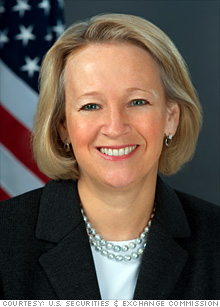 |
| Mary Schapiro said regulators need more information about derivatives markets. |
NEW YORK (Fortune) -- Treasury Secretary Tim Geithner set plans Wednesday to rein in the wild and wooly derivatives markets.
Geithner proposed requiring that over-the-counter derivatives such as credit default swaps be traded on exchanges, and that all major dealers in derivatives markets be subject to federal oversight.
Geithner said the rules would bolster the stability of financial markets, promote efficient and transparent pricing and help regulators stamp out fraud and abuse.
Appearing at a press conference in Washington, Geithner said he expects to propose the new framework to Congress in coming weeks as the administration and legislators hash out new laws governing derivatives markets.
"The financial crisis was caused by -- and exposed - significant gaps in oversight," he said. "We are committed to working with Congress to create more comprehensive system."
The proposal comes as the administration struggles with an economic downturn that has been deepened by last fall's near collapse of the financial sector. Simply put, derivatives are types of securities that derive their value from another asset, such as a stock, bond or currency.
Many large financial firms had made outsized bets on certain types of derivatives during the past few years. When credit markets were functioning normally, many users profited handsomely, seemingly with little risk. But last fall's collapse of Lehman Brothers changed all that.
Geithner said that while derivatives weren't the cause of that plunge, their untrammeled growth over the past decade and poor disclosure surrounding their use made the financial system more vulnerable to panics.
Meanwhile, it has become clear since the implosion of AIG (AIG, Fortune 500) last September that numerous players in these markets failed to understand the risks they were taking on.
AIG, an insurer that got caught on the wrong side of many credit default swaps as financial markets unraveled, is the poster case for misunderstood derivatives risk. It has cost taxpayers $182 billion so far just to keep the company afloat.
But AIG wasn't the only entity to get burned over the past year. Several municipalities, most notably Jefferson County, Alabama, signed up for derivatives such as interest-rate swaps that were supposed to cut their borrowing costs but have come back to cost them large sums.
As such, Geithner and Securities and Exchange Commission chief Mary Schapiro proposed imposing new suitability requirements on derivatives Wednesday. They want to make sure that those who deal in these investments understand their risks.
"There is widespread agreement that OTC derivatives, particularly credit default swaps, may have contributed greatly to the financial mess we're cleaning up today," Schapiro said. "Unfortunately, the lack of clear regulatory authority over this vast market has hindered the ability of regulators to fully understand how this market functions or to ensure that basic standards of fairness are followed."
Under the administration's proposal, derivatives such as credit default swaps -- contracts that allow traders to buy or sell exposure to the risk that a bond issuer will default -- will be traded like stocks, on well capitalized, centralized clearinghouses.
Currently these swaps and other over-the-counter derivatives are structured as bilateral contracts between traders. Backers of the OTC derivatives markets say these so-called counterparties have considerable incentives to make sure they are protected against the possible default of a trading partner, by holding collateral and using appropriate hedges.
But Geithner said central clearing is crucial to creating more stable markets. He said the panicked response last year to the failure of Lehman Brothers and Washington Mutual, and the near collapse of Bear Stearns and AIG, shows the folly of the current setup, in which there is next to no public disclosure of firms' derivatives exposure to one another.
"In a crisis, people pull back generally from everything, and that has the effect of sucking the oxygen out of markets," Geithner said.
A particular problem, he added, is that firms don't know how their counterparties could be affected by problems at other firms. Central clearing, he added, reduces this uncertainty because it "allows me to know what my exposure is in one number."
While Geithner's plan to put credit default swap trading on exchanges would sharply reduce this so-called counterparty risk, it could hit the big banks that handle most derivatives dealings, by making pricing more transparent and narrowing bid-ask spreads. Among the biggest dealers in derivatives are Wall Street firms such as Goldman Sachs (GS, Fortune 500) and JPMorgan Chase (JPM, Fortune 500).
But the head of the trade group that represents the big derivative dealing banks, the International Swaps and Derivatives Association, said the industry backs the administration's efforts to rationalize the financial regulatory system.
"This proposal is an important step toward much-needed reform of financial industry regulation," ISDA chief Robert Pickel said in a statement. "We look forward to working with policymakers to ensure these reforms help preserve the widespread availability of swaps and other important risk management tools."
Along the same lines, another financial industry trade group - the Securities Industry and Financial Markets Association (SIFMA) - signaled its own support.
"It is important that new regulatory measures preserve the usefulness of derivatives as risk management tools for American businesses and we look forward to working with the Administration to ensure that outcome," said SIFMA president Tim Ryan in a statement. 


-
 The retail giant tops the Fortune 500 for the second year in a row. Who else made the list? More
 -
 This group of companies is all about social networking to connect with their customers. More
 -
 The fight over the cholesterol medication is keeping a generic version from hitting the market. More
 -
 Bin Laden may be dead, but the terrorist group he led doesn't need his money. More
 -
 U.S. real estate might be a mess, but in other parts of the world, home prices are jumping. More
 -
 Libya's output is a fraction of global production, but it's crucial to the nation's economy. More
 -
 Once rates start to rise, things could get ugly fast for our neighbors to the north. More









