
Treasury Dept. is giving 'cash-for-keys'
Adding to its mortgage rescue program, the government will now offer additional incentives to get troubled borrowers out of homes.



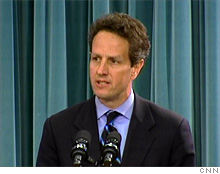 |
| Treasury Secretary Geithner |
| 30 yr fixed | 3.80% |
| 15 yr fixed | 3.20% |
| 5/1 ARM | 3.84% |
| 30 yr refi | 3.82% |
| 15 yr refi | 3.20% |
NEW YORK (CNNMoney.com) -- When all else fails, the Treasury Department is now willing to cough up cash to get homeowners to move on and to get loan servicers to forgive mortgage debt.
The new initiatives are part of the government's Making Home Affordable program.
Under the original program, unveiled earlier this year, homeowners could be eligible for loan adjustments or refinancings if they meet several criteria: the home must be their primary residence, for example, and the mortgage balance must be no more than $729,750.
Even then, however, mortgage help is not assured. The homeowners may still not be able to afford reduced monthly mortgage payments of 31% of income. And to protect the investors who own the mortgage, the value of a modified loan still has to be greater than the value of what would be recovered in foreclosure.
In these cases, lenders first consider a short sale, a deal in which the home is sold for less than the mortgage balance, and loan servicers may forgive the difference.
If that is unsuccessful, the final step is a "deed in lieu of foreclosure," when borrowers voluntarily forfeit the deed and the debt may be erased.
Under the new initiatives, for short sales and deeds in lieu, borrowers will get up to $1,500 to assist with relocation expenses. Treasury will also pay the servicers $1,000 to complete a short sale or deed in lieu.
A deed in lieu can be the least painful way of ending a mortgage default nightmare, according to Pamela Simmons, a real estate attorney in California.
"Borrowers often prefer to end it quickly and cleanly," she said. "They just want to get it over with." And it's better than just walking away from a mortgage, a situation where the debt still looms.
A deed in lieu might also be better for the banks. Banks acquire the properties back from delinquent borrowers faster and more easily, saving them legal, financial and other costs associated with going through the entire foreclosure process.
Not every deed in lieu involves "cash for keys," but motivated lenders will often pay borrowers something, typically about $1,000, to vacate by a fixed date and to not vandalize the homes or strip it of fixtures.
The borrowers who may benefit most from this program are the ones who would still not be able to repay their mortgages under any reasonable workouts.
These would include delinquent borrowers who are way underwater, owing much more on their mortgages than their homes are worth, people who have lost their jobs with little hope of finding another and ones who have gone through a divorce or another life-changing event.
In those cases, they may be better off cutting their housing expenses by switching to a rental and the cash-for-keys is one more good reason to do so.
But deed in lieu may not be simple, according to Lawrence Jacobson, a Los Angeles-based real estate attorney.
The least complicated scenario is a borrower with no other debt on the home. In that case, it's just a matter of the lender taking its lumps and writing off the difference between what it's owed and what the repossessed home realizes when resold.
If there's a second mortgage, however, the lender will not allow a deed in lieu unless they get the full cooperation of the holder of the second mortgage.
"[Giving the deed back to the bank] is a transfer of title," said Jacobson, "and it's subject to all encumbrances. Lenders will only consider deed in lieu if they're the only [mortgage holder] or if the second lien-holder is willing to give up its interests. Everyone has to be a party to the transaction."
To help solve that issue, Treasury will also make incentive payments to second mortgage holders, up to $1,000, if they give up all claims. 



