
Relax. The U.S. isn't a deadbeat
Fears that the U.S. could lose its AAA credit rating are growing. But a downgrade isn't imminent since the chance of the government defaulting on its debt is slim.




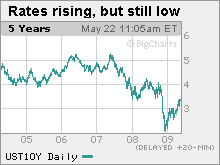 |
| Some are worried about the recent rise in long-term bond yields. But rates are still relatively low, a sign that there continues to be demand for U.S. Treasurys. |
NEW YORK (CNNMoney.com) -- It looks like after two months of ignoring the risks that remain for the economy and markets, Wall Street has finally found something else to worry about: the possibility that the United States could lose its AAA credit rating.
Thursday was one of those rare days when stocks, bonds and the dollar all fell. Stocks recovered slightly Friday morning ahead of the Memorial Day weekend, but Treasurys and the greenback were lower again.
The sell-off was partly sparked by Thursday's news that rating agency Standard & Poor's had decided to place the sovereign rating of the United Kingdom on "negative watch."
S&P did not actually downgrade the United Kingdom. Like the United States, it still has an AAA rating, the highest that a country, municipality or corporation can have.
Nonetheless, the move was viewed as a precursor to an eventual downgrade. And investors went one step further to assume that if Britain was being put on notice, then the "colonies" might be next.
White House spokesman Robert Gibbs said Friday that the Obama administration was "not concerned about a change in our credit rating."
But downgrade fears were heightened because the highly respected bond guru Bill Gross, who manages the Pimco Total Return fund, said in published reports that the United States could lose its AAA rating in a few years, if not before then.
If that actually happens, watch out.
For one, it would likely lead to higher interest rates across the board in the United States since a credit downgrade makes it more expensive for the borrower to issue new debt. It's not different than trying to get an attractive mortgage or credit card rate after taking a hit to your FICO score.
It would also be a huge psychological blow to the nation, and possibly lead to a further dip in investor sentiment. It has always been widely assumed that the United States would never lose its pristine credit rating.
Talkback: Should the U.S. lose its AAA credit rating? Leave your comments at the bottom of this story.
Even in the midst of this recession, many investors have continued to view the U.S. dollar and Treasury notes as safe havens, or at the very least, safer havens, than other assets. That might no longer be the case if the United States has its rating cut.
But let's take a step back. While I do think it's about time that investors woke up after this heady two-month rally and realized that not every bit of potential bad news is factored into the market (General Motors (GM, Fortune 500) filing for bankruptcy? No problem!), worrying about an imminent credit downgrade for the United States is probably premature.
Jack Ablin, chief investment strategist with Harris Private Bank in Chicago, points out that even though the government's rising debt is a concern, it's not as if the United States is at risk for defaulting on its financial obligations.
"Any concern about an impending U.S. downgrade is probably way overblown," Ablin said "As long as our debt is denominated in dollars, the U.S. will be able to make the payments. We print the money."
If anything, Ablin said investors should worry more about the impact that more debt will have on the U.S. dollar, which has weakened as of late, and not the country's credit rating.
What's more, the notion that the U.S. could eventually lose its credit rating isn't really new news. It's been discussed for months. It's no secret that if the government's debt burden rises further and becomes even more burdensome, the credit rating agencies may be forced to take action.
In a report on May 9, S&P rival Moody's reaffirmed its stable rating on the United States but warned that "if the current upward trend in government debt were to continue and become irreversible, the rating could come under downward pressure."
Still, one economist thinks that it would be a mistake for the rating agencies to downgrade the U.S. just because of rising debt loads. That's because the credit ratings should not really reflect whether or not a nation has too much debt, but if default is a risk.
"It's true that the long-term budget outlook is deteriorating and that is a cause for concern," said Zach Pandl, economist with Nomura Securities. "Those problems should be addressed by policymakers. But the chances that the U.S. will default on dollar-denominated debt is almost zero."
But the ratings agencies may be eager to prove to investors that they have teeth.
S&P, Moody's and other credit rating firms have been lambasted by many for not acting sooner to warn investors about the risks posed by subprime mortgages and other "toxic" assets that helped sow the seeds for the recession and credit meltdown.
"These agencies are certainly on their heels. There is no doubt about that. The level of confidence in credit ratings has been diluted," said Ablin.
So the credit rating firms have something to prove and they have been acting tougher in recent months. Several of them downgraded companies that previously had AAA ratings, including General Electric (GE, Fortune 500), Warren Buffett's Berkshire Hathaway (BRKA, Fortune 500) and Toyota Motor (TM). Before this crisis, it would have been unthinkable that any of those firms would have their ratings cut.
Now don't get me wrong. It's good that the ratings agencies are looking to be more proactive than reactive. And this is not to dismiss the many problems that the U.S. economy still faces. But of the many things left to still worry about, a credit rating downgrade should be at the bottom of the list.
After all, even though there has been a sell-off in bonds that has pushed long-term rates higher lately, the yield on the U.S. 10-year Treasury is still at a relatively low 3.4%. (Bond prices and yields move in opposite directions.)
Mike O'Rourke, chief market strategist with BTIG, an institutional brokerage firm, said if investors really are worried that the United States will have its credit rating lowered, then Treasury rates will go much higher from here. And he doesn't see that happening.
"If the 10-year yield was at 4.5 % to 5%, I would be more concerned. But we're barely off multi-decade lows," O'Rourke said. "The market is still indicating there is tremendous demand for U.S. Treasurys."
Talkback update: Greetings Buzz readers. There is a new way to post comments for this column. If you have a Facebook account, you can submit your feedback using the Facebook Connect feature that will appear at the bottom of the page. If you don't have one, it is free to sign up.
The good news is that reader comments will now appear immediately and on the same page as the column as opposed to a separate page. I trust that loyal Buzz readers will continue to actively share their thoughts with this new feature. And rest assured, I will still be using the best reader reaction as fodder for video installments of The Buzz.
So with that in mind, here is today's question for readers. Should the U.S. lose its AAA credit rating? 



