Health reform: A $1 trillion question
Fixing the health care system will be expensive - and likely shared by public and private players. Here's a look at how consumers may be paying their share.



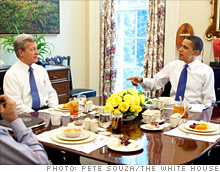 |
| Sen. Max Baucus, D-Mont., who is leading the charge on health reform, met with President Obama on May 6. Also present were Vice President Biden and Sen. Charles Grassley, R-Iowa. |
NEW YORK (CNNMoney.com) -- If President Obama has his way, health care reform will be finalized this year. Key Senate and House committees are planning to mark up legislation in June, and the House is aiming to vote on the issue by August.
And while the specifics of how to fix the nation's health care system are far from final, the debate over how to pull it off will turn on a key question: How to pay for it.
The total cost of overhauling health care is estimated at over $1 trillion, and the administration has made it clear that it doesn't want the overhaul to add to the already giant federal budget deficit.
Senate Finance Committee Chairman Max Baucus, D-Mont., one of the leading legislative players on the issue, last week laid out the likely elements in any health reform package. He also identified some of the main options for how to pay for it.
A system overhaul will guarantee coverage for most of the 47 million people currently uninsured, Baucus said at a Kaiser Family Foundation forum. And there's a good chance that a government-funded public health plan option will be added to the mix of plans offered by private insurers, Baucus said.
The final legislation is also expected to lay out requirements for minimum benefits; prohibitions against denying someone coverage due to a pre-existing condition; and guarantees for affordable, quality health care, he said.
House Ways and Means Chairman Charles Rangel, D-N.Y., another key player, echoed what Baucus outlined at a National Coalition on Health Care conference on Wednesday.
In terms of reimbursing doctors and hospitals, the focus for insurers is likely to shift from paying for the volume of services provided to reimbursements based on positive health outcomes.
When it comes to paying for all those changes, it'll be all hands on deck. Consumers, employers, health care providers and others in the industry will be asked to contribute. "We'll pay for it in a balanced way," Baucus said.
But "balanced" may not guarantee bipartisanship support in the House and Senate. In fact, deciding exactly who pays what - and figuring out how much reform costs can be taken care of through greater efficiencies and increased competition - will be among the hardest issues on which to find consensus.
Here are some of the leading ideas that could most directly affect health consumers' wallets:
Tax part of employer contributions to health insurance: Right now, if you get your health insurance at work, any money your employer contributes to pay for premiums is tax-free income to you.
It's the costliest tax benefit the government offers, reducing federal tax revenue by $226 billion last year, according to the Joint Committee on Taxation. And it's a break that many officials, including Obama, say they are reluctant to change.
But tax and health care experts agree it's not only a costly incentive but one that offers the biggest tax break to high-income workers and to employees with the most expensive plans, which include union workers. Plus, they say, divorcing consumers from the true cost of their health care encourages them to buy more care than they might need and that, in turn, contributes to growth in costs.
Baucus has said lawmakers are considering limiting - but not eliminating - the tax-free exclusion in some way.
Limits might be based on the cost of a plan, an employee's income or some combination of the two. Another option would be to convert the exclusion to a tax credit or deduction. Lawmakers are also considering whether to grandfather in existing plans that unions won through collective bargaining agreements.
How much revenue can be raised is entirely dependent on the option chosen. There are no official estimates available from the Congressional Budget Office yet, but the Tax Policy Center estimates that capping the exclusion at the average cost of health insurance in 2009 ($5,370 for individuals; $13,226 for families) and adjusting that cap for inflation every year could raise $848 billion in revenue over 10 years.
Impose Medicare tax on state and local government employees: Currently the wages of some state and municipal employees are not subject to the 2.9% Medicare payroll tax that other workers and their employers pay. Lawmakers may decide to subject all such employees to the tax.
Tax sugary and alcoholic drinks: One option under consideration would standardize and increase the federal tax on alcohol. Another would impose a new federal tax on beverages sweetened with sugar, high-fructose syrup or other ingredients. Diet sodas and other artificially sweetened beverages, however, would not be taxed.
Change or eliminate Flexible Spending Arrangements: Currently, employees get a tax break for money contributed to FSAs. The amount they may contribute is unlimited, although the employer may set a limit. And the money may be used for a host of health-related expenses that insurance doesn't cover, as well as for dependent care expenses.
Lawmakers are considering either limiting how much money may be contributed or getting rid of the accounts entirely.
Modify Health Savings Accounts: Individuals with high-deductible health insurance policies may set up HSAs to which they and their employers may contribute money tax-free. Earnings on those contributions are tax-free, as are withdrawals used for qualified medical expenses.
Lawmakers may opt to limit the amount of money that may be contributed to HSAs or to boost the penalty for making withdrawals for non-medical expenses. They also may require third-party certification that the withdrawals were used for qualified expenses.