
S&P's commercial real estate revolt
Blistered by congressional wrath over the housing bubble, the ratings agency now has the financial industry fuming over an 'arbitrary' downgrade plan.



 |
| A possible ratings downgrade could complicate Tim Geithner's TALF program. |
NEW YORK (Fortune) -- Despite near universal criticism of their many missteps during the credit bubble, the ratings agencies aren't irrelevant just yet.
Commercial real estate investors discovered as much last week, when an announcement by Standard & Poor's doused the spring rally in the beaten-down market for commercial mortgage-backed securities, or CMBS.
S&P's move left commercial property investors scratching their heads over the ratings agency's timing. The proposal, in which S&P warned it may soon downgrade hundreds of recent bond issues, could complicate a new federal plan to make financing more available for office buildings, apartment complexes and shopping malls.
Investors also wondered about S&P's change in tone on the prospects for the senior-most commercial real estate-backed debt securities. The ratings agency and its rivals Moody's (MCO) and Fitch have been under fire in Congress for their failure to alert investors to the housing bubble, and some observers wonder if they aren't hastily trying to make amends.
"They've spent 18 months getting raked over the coals for being too lenient, and now they appear to be oversteering," said Steve Jernigan, a director at NewOak Capital, an advisory, asset management and capital markets firm in New York.
S&P says politics aren't influencing ratings actions.
"Our ratings are driven only by our best analytical judgment of the creditworthiness of the issuers and securities we rate and are formed independent of other concerns," spokesman Ed Sweeney said in an email. He added that S&P's comments last week reflect its "careful review and analysis of the current CMBS market and our expectations for it going forward."
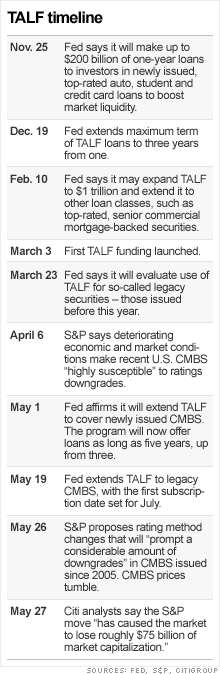
The flap started last Tuesday, when S&P said it was considering changes in how it rates CMBS. The New York-based unit of McGraw-Hill (MHP, Fortune 500) warned that the changes could result in downgrades of a large number of recent-vintage issues -- including 90% of the most-senior notes issued in 2007, the peak year for commercial mortgage securities issuance.
The so-called request for comment -- industry participants have until June 9 to give the agency feedback on it -- came a week after the government passed a major milestone in its support for the commercial real estate market.
On May 19, the Federal Reserve extended a plan for financing asset-backed securities to so-called legacy CMBS -- triple-A-rated commercial mortgage securities issued before this year.
The move, which followed a decision by the Fed in March to expand the government's Term Asset-Backed Securities Loan Facility, or TALF, to cover newly issued triple-A-rated CMBS, was met with enthusiasm in the industry. The Fed's earlier move helped spark the spring credit market rally.
But since S&P issued last week's request for comment, the market has refrozen, as investors wait to see whether S&P will go through with its changes as proposed and how the Fed might proceed.
A raft of S&P downgrades of top-rated CMBS issued in recent years could "neuter" the legacy TALF program, Jernigan said, by sharply reducing the number of deals eligible for TALF funding.
A report last Wednesday from Citigroup analyst Darrell Wheeler blamed the S&P request for a $75 billion drop in the market value of outstanding CMBS, though the market has since recovered about half those losses.
TALF could offer a bit of much needed support to a troubled market. Realpoint, a small rating agency in Horsham, Pa., said last month that the number of CMBS borrowers that were at least 30 days late in their payments rose fourfold over the past year. The firm expects delinquencies on CMBS issues rise from a recent level of 2.1% to 4%-5% by the end of the year.
The timing of the S&P move wasn't the only puzzler. So was S&P's rationale for laying the groundwork for a downgrade of the senior most CMBS issues, bonds that shouldn't face principal losses unless 75% of the underlying mortgages default.
Skeptics say S&P has failed to explain why the safest CMBS issues should be subject to a downgrade without any evidence that their default risk has risen.
"This unexpected announcement is viewed by many market participants as highly subjective and excessively arbitrary based on the company's previous perspective," said Chip Rodgers, a senior vice president at the Real Estate Roundtable lobbying group.
What's more, S&P seemed more sanguine on the fate of the top-rated CMBS bonds as recently as two months ago.
In an April 6 report, S&P indicated that widespread downgrades of the most senior securities -- known as "super dupers" because they are senior to all others and their holders are protected against losses up to a certain level -- were unlikely.
Analysts are at a loss to explain the change.
S&P's latest proposal "will initially punish pricing of the various senior triple-A ratings with no evidence that additional credit support is justified," Wheeler wrote last week. "We think the key point is that S&P needs to quantitatively demonstrate why a triple-A CMBS bond is not up to withstanding significantly worse economic conditions."
S&P says investors comparing the April and May statements are mistaken. April's analysis "never served as rating criteria, but was meant to test the resiliency of our ratings under different economic environments under our existing criteria," said Sweeney.
He added that the new criteria in last week's report "is designed to create 'AAA' credit enhancement levels that are, in our view, sufficient to enable tranches rated at that level to withstand market conditions commensurate with an extreme economic downturn without defaulting."
As the deadline for commenting on the S&P proposal draws near, investors are wondering how the Fed might adapt TALF. The Fed didn't respond to requests for comment, but observers say the agency might tweak the TALF guidelines to expand eligibility to loans that were initially rated triple-A, regardless of their current rating.
Another question is in the political arena, where the ratings agencies are under attack from all angles. Sen. Jack Reed, D-R.I., last month introduced a bill that would allow investors to sue ratings agencies that "knowingly or recklessly" failed to review key information. The House last month held a hearing on revamping regulation of the credit rating firms.
Connecticut Attorney General Richard Blumenthal, who last year filed an antitrust suit over their ratings on municipal bonds, has been among the most vocal critics of the big ratings agencies. This spring Blumenthal asked Treasury Secretary Tim Geithner and Fed chief Ben Bernanke to make the TALF program less dependent on the big rating agencies' participation.
Last month, the Fed did so, adding Realpoint and Toronto-based DBRS to the roster of firms eligible to rate securities used in TALF.
Even so, the critics of the big rating agencies aren't about to let up.
"The feds need to revisit how much emphasis they put on S&P, Moody's and Fitch," said Realpoint chief Robert Dobilas. "I don't think anyone can depend on those agencies." 


-
 The retail giant tops the Fortune 500 for the second year in a row. Who else made the list? More
 -
 This group of companies is all about social networking to connect with their customers. More
 -
 The fight over the cholesterol medication is keeping a generic version from hitting the market. More
 -
 Bin Laden may be dead, but the terrorist group he led doesn't need his money. More
 -
 U.S. real estate might be a mess, but in other parts of the world, home prices are jumping. More
 -
 Libya's output is a fraction of global production, but it's crucial to the nation's economy. More
 -
 Once rates start to rise, things could get ugly fast for our neighbors to the north. More









