
Palm Pre review: To Pre or not to Pre?
Fortune senior writers Michael V. Copeland - a BlackBerry fan - and Jon Fortt - an iPhone devotee - share their reactions to Palm's new smart phone.



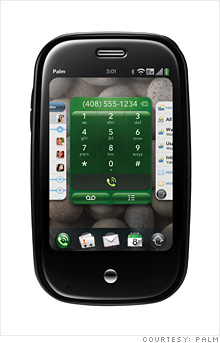 |
| The Pre's design is good, but not gorgeous. |
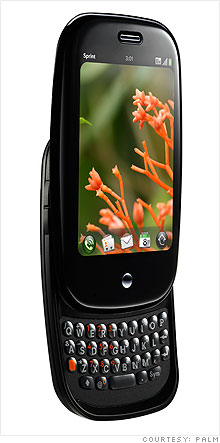 |
| Unlike the iPhone, the Pre has a keyboard. |
NEW YORK (Fortune) -- Here's how we are going to break this review down. I am Michael Copeland -- I'm a BlackBerry user. I have the Bold. It's a silly name, but I never reference it in public ("Where's my bold?" See -- silly). My colleague Jon Fortt is an iPhone user/lover. The reason I point this out, is that BlackBerry users and iPhone users are likely to have different reactions to Palm's shiny new Pre.
I think it's pretty slick, and spoke with more than a few BlackBerry users who would swap out their BBs for the Pre. The iPhone users, (ahem, lovers), they don't seem ready to break up with their phones yet over the newest lovely in the gadget world. (See more Pre reviews)
The view from the BlackBerry contingent? I want to say that the Pre and I only had a short time together, about a week, and for part of that time it was useless as I was camping alongside a fetid creek, surrounded by raccoons and didn't have a signal. So, there wasn't enough time to develop a real relationship with Pre, to find out all of its hidden strengths and annoyances, but enough time to form an opinion.
Interface. It's a great device. Setup is easy, and it integrates well with standard services like Facebook, chat and web-based email. A smart approach the Palm (PALM) team took is how the Pre circles around contacts rather than applications. A person is associated with their Facebook page, their email and phone number, and you can have a continuing conversation with them using whatever mode is most convenient at the moment. So you might use email when you are in a WiFi zone (the phone has WiFi and Bluetooth built in), switching to SMS or voice if you choose. You don't have to think about what form of communication to use,just the person you want to contact. The Pre has some battery issues, especially with AOL instant messenger running, but those are being addressed according to the Palm folks.
Operating system. What I liked most about the Pre was the much hyped WebOS, which lets you launch and shuffle so many applications like cards. It worked well, and while a little sluggish, didn't bog me down. WebOS is by far the coolest thing about the Pre, and the reason for taking a hard look at it. If you find your interaction with the BlackBerry too boring, or the iPhone just too commonplace these days, the Pre is a good alternative. It has all the touch screen gestures -- sweeping, tapping, etc. -- if you like that sort of thing. The screen itself is bright, and video looked spectacular, even though the screen is a bit smaller than Apple's (AAPL, Fortune 500) iPhone.
What it also has is a keyboard. That's right, with actual keys you can push.
I like that, a lot. I like my BlackBerry because it has a keyboard. The Pre keyboard is much smaller than on the Bold. The keys themselves are a bit squishy and sticky. Some described them to me as "plasticky," but the stickiness sort of guides your fingers home and makes texting or composing an email easier. I use two hands on the Pre keyboard, but I do on my BlackBerry as well, so that's a non-issue for me.
Design. As a piece of hardware the design of the Pre is good, but not drop-dead gorgeous. Think Lexus, not Ferarri --nice but you don't hurt your neck looking at it as it speeds by. In San Francisco I made a point of taking the Pre out and displaying it strategically at as many places as I could -- bars, lunch counters, my desktop. No-one batted an eye until I told them what it was. Maybe it is gadget-jaded Silicon Valley, but that was disappointing to me. You want the newest, shiniest gadget on the block to elicit at least an appreciative "Oooh," but I got nothing. Babe magnet, the Pre is not.
On our subway system here in San Francisco the other day, I settled myself and my bicycle in a crowded car and took the Pre out yet again. Finally, an iPhone user started eying it. I handed it over, proclaiming the gadget Palm's best hope for salvation. Mr. iPhone peeped at it a bit, slid the keyboard open, and then handed it back. He then asked me about my bicycle. I changed the subject back to the Pre. "Would you trade in your iPhone for it?" I asked. He looked at my bicycle, and responded. "I would trade my bike for yours, but I wouldn't trade my iPhone for your Pre." I am not sure what that means for Pre sales, but maybe Palm should consider the bike business.
So will I trade in my BlackBerry? Not yet. If I can get a Pre running on AT&T's (T, Fortune 500) network I would be much more tempted. As of now, Sprint (S, Fortune 500) is the only option, and given the poor experience I had with Sprint years ago, it's not much of an option for me. In six months, however, that could change as Sprint's exclusive rights to Pre expire. Does Palm have that much time? I would say yes. The Pre is good enough to attract enough buyers to give struggling Palm the breathing room it needs to last out the year. If you like a keyboard, or just want something different than an iPhone, you are part of the customer base that will keep Palm alive.
Is the Pre the second coming of the iPhone? I will let Mr. Fortt answer that.
The Palm Pre is the second-best smartphone I've used. Its black plastic physical casing is attractive and feels well crafted. Its screen is bright and sharp. Its keyboard, though too cramped for comfortable one-handed typing, feels good and works well when attacked with two thumbs. And the software -- the true test of any modern phone -- is smooth and intuitive enough to challenge Apple's iPhone.
Before I share details of my take on the Palm Pre, a little context: I was an avid Palm Treo user (and Sprint customer) for four years. It was a tough decision to leave the Treo, because we'd become friends. I knew its keyboard and its quirks. But after months of frustration with Sprint's coverage and customer service, I got an iPhone three months ago.
After spending a few hours with the Pre, I wasn't tempted to give up my iPhone. While the Pre is a very good device that matches the iPhone in many ways and even surpasses it in a few, the iPhone is still a better handset in the ways that matter to me -- and in ways that I think will matter to a lot of potential buyers. Here's how the two phones stacked up against each other:
Design. iPhone has the advantage. When it's closed, the Pre looks like a smooth stone, fits easily into a pocket, and does so without extraneous buttons -- there's an on/off switch on top and a navigation button in front, and that's it. Open it and there's a small keyboard. Compared to the iPhone, the Pre feels lighter, more plastic and less luxurious. But it also feels durable enough that you might throw it into a pocket or purse without worrying about it getting scratched up. The Pre's camera is better than the iPhone's too, through many expect Apple to address that with new hardware and a software upgrade.
The Pre gets points for having a removable battery (which the iPhone lacks), and for its keyboard (a must for some heavy e-mailers). It falls short, though, in usability. The Pre is a little too slim and small to use comfortably with one hand, and the keyboard is so small and squat that one-handed typing is a painful affair. And the battery, while accessible, doesn't last long -- with WiFi on it seemed to drain more quickly than the iPhone.
Interface. It's a tie. Palm deserves huge credit for giving the iPhone a run for its money in the usability department. It's pretty easy to find what you're looking for on the Pre, whether it's e-mail, instant messaging, the web browser or the camera. The touch screen navigation is smooth, including a method of managing tasks that's like working through a deck of cards - flick to the side to show a new window, flick up to discard it.
There are a couple of areas where the Pre outshines the iPhone. Its ability to run multiple programs at once -- a talent the iPhone lacks -- is probably the most hyped, but there are others. The way the Pre's address book pulls down contacts from online sources like Google (GOOG, Fortune 500) and Facebook is nifty, though it can cause duplicate entries for the same person; it similarly pulls info from online calendars. And its universal search function is a nice one-stop way to find information both on the device and the web.
But there are other aspects of the Pre's interface that aren't so great. The screen is too small to easily navigate through calendar information. And the screen size also becomes a problem on the web, where text is often too small to read without first zooming in.
Applications. Here the iPhone has the advantage. Apple has a store with tens of thousands of applications that iPhone and iPod users can download. Palm doesn't. The availability of so many applications makes the iPhone a more useful tool. Whether you're looking for a game, a database, or a Twitter client, you'll have a better chance of getting a great one that works on the iPhone rather than the Pre.
It's a bit early to criticize Palm too much for this, since the Pre is brand new. But the disparity in applications isn't likely to even out anytime soon.
Why? Third-party software developers want to make back the money it costs to create their product, and to do that they need volume. When they're deciding whether to make an app for the Pre versus. the iPhone, the BlackBerry or Android, they'll want to see which is most likely to pay off. The iPhone and BlackBerry have sold millions of units already, so they're in the lead. Android, which is backed by Google, hasn't done nearly as well -- but word is that more than a dozen Android phones will be out by the end of the year, expanding the potential market.
One ambitious mobile developer I spoke with last week said that even if developing for the Pre is easy, he's focusing on the iPhone and Android for the foreseeable future -- the Pre just isn't worth it yet.
That means even if you're one of the folks who likes the Pre's features a bit better than the iPhone's, you might have to do without some of the cooler mobile apps for a while. If that's OK with you, the Pre is a very good choice. 


-
 The retail giant tops the Fortune 500 for the second year in a row. Who else made the list? More
 -
 This group of companies is all about social networking to connect with their customers. More
 -
 The fight over the cholesterol medication is keeping a generic version from hitting the market. More
 -
 Bin Laden may be dead, but the terrorist group he led doesn't need his money. More
 -
 U.S. real estate might be a mess, but in other parts of the world, home prices are jumping. More
 -
 Libya's output is a fraction of global production, but it's crucial to the nation's economy. More
 -
 Once rates start to rise, things could get ugly fast for our neighbors to the north. More









