
Fed gets subpoena on BofA-Merrill deal
Legislators demand the Federal Reserve produce documents clarifying its role in Bank of America's decision to buy troubled broker Merrill Lynch.



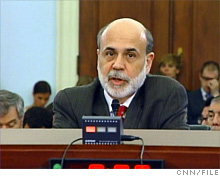 |
| What did Fed chief Ben Bernanke say when BofA was trying to back out of its Merrill Lynch purchase? |
NEW YORK (Fortune) -- For the second time this year, the Federal Reserve is under pressure to come clean on its role in a costly government bailout of a big financial company.
Two congressmen on Tuesday subpoenaed the Fed for documents tied to Bank of America's (BAC, Fortune 500) Jan. 1 acquisition of the troubled brokerage firm Merrill Lynch.
The legislators -- Edolphus Towns, D-N.Y., and Darrell Issa, R-Calif. -- are seeking "emails, notes of conversations and other documents" tied to the Fed's involvement in the BofA-Merrill deal.
The Fed said Tuesday it has received the subpoena and planned to respond "fully and completely" to its requests.
Towns and Issa are the chairman and the ranking member of the House Oversight and Government Reform Committee, which has been investigating the government's involvement in the troubled deal. Lewis is scheduled to appear at a hearing in front of the committee on Thursday morning.
In April, investigators released a report revealing that BofA CEO Ken Lewis said he felt pressured by top officials at the Treasury Department and the Fed to complete the deal, even as it became clear Merrill was in a state of near collapse. Lewis was stripped of his chairman's title by BofA shareholders a week later.
Lewis told investigators in the office of the New York attorney general that when he learned in December of Merrill's deterioration, he told then Treasury Secretary Henry Paulson that BofA was considering backing out of the deal.
Paulson responded that Lewis and the BofA board would be replaced if they sought to end the merger, which Paulson viewed as integral to the good health of the U.S. financial system. Paulson told New York investigators that he threatened Lewis' job at the behest of Fed chief Ben Bernanke.
Lewis also said he was urged by Paulson and Bernanke not to disclose his discussions with them about the extent of federal assistance that would be provided to BofA were it to complete the Merrill acquisition. Both Paulson and the Fed denied telling BofA what to disclose.
The report in which the firing threat came to light, issued in April by New York Attorney General Andrew Cuomo, said Paulson's account "largely corroborated" the events as described by Lewis.
But Cuomo concluded that "we do not yet have a complete picture of the Federal Reserve's role in these matters because the Federal Reserve has invoked the bank examination privilege," which bars disclosure of information gathered in a regulatory review of a bank.
The BofA-Merrill deal was valued at $50 billion when it was announced in mid-September -- the same day that Lehman Brothers declared bankruptcy. But it ended up being worth $19 billion due to the plunge in Bank of America's shares over the following three-and-a-half months.
Regulators and BofA announced later in January that the government would provide BofA with $20 billion in new capital and $118 billion in asset guarantees to cover possible losses tied to the transaction.
This isn't the first time the Fed's role has been questioned during the financial crisis.
In March, AIG (AIG, Fortune 500) -- the troubled insurer that has gotten more than $170 billion of federal aid -- released a list of the names of trading partners that received federal payments as a result of its collapse in September.
The company did so just days after legislators, including Senate Banking Committee Chairman Chris Dodd, D-Conn., demanded the Fed name those so-called counterparties.
Fed Vice Chairman Donald Kohn claimed the Fed couldn't do so, because naming the companies could undermine confidence in the markets and reduce economic stability. That response drew a rebuke from legislators, though AIG's decision a week later to name the parties made the matter moot.
"Public confidence in what we're doing is at stake, and the public right now is deeply, deeply troubled," Dodd replied March 5. "I understand the legal arguments you've given me, but that kind of answer undermines public trust." 


-
 The retail giant tops the Fortune 500 for the second year in a row. Who else made the list? More
 -
 This group of companies is all about social networking to connect with their customers. More
 -
 The fight over the cholesterol medication is keeping a generic version from hitting the market. More
 -
 Bin Laden may be dead, but the terrorist group he led doesn't need his money. More
 -
 U.S. real estate might be a mess, but in other parts of the world, home prices are jumping. More
 -
 Libya's output is a fraction of global production, but it's crucial to the nation's economy. More
 -
 Once rates start to rise, things could get ugly fast for our neighbors to the north. More









