CNNMoney.com
Companies Economy International Corrections Pre-market Trading After-hours Trading Winners/Losers/Actives Bonds Currencies Commodities World Markets Money Magazine Real Estate Taxes Jobs Ask the Expert Money 101 Autos Mutual Funds The Help Desk Loan Center Best Places to Live Ask the Expert Ultimate Guide to Retirement Retirement Calculators Best Funds Best Places to Retire Fortune Brainstorm Tech Apple 2.0 Blog Big Tech Blog Sectors and Stocks Tech Talk Resource Guide Small Business Makeovers Questions & Answers Small Business Video 100 Best Places to Launch FSB 100 Fortune Small Business Fortune 500 Brainstorm Tech Investing Management C-Suite Rankings Main Create Portfolio Edit Portfolio Create Alerts Edit Alerts

40 banks failures in 2009

Banks in Georgia, North Carolina and Kansas are closed by regulators as the financial crisis takes a toll on local banks across the nation.

EMAIL  |   PRINT  |   SHARE  |   RSS
 
google my aol my msn my yahoo! netvibes
Paste this link into your favorite RSS desktop reader
See all CNNMoney.com RSS FEEDS (close)
By Ben Rooney, CNNMoney.com staff writer

Map
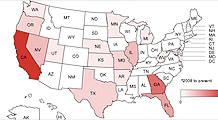
Where the banks are failing
Bank failures and foreclosures keep mounting
What investment strategy will you follow for the rest of the year?
  • Aggressively buying stocks
  • Slowly adding more stocks
  • Beefing up bonds and cash
  • Not changing a thing
DID YOUR BANK FAIL?
  • For more information visit www.fdic.gov
  • Don’t panic – your savings are insured
  • Keep paying your loans – the terms remain the same.
  • The FDIC will notify you by mail about your accounts/loans.
  • Contact the FDIC with any questions until further notice
  • If your bank is purchased, you will be contacted by your new bank.

NEW YORK (CNNMoney.com) -- Regional banks in North Carolina, Kansas and Georgia were closed by state regulators Friday, bringing the total number of failed banks this year to 40, the Federal Deposit Insurance Corporation said.

The 24 branches of Wilmington, N.C.-based Cooperative Bank will reopen Monday as branches of First Bank, which is based in Troy, N.C.

Cooperative bank had assets of $970 million and total deposits of approximately $774 million. First Bank will assume all of the failed bank's deposits and agreed to purchase $942 million of its assets.

In Kansas, First National Bank of Anthony, which operated 6 branches - including two under the name of First National Bank of Johnson County - will be taken over by Bank of Kansas.

Bank of Kansas, which is based in South Hutchinson, acquired all of First National Bank of Anthony's $156.9 million deposits. It also purchased the bulk of the failed bank's $156.9 million worth of assets.

Meanwhile, the five branches of Southern Community Bank, which is based in Fayetteville Ga., will become part of United Community Bank of Blairsville. It was the seventh bank to fail in Georgia this year.

United Community Bank paid a premium of 1% to acquire all of the of the $307 million deposits held in the failed bank. It also agreed to purchase approximately $364 million of assets.

The assets not purchased by the acquiring banks will be retained by the FDIC and sold later.

The FDIC said it entered into a "loss-share transaction" with the acquiring banks for a portion of the assets belonging to the failed banks. The arrangement is designed to maximize returns on the assets covered by keeping them in the private sector, the FDIC said.

"Under the loss sharing agreement the FDIC will reimburse United Community Bank for losses on Southern Community Bank's loans and foreclosed properties," said Jimmy Tallent, president and chief executive of United Community Banks, in a statement.

The total cost of Friday's bank failures to the FDIC is $203 million, bringing the total for this year to $11.53 billion. That compares with $17.6 billion in all of 2008.

So far this year, the number of bank failures has already exceeded last year's total of 25, with an average of nearly 7 failures per month.

The FDIC expects roughly $70 billion in losses due to the failures of insured institutions over the next 5 years.

The FDIC, which is funded primarily by fees paid by banks, insures individual deposits up to $250,000. The amount was increased from $100,000 late last year in response to concerns about the stability of the nation's banks.

The Obama Administration unveiled a highly-anticipated new plan to overhaul how banks and other firms are regulated in the hope of preventing another financial collapse.

Under the new proposal, the FDIC and other regulators would have more power to take over and unwind troubled financial companies beyond banks.

The plan would also, among other things, expand the powers of the Federal Reserve and create a new agency dedicated to consumer protection. To top of page

Features
Markets Last Change
Dow Jones 10,469.61 35.90 / 0.34%
Nasdaq 2,177.10 7.92 / 0.37%
S&P 500 1,109.40 3.75 / 0.34%
10-year Bond 100 13/32 Yield: 3.32%
U.S.Dollar 1 euro = $1.506 0.010
November 25, 2009 11:09 AM ET
CompanyPrice% Change
US Airways Group Inc 3.46 4.85%
Ubs Ag Jersey Brh 22.00 4.61%
Barnes & Noble Inc 23.16 4.09%
Limited Brands Inc 17.24 3.61%
Nov 25 11:04am ET †
More Galleries
Most (and least) affordable cities to buy a house Here are the 5 metro areas where the average American family can afford to purchase a median-priced home -- and the 5 where they can't. More
Holiday gifts for work and play You've got enough to worry about. So take the stress out of holiday shopping with our picks for everyone on your list. More
7 wicked Black Friday Car deals It turns out the day after Thanksgiving is a great day to shop for a car. Here a few deals that deserve special attention. More
Sponsors

© 2009 Cable News Network. A Time Warner Company. All Rights Reserved. Terms under which this service is provided to you. Privacy Policy
Copyright © 2009 BigCharts.com Inc. All rights reserved. Please see our Terms of Use.
MarketWatch, the MarketWatch logo, and BigCharts are registered trademarks of MarketWatch, Inc.
Intraday data provided by Interactive Data Real-Time Services and subject to the Terms of Use.
Intraday data is at least 20-minutes delayed. All times are ET.
Historical, current end-of-day data, and splits data provided by Interactive Data Pricing and Reference Data.
Fundamental data provided by Morningstar, Inc..
SEC Filings data provided by Edgar Online Inc..
Earnings data provided by FactSet CallStreet, LLC.