Stimulus dollars at work: Fighting forest fires
In Oregon, the Recovery Act is paying for a local small business to thin forests and protect nearby communities from wildfires.



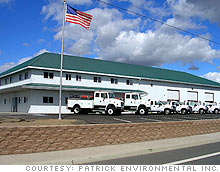 |
| Fire trucks parked outside PatRick's headquarters. |

NEW YORK (CNNMoney.com) -- Paul Solarz is a real life Smokey the Bear who knows how to prevent and manage forest fires. And his company, PatRick Environmental, recently landed a contract, backed by stimulus money from the Recovery Act, to do just that.
PatRick won a bid to trim areas of Oregon's Deschutes & Ochoco National Forest and Crooked River National Grassland. This controlled thinning will promote new growth and cut some trees so that natural wildfires don't become unmanageable.
The project is just one of thousands being carried out across the U.S., in which stimulus money is being used to shore up the country's infrastructure and generate much-needed business for local companies.
"It's hazardous if there's too much trees -- the wildfires get out of control," says Paul Solarz, the operations manager of the Redmond, Ore.-based company.
PatRick Environmental typically spends summers putting out natural forest fires. But during the rest of the year, the company makes bids to the Department of Agriculture Forest Service for "fuel reduction" projects that aim to thin timber through controlled burning and timber trimming. "Half of the year we like fires, the other half we don't," Solarz quips.
With five offices around the country, PatRick has only 20 full time employees, 11 of them in Redmond. But an additional 300 workers are on an "as-needed" status and work only when there is a call to create or put out fires.
"The competition has become so fierce over the past two years. We used to bid on a contract and 10 people would also bid. But now when there's an opening, 40 to 50 people will bid," says Solarz, who attributes this shift to both changes in his industry and to the poor economy. "We've had to be careful on how we bid, because others are willing to underbid just to get the work."
While the company hasn't had to lay off employees, Solarz and company owner Rick Dice have cut costs as much as they could in recent months. "It was essential spending only," Solarz says.
PatRick searches for upcoming contracts daily through the FedBizOpps.gov Web site and local newspapers, so the company anticipated bidding for stimulus projects. As soon as the Department of Agriculture posted local forestry opportunities, PatRick's staff took several days to survey the land and write a proposal. Their bid included details on the acreage they thought necessary to trim, plus an estimate on the job's parameters.
"We were nervous because the competition was so high," Solarz says. "We're still nervous, because now our bid is public knowledge. Other companies can sharpen their pencils more going forward to be even more competitive."
They won two contracts, one in Jefferson County and the other in Crook County, collectively priced at about $711,400, and began thinning in late March.
Local forest officials say the thinning work PatRick is performing is essential to keeping the forests healthy and protecting local communities. In that area of central Oregon, east of the Cascade Mountain range, the climate is very dry and the forests, populated with juniper and pine species, are prime feeding grounds for wildfires.
"There are many communities, such as Bend, Sisters, Crescent -- they are all very close to the Deschutes or other federal lands that are at threat for major wildfires," says Sue Olson, public affairs officer for the Deschutes & Ochoco National Forests. "And they do occur, just about every year."
The projects PatRick landed are among several "hazardous projects" that were queued up on the forests' list of planned investments.
"We had planned to do them, but the economic stimulus money we received in February allowed us to get started sooner," Olson says.
About 1,100 acres have already been cleaned up -- approximately 50% of the project. PatRick is now gearing up for the wildfires season and will put this job on hold from mid-July until the autumn.
"We've hired two new full-time employees and we're increasing the tours of 40 others from the three surrounding counties, giving them double what they've been used to getting," says Solarz. "Instead of just working four to five months a year, we've been able to hire them earlier this year and bring them back in the fall, totaling nine to 10 months' of work."
The money is rippling outward to other businesses. Solarz estimates that his company has upped its equipment and supply orders by 10%. A safety apparel company, for instance, sells goggles, gloves and hats to PatRick. A power equipment company sells saw parts, and a packaging supplies distributor sells plastic covers that the company uses on its jobs. All three suppliers are located in Oregon.
The ripple through the supply chain is a significant benefit in Oregon, where the unemployment rate is at 12% -- the second worst in the nation, behind Michigan.
Southwick Specialty Advertising, another distributor located in Bend, Ore., provides PatRick Environmental with the hats, t-shirts and sweatshirts that make up the company's uniforms.
"They ordered three times in a one-month period -- while it's not above and beyond for PatRick, any normal order we've received in last 16 months is good. A lot of other clients are not doing normal business," says Duane Barker, sales and marketing specialist at Southwick. "All the garments were decorated in Oregon, and decorators got some business through that order. Looking at the businesses we work with, I bet it affected six different companies that together employ a couple hundred people."
PatRick won't get rich off these contracts, Solarz acknowledges, but right now, every bit of business makes a difference.
"Our employees are able to work and pay their bills on time, and hopefully weather the recession," Solarz says. "This is important to the local communities because the money goes back to them."
CORRECTION: While PatRick is involved in other contracts that require controlled burning, the stimulus contract the company received does not require this work, as previously stated. Stimulus money is only being used for trimming and piling. 

-
 The Cheesecake Factory created smaller portions to survive the downturn. Play
 -
 A breeder of award-winning marijuana seeds is following the money and heading to the U.S. More
 -
 Most small businesses die within five years, but Amish businesses have a survival rate north of 90%. More
 -
 The 10 most popular franchise brands over the past decade -- and their failure rates. More
 -
 These firms are the last left in America making iconic products now in their twilight. More