
The right dose of pharma stocks
Paul Abel of Kinetics Medical Fund calls for a simple balance that doesn't waste time looking for the next big superstar.



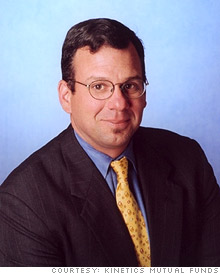 |
| Paul Abel, manager, Kinetics Medical Fund |
| MMA | 0.69% |
| $10K MMA | 0.42% |
| 6 month CD | 0.94% |
| 1 yr CD | 1.49% |
| 5 yr CD | 1.93% |
NEW YORK (Fortune) -- Fund manager Paul Abel has one warning for investors looking to delve into pharmaceutical and biotech stocks: Don't think you'll spot the next Amgen.
Abel, who manages the Kinetics Medical Fund, is a true believer of start-up companies, but he advises investors to think of them more as "publicly traded venture capital" rather than the next big biotech superstar. "When you've adopted that sort of mindset," he says, "you can pick them judiciously."
Abel's strategy for investing in biotech and pharmaceutical stocks is simple: One-third of his portfolio consists of Big Pharma, one-third is what he calls "profitable biotechs," and the final third is the previously mentioned publicly traded venture capital, or yet-to-be profitable biotechs.
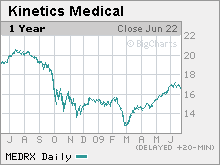
The Kinetics Medical Fund has fallen about 10% over the last year, according to Morningstar. But it's up 9% year-to-date, while its overall health category is up less than half a percent. It has 46 holdings and assets of about $18 million.
Abel says part of the attraction of large pharmaceuticals and some biotechs these days is their lack of exposure to the credit markets. Many Big Pharma companies sit on large amounts of cash and can borrow money easily. He points to the $30 billion bridge loan Pfizer (PFE, Fortune 500) secured at the end of January to finance its $64 billion acquisition of Wyeth.
While pharmas and biotechs aren't immune from the current credit crunch, Abel says the damage has been collateral. "Over the past couple of months we've experienced a strange systemic arbitrage," he says. "But you can't sell a dollar for twenty-five cents for very long."
One of the biggest issues for Abel in picking stocks for his fund is keeping companies that fit into the middle third of his portfolio -- the profitable biotechs. "For about five years now we've lost roughly one company per quarter out of our portfolio through an acquisition," Abel says. "It's been lucrative but a little unnerving at the same time."
Another hot topic that's weighing on Abel is the health care reform debate. Assuming Congress could pass some sort of universal measure, there may be some pricing pressure on pharmaceutical companies, but he thinks it would be offset by market opportunity because a slew of people who didn't have access to drugs would be able to fill their prescriptions.
In deciding which companies to invest in, Abel follows a bottom-up mentality. He first evaluates the company's underlying business model and how it makes its money. Then he sees if he can buy it at a discount to the actual value of the company. Here are some of his top picks:
In Big Pharma: Novartis (NVS) The company, which Abel has held for awhile, just unveiled its first batch of swine flu vaccines ahead of schedule and its CEO predicted 2009 will be its best year ever. In this category, value investing is the way to go, Abel says, particularly because of the dividend yields of 4% to 6% that many Big Pharmas such as Novartis offer.
In profitable biotechs: Biogen Idec (BIIB) Abel liked Biogen even before Carl Iachn eyed the nimble company. "They've been able to execute the business model repeatedly by introducing drugs and growing their revenue," he says. The fourth quarter of 2008 was Biogen's first billion-dollar quarter and it's projecting $5 billion for this year.
In the smaller space: Affymetrix (AFFX) Only a couple months ago, the company was trading around $2 a share -- a major discount to Affymetrix's book value -- or really its cash position because its operations were financed through the sale of equity. "When the company was trading at thirty cents on the dollar to its cash position it almost became too easy," Abel says. With smaller companies, Abel recommends buying a small position and then adding to it if you like what you see.
"Some pundits say that's not a viable strategy anymore," Abel says of the power of buy and hold. "But I disagree. There's no need to sell the winners." 


-
 The retail giant tops the Fortune 500 for the second year in a row. Who else made the list? More
 -
 This group of companies is all about social networking to connect with their customers. More
 -
 The fight over the cholesterol medication is keeping a generic version from hitting the market. More
 -
 Bin Laden may be dead, but the terrorist group he led doesn't need his money. More
 -
 U.S. real estate might be a mess, but in other parts of the world, home prices are jumping. More
 -
 Libya's output is a fraction of global production, but it's crucial to the nation's economy. More
 -
 Once rates start to rise, things could get ugly fast for our neighbors to the north. More









