
Wall Street's selective memory
Wall Street is whining about government intervention. Uh ... whose fault is that?



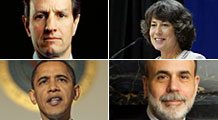
(Fortune Magazine) -- Yes, the federal government does a lot of stupid things. And yes, it's easy to see why Wall Street firms are bailing out of the Troubled Asset Relief Program: to avoid having to deal with the government's ever-changing rules and with publicity-hungry congressmen. (Is there any other kind?) But that doesn't excuse the way that Wall Street is engaged in selective memory now that the government has shelled out trillions of taxpayer dollars to keep the Street alive. Wall Street, which I define as our major financial institutions, is complaining that the government is messing up the financial system through its attempts at reregulation, its new credit card rules, and its invention of things such as a pay czar.
But before you accept the Street's version of events, recall that you didn't hear complaints about "socialism" when the government bailed out creditors of Bear Stearns and AIG (AIG, Fortune 500), and let Goldman Sachs (GS, Fortune 500) and Morgan Stanley (MS, Fortune 500) become bank companies so that they could borrow hugely -- and cheaply -- from the Fed.
Let's also remember that Wall Street brought all this Washington attention on itself. When it was left alone, the Street unleashed a wild speculative bubble that almost destroyed the world's financial system when it burst. The Street abused vulnerable credit card customers with 30% interest rates and endless fees, and paid its big hitters obscene amounts of money. Now we're seeing the reaction to those excesses.
You should also remember that the recession, which has so empowered the liberal Democrats whom Wall Street loathes, was touched off by the financial markets' meltdown. So the Street really has no one to blame but itself for its current problems.
The meltdown was so bad that if the government hadn't bailed out the financial system, even prudently run outfits could well have gone under if the government had allowed more giant firms to fail. So these outfits too owe Uncle Sam. Bigtime.
It's not hard to understand firms' motivation to escape from TARP, which gave them bailout money on attractive Bush administration terms but has now stuck them with expansive Obamoid regulations. Who needs this?
The Street's biggest hope -- and my biggest fear -- is that Washington will focus on symbolism such as a pay czar while substantive things, such as regulating derivatives and setting capital requirements, are done out of public view. Wall Street wants to make its own rules again -- and could get away with it. What's more, now that many big banks have raised money from investors and are repaying their federal bailout loans, they're trying to buy back the stock-purchase warrants Treasury got as part of the deal. Those warrants -- the right to buy a fixed number of shares at a fixed price -- were taxpayers' big chance to make some serious money.
However, as Amy Baumgardner of the Morrison & Foerster law firm explained to me, the Treasury has to sell back its warrants to institutions that repay TARP this year and are willing to go through a long, complex procedure designed to determine a fair price. That means the Treasury will get a price that's fair in today's market, but less than the banks think the warrants will be worth. That could be a substantial difference, because despite all of Wall Street's capital raising and TARP repaying, it's still feeding at the public trough in a variety of ways.
One of the biggest subsidies, which will never show up as a bailout expense, is the Fed's maintaining short-term interest rates at close to zero. This helps the economy recover, the stated reason for keeping rates so low. (It penalizes those of us who are savers, but that's another story.) But an unstated reason for the ultralow short rates is that they give banks a chance to make big profits by reinvesting cheap deposits in much higher-yielding securities.
Then there's the final irony. If any of the giant TARP-repaying firms manage to get into serious trouble again despite the new rules being pushed by the Obama administration, they'll still be too big to fail. And who'll pay to save them? As always, you and I will. 


-
 The retail giant tops the Fortune 500 for the second year in a row. Who else made the list? More
 -
 This group of companies is all about social networking to connect with their customers. More
 -
 The fight over the cholesterol medication is keeping a generic version from hitting the market. More
 -
 Bin Laden may be dead, but the terrorist group he led doesn't need his money. More
 -
 U.S. real estate might be a mess, but in other parts of the world, home prices are jumping. More
 -
 Libya's output is a fraction of global production, but it's crucial to the nation's economy. More
 -
 Once rates start to rise, things could get ugly fast for our neighbors to the north. More









