
Taxing the fat in your food
New study argues that a tax on fattening foods could help pay for health reform and curb obesity -- and lower health costs. Others aren't so sure.



NEW YORK (CNNMoney.com) -- Health care costs keep growing fatter in part because Americans are, too.
More than 25% of the increase in medical costs between 1987 and 2001 is attributable to obesity and obesity-related conditions such as hypertension and diabetes, according to a new report from the non-partisan Urban Institute.
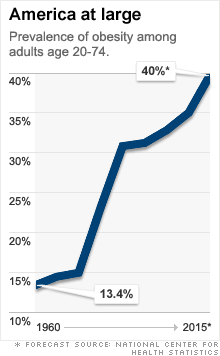
Come 2015, it is estimated that 40% of American adults will be obese, which is more than double the rate 40 years ago.
And today, close to 20% of children are obese, up from 4% four decades ago.
"What does that mean for health care costs years from now?" said Paul Fronstin, director of the health research program at the Employee Benefit Research Institute.
All told, 9% of health spending last year -- or more than $200 billion -- was spent on obesity-related costs, according to Urban Institute. Half of that bill was footed by taxpayers through Medicare and Medicaid.
Taking their cue from steep taxes on tobacco, which have helped reduce smoking rates, the health policy experts who wrote the report argue that a tax on fattening foods could not only raise a lot of revenue to pay for health reform but could also help curb obesity and thereby slow the growth in health care costs over time.
"Aggressive policy remedies like those used with tobacco deserve serious consideration, in view of the terrible and rising toll that obesity is taking on the United States," the authors write.
Depending on how it's set up, the authors estimate that a 10% federal tax of fattening foods could raise up to $530 billion over 10 years. That would be more than half the estimated cost of reform.
Of course, low-income Americans would be disproportionately affected by such a tax, both because they spend a higher percentage of their disposable income on groceries and because they tend to have a higher incidence of obesity-related conditions, at least some of which are attributable to diet.
To relieve that burden, the authors suggest $180 billion of the revenue raised be used to subsidize low-income families' purchase of fruits and vegetables and to otherwise make healthier foods available to them.
Stan Dorn, one of the authors and a senior research associate at the Urban Institute, noted that one study shows that states that already tax sodas and snack foods are much less likely to rank among states with the highest growth rates in obesity.
And that's just with a very limited tax on specific kinds of fattening foods, Dorn said. When a tax is limited to specific unhealthy foods, studies show that consumers tend to reduce consumption of the taxed product but then switch to other unhealthy foods that aren't taxed.
The authors of the Urban Institute study say a tax alone would not be sufficient to reduce obesity rates. They also recommend measures such as bans on advertising fattening foods to children and more explicit labeling on fattening foods.
"It's a multi-pronged approach," Dorn said.
They also concede, however, that enacting a tax on fattening foods would be a long and uphill battle, given the powerful interests involved in food production.
As it is, lawmakers already appear to have tabled a proposal to tax sugar-sweetened beverages as a way to pay for health reform. The Congressional Budget Office had estimated such a tax could raise $50 billion over 10 years.
Beyond the lobbying obstacles, however, some experts believe that the idea of taxing fattening foods per se isn't a good one.
Calling the proposal "social engineering," Joseph Antos, a health care scholar at the conservative American Enterprise Institute, also thinks that changing the way Americans eat in ways that would significantly improve their body-mass index -- a key measure of obesity -- is a very long-term prospect. "If it did have an effect it would be over decades," Antos said.
In the meantime, both obese and non-obese people would be paying tax on items with saturated fat.
"It's not efficient," said economist Erik Finkelstein, author of "The Fattening of America: How the Economy Makes Us Fat, If It Matters and What to Do About It."
If the goal is to reduce obesity rates, Finkelstein argues, why not charge obese people higher insurance premiums.
Or, Finkelstein said, "by the same logic, you could tax things that promote sedentary behavior, such as the use of computers and the Internet."
Whether or not taxing fattening foods is a good idea, the proposal shines a light on one of the big cost drivers in health care and just how hard it is to change behavior and reduce costs.
But sustained reduction in health costs won't happen if obesity is ignored, wrote the authors of a recent article in the journal Health Affairs that estimates obesity-related costs were $147 billion last year.
"Although health reform may be necessary to address health inequities and rein in rising health spending, real savings are more likely to be achieved through reforms that reduce the prevalence of obesity and related risk factors, including poor diet and inactivity."
Correction:An earlier version of this article incorrectly identified the organization that American Enterprise Institute scholar Joseph Antos is affiliated with. 



