Small Business Administration chief: 'We're the popular kid'
SBA head Karen Mills says Washington is looking to small businesses to lead the economic recovery.



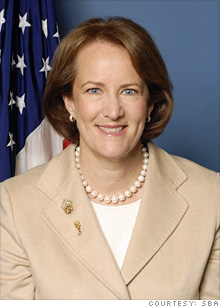 |
| SBA Administrator Karen Mills |


NEW YORK (CNNMoney.com) -- The economy is showing signs of revival, but in the small business trenches, companies are still struggling. Sales are down, credit is tight, and the tally of laid-off workers keeps growing. Leading the federal government's effort to shore up Main Street businesses is Karen Mills, now four months into her job heading the Small Business Administration.
Getting attention at the highest levels in Washington isn't a problem, Mills said in a recent interview with CNNMoney: "The world has changed, and everyone has realized that it is small businesses that are going to drive the economy and the recovery," Mills said. "We're the popular kid at the dance."
But many small business owners feel slighted by the giant bailout packages showered on Wall Street companies and the auto giants. We asked Mills for her take on the government's small business recovery efforts so far, and the goals still left to achieve.
"We hit the right formula," Mills said of the stimulus bill's combination of fee reductions and higher guarantees for banks that make loans through the SBA's programs. "Our objective is to get money into people's hands, and we're starting to see that."
More than 400 banks that hadn't made an SBA-backed loan since 2007 resumed lending after the Recovery Act was enacted in February. Weekly loan volumes have risen 45% since the stimulus bill passed, compared to the months immediately prior.
But compared to last year, the SBA's lending volume is still way off. For the quarter ended June 30, the SBA backed 30% fewer loans than it did a year ago, and 55% fewer loans than it did in 2007, before the recession set in.
"I think we have a ways to go in our volume of loans, but I've very happy with the trajectory," Mills said. "We're on track to continue to accelerate."
Discussions are ongoing with President Obama's administration about whether the SBA's loan-guarantee programs need to be expanded further. One option being considered is offering larger loans. Currently, the SBA's most active program maxes out at a $2 million loan size, a limit the agency is in talks about temporarily lifting.
But the change small business owners most often press for -- greater direct government lending, bypassing the banks entirely -- isn't a likely one.
The SBA's main lending programs insure bank loans to small companies against default. Only one major program, the agency's Disaster Loan Program, makes loans directly from the government's coffers. On the campaign trail, Obama called for the SBA to expend that program to cover the economic disaster that the recession has inflicted on many small firms. Since taking office, though, he has stayed mum on that idea.
Asked about direct lending, Mills emphasized the SBA's alliance with its partner banks. "We have a very powerful network of banks," she said. "Our partnership with the banks is the conduit to reach small business."
One lending initiative Mills sees as successful is the America's Recovery Capital (ARC) loan program, a Recovery Act initiative that offers interest-free loans of up to $35,000 to help struggling businesses temporarily make payments on other debts. Intended to help "viable" small businesses weather the recession, the program is now averaging 133 loans a week, and Mills anticipates that it will hit its target of 10,000 loans by the time the funding is exhausted in late 2010.
But, she acknowledged, the ARC program is designed for a fairly small number of qualifying businesses. Relatively few banks are participating, and businesses are only eligible to borrow if they were profitable in one of the last two years.
"We don't want to give a business that is not going to come through the troubled waters a loan that they can't pay back," she said.
So what should small companies that need credit lines do if they've been repeatedly turned down by the banks? Try again, Mills advised.
"We're planning on getting back to the levels of last year," she said. "If they're still having trouble, they should get connected to a [small business development center] or SCORE counselor. Very often, that will help a business find what options they might have. There might be a different loan or opportunity, a different bank. We are in the business of helping these companies one by one, individually."
Small business development centers, located around the country and funded in part by the SBA, offer business owners access to professional advice. Another SBA-backed program, SCORE (Service Corps of Retired Executives), provides business owners with free counseling from veteran entrepreneurs. Mills regards those programs, which encompass 14,000 counselors, as critical to extending the SBA's reach.
"I haven't check this out yet, but one of our guys told me we have a counselor within 45 minutes to an hour of most small businesses in this country," Mills said. "That's really powerful. I call it our bone structure."
While implementing the Recovery Act is Mills' number one priority right now, she is also deeply involved in the ongoing health care debate. In her view, reform is no longer optional: "The status quo is untenable."
With so many legislative drafts kicking around, Mills was hesitant to endorse specific proposals, but she is an advocate of insurance exchanges that would broaden access for small business owners. Designed to replicate the economics of scale large companies enjoy by banding small businesses together into bigger purchasing groups, exchanges are a key feature in most of the proposals being considered in Congress.
In the past, health insurance buying pools have struggled to attract insurers willing to participate. Legislators and other officials are aware of the obstacles, Mills said.
"People are thinking very, very hard about how to make this work, because it's a must-have for small businesses," she said. "Any marketplace that becomes more open will be a good thing for small businesses."
Through all the policy debates playing out right now -- about health care, economic recovery, and where the government should invest its resources -- small business is top of mind, Mills emphasized.
"The President is saying we have to make sure that we are getting all of the aspects of the Recovery Act into the hands of small businesses. Personally, he talks about them as being created around the kitchen table, being the path to middle class prosperity," she said. "I want to make sure people understand our level of commitment in this. Not a day goes by in the White House that we don't think about small business." 

-
 The Cheesecake Factory created smaller portions to survive the downturn. Play
 -
 A breeder of award-winning marijuana seeds is following the money and heading to the U.S. More
 -
 Most small businesses die within five years, but Amish businesses have a survival rate north of 90%. More
 -
 The 10 most popular franchise brands over the past decade -- and their failure rates. More
 -
 These firms are the last left in America making iconic products now in their twilight. More