
'Whole Paycheck' makes a comeback
Don't mistake a turnaround at organic grocery king Whole Foods as a sign that consumers are going to start spending healthily anytime soon.




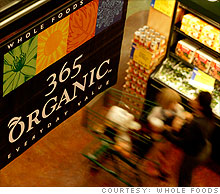 |
| Whole Foods reported its first profit increase in nearly three years Tuesday. Are consumers rediscovering their appetite for pricey organic food? |
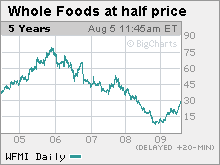 |
| Shares of the organic grocery store chain have rebounded sharply this year, but the stock is still well-below the levels it traded at before the recession. |
NEW YORK (CNNMoney.com) -- Looking for more evidence that maybe, just maybe, those green shoots aren't really just sprouts of crabgrass? Look no further than the comeback of Whole Foods Market.
The organic food retailer -- jokingly referred to by many as "Whole Paycheck" because prices are so high compared to other supermarkets --actually reported a slight increase in its fiscal-third quarter profits Tuesday. Analysts were expecting a 13% decline in earnings.
For Whole Foods (WFMI, Fortune 500), which had been struggling well before the recession hit, this was the first time that earnings rose on a year-over-year basis since the third quarter of 2006.
Sure, like many other companies, Whole Foods benefited from cost cutting. But sales did rise 2%, so growth was not just a function of firing people and reducing corporate expenses.
Wall Street ate up the news. The stock soared more than 15% Wednesday, continuing a surge that began earlier this year on economic recovery hopes.
But does the fact that consumers are once again embracing Whole Paycheck really a sign that the economy is getting back on track?
It's tough to say. Consumer spending did decline in the second quarter as many hunkered down and added to their savings. That trend is likely to continue.
With that in mind, it was interesting to note that Whole Foods executives went out of their way to stress during the company's conference call Wednesday that they are not trying to position Whole Foods as a grocery store only for the affluent.
"We do not believe we are marketing to an upper-income customer. We have never believed that. We are primarily marketing to a well-educated customer, a customer who has made a lifestyle change and that tends to correlate in terms of healthy eating with being a better informed customer, better educated," said chief executive officer John Mackey.
Talkback: Do you shop at Whole Foods or do you think their prices are still too high? Leave your comments at the bottom of this story.
Co-chief operating officer Walter Robb added that the company has been focusing on keeping prices lower in the past year in order to slow the loss of customers. Robb said that these efforts were a key factor in the company's recent success.
"People are giving us increasing credit for being competitive, and also they're seeing the visibility of the value in the stores," he said.
And it does seem that consumers, while remaining thrifty, are willing to shell out on the finer things in life, whether it's an organic free-range chicken or a new car, if the prices seem reasonable.
"It is possible that with a better value image, WFMI is benefiting from more confident consumers spending their marginal disposable income on modest luxuries, like lunch at Whole Foods," wrote Jefferies & Co. analyst Scott Mushkin in a report Wednesday.
But make no mistake. Whole Foods hasn't suddenly transformed into Wal-Mart, or for that matter, Kroger.
And even though total revenue was up, sales at stores open at least a year, a key figure in retailing known as same-store or comparable sales, fell 3.8% from a year ago. So the total sales growth was due more to an increase in the number of stores.
As such, Simeon Gutman, an analyst with Canaccord Adams, said that the company still needs to show that demand is really improving.
"They're getting a little bit of foot traffic back. There's not this same feeling of devastation that we had six months ago," he said. "But going forward, sales are going to have to be more responsible for earnings growth. That's a more challenging proposition."
CEO Mackey conceded that Whole Foods is kind of like the proverbial canary in the coal mine for consumer sentiment. It seems safe to suggest that if more people are willing to spend $4.79 for a box of six Kashi TLC granola bars (that was the regular price listed for Whole Foods stores in Manhattan), they must be more confident.
"It could be the economy is firming up and people are feeling like we're going to avoid a depression," Mackey said. "You could take this as an early indicator that maybe the economy is getting better if Whole Foods has firmed up some. But we don't really know."
And that's the scary thing. Nobody really knows. So far, Whole Foods appears to be the only high-end (sorry, Mr. Mackey, but perception is reality) retailer to be making a comeback.
Handbag maker Coach (COH) reported last week that its fiscal fourth-quarter sales were down slightly and that profits plunged 32% from a year ago.
Jeweler Tiffany & Co. (TIF) and apparel retailer Nordstrom (JWN, Fortune 500) will report their second-quarter results later this month. Analysts are expecting sizeable drops in sales and earnings for both companies.
And even if you agree with the notion that Whole Foods is just a grocery store chain, results from other supermarkets aren't looking too promising.
Supervalu (SVU, Fortune 500) reported a 30% decline in first-quarter earnings last week while Safeway (SWY, Fortune 500) recently lowered its full-year profit and same-store sales targets for the second time this year.
As a result, Bob Summers, an analyst with Pali Capital, suggests that the turnaround at Whole Foods is simply a refection that the company's efforts to get back on track after years of poor performance. So it's just good news for Whole Foods, not the broader economy.
"It would be categorically inappropriate to extrapolate Whole Foods' results as a sign that the consumer is recovering," said Summers. "If you look at what retail sales are, they are still pretty horrific."
Talkback: Do you shop at Whole Foods or do you think their prices are still too high? 



