Black businesses hit hard in New Orleans
African-American firm owners exited the business community in higher numbers than white owners - and those that returned face more challenges.



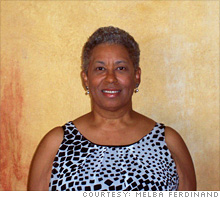 |
| Melba LeBrane Ferdinand's cafe has struggled in the aftermath of Katrina. |
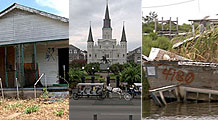
NEW ORLEANS (CNNMoney.com) -- Brad Pitt ensured that the nation noticed Hurricane Katrina's utter destruction to hundreds of shotgun houses and Creole cottages in New Orleans' working-class Lower Ninth Ward.
Less known and perhaps more devastating to the African-American business community was the destruction of many black middle-class neighborhoods. Doctors, lawyers, architects, teachers and business owners have yet to return to homes in New Orleans East and Gentilly.
Just as these neighborhoods have been the slowest to repopulate, black-owned companies have been slowest to return and restart.
Based on phone disconnection rates, nearly one in four black-owned companies in New Orleans and Biloxi had closed in 2008, a rate 52% higher than for white-owned businesses, according to the Political & Economic Research Council, a North Carolina think tank.
"In the immediate aftermath, it was devastating, we had no voice, no resources," said Arnold Baker, chief executive of Baker Ready Mix, whose black-owned company was initially hobbled by six months without revenue and the loss of all five of its cement trucks. "Whole industries disappeared, and the business failure rate on the Gulf Coast was phenomenal."
Now, as cranes, backhoes and steamrollers become more commonplace in the city, New Orleans' storied African-American business community could be left out of the rebuilding of the city.
That worries Mayor Ray Nagin.
In a speech to African-American businessmen in late July, Nagin pointed out that the city is entering the major reconstruction phase and has $26 billion to spend.
While there's a new law on the books that encourages the city to spend 35% of all public financing on minority- and women-owned businesses, Nagin said he's worried the city can't meet those goals due to the smaller pool of available companies.
"I do not see construction companies owned by African-Americans and women. Do y'all see it? Because I don't see it," he said during the speech. "We've still got a little time but not a lot of time."
Black-owned businesses in New Orleans never reflected the city's demographics. In 2002, African Americans made up two-thirds of the population in New Orleans. But less than a third of businesses were black owned.
Solid post-Katrina recovery numbers are scarce, but the Political & Economic Research Council has focused on small businesses in New Orleans and Biloxi, Miss., and in three surveys they found that African-American owned companies were hardest hit.
Another example can be seen through numbers of minority and women owned companies that have become certified to do business at the New Orleans airport. In 2003, 300 New Orleans area "disadvantaged" companies were certified to work at the New Orleans airport. In 2009, such certified "disadvantaged" companies had dwindled to 164.
"The African-American community was dealt a pretty heavy blow from an economic perspective," said Octave Francis III, chief executive of FFC Capital Management, a small, minority-owned wealth management firm that has fared OK. "We lost businesses and business owners, and the future is at stake, because many of our young people left for Atlanta, Houston and Denver."
Many black-owned small businesses were particularly ill-prepared for such devastation, because they tended to start out deeper in debt, with far less access to start-up investment funds.
"The minority business community had been historically plagued with lack of operating capital and commonly over leveraged, because we had to borrow money or use credit cards to get into business," said Baker, 44, a founder of the New Orleans Regional Black Chamber of Commerce.
According to the Political & Economic Research Council, those black-owned companies that survived reported lower sales, higher debt and a tougher time getting access to affordable credit than companies owned by whites or Hispanics. Michael Turner, president of the think tank said that most of their reports have concluded that African-American owned companies were "sucking wind" compared to those owned by other ethnicities.
Consider Cafe Rose Nicaud, which didn't flood and had brisk foot traffic when they first reopened two months after the storm, back when out-of-state insurance adjustors inundated the city and residents lacking power or kitchens needed their coffee fix.
Named for a slave who won her freedom by selling coffee to French Quarter church-goers, Cafe Rose Nicaud has lately been struggling, as the recession has deepened and more coffee shops re-opened. The six-year-old Cafe has grown more dependent on its original customer base, artists and residents who just haven't quite returned to pre-storm levels.
Owner Melba LeBrane Ferdinand, 59, says fellow African-Americans made up 40% of her latte and cappuccino sales before the storm. Now, they're about a quarter of her traffic. One regular customer was brother-in-law Dr. Keith Ferdinand, who closed his minority-owned cardiologist practice in New Orleans East, settling in Atlanta.
"Sometimes when I get really down about it, I think about Rose Nicaud and wonder what kind of obstacles she had to go through to do," Ferdinand said. "It inspires me."
The survival story of Rhodes, the city's largest and oldest African-American funeral home exemplifies some of the recovery problems for companies whose core resources of customer networks, employees and offices were concentrated in the more devastated areas.
The 125-year-old, family-owned business employed between 50 and 100 employees at six locations. They were known for their bright, bold jazz funerals, a New Orleans tradition, where a parading brass band and mourners raising black umbrellas dance behind a hearse through city streets.
Yet, the storm wiped out their fleet of white limos, damaged every New Orleans location, and ravaged their signature funeral parlor, a grand 1920s theater in the Broadmoor area. Employees were scattered and homeless.
The Rhodes family tried to balance renovating damaged buildings with performing funeral services, usually at other churches. They got some insurance help and learned how to apply for public financing and historic tax credits to rebuild.
"Post-Katrina was very, very humbling," said Kathleen Rhodes Astorga, one of the five owners. "We're private people. We've never looked to government for any help. Never."
After four years, on Aug. 26, they're finally re-opening and dedicating their premiere funeral parlor in the stately theater, which has a new raised floor, new plaster walls and is decorated with African-American artwork.
Astorga is a no-nonsense businesswoman who doesn't believe that minority owners have it any tougher than anyone else in the city. Yet, she does acknowledge that the Katrina destruction dealt them deep blows, so thoroughly damaging so many locations and displacing so many families.
They're back to 60% of pre-storm levels. And they've branched out and are now doing funerals for whites and Hispanic residents.
"Business is business is business. And business is hard. But that's true, if you look at it across the country," she said. "We do the best we can."