
Windshields to wine glasses: What happens to Clunkers
The metal, tires, and even the oil filters from the cars scrapped in the Cash for Clunkers program will be recycled into everything from handbags and high-rises.



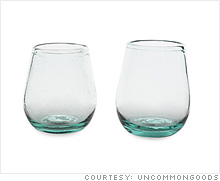 |
| Brooklyn-based retailer UncommonGoods sells wine glasses made from windshields. |
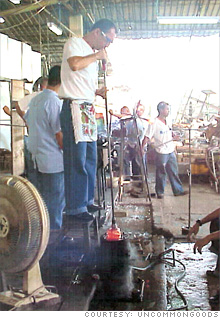 |
| Manufacturers in Columbia turn windshields into drinking glasses. |

NEW YORK (CNNMoney.com) -- Next time you're sipping your favorite wine, examine the glass closely: If it's thick and greenish, it might have been the windshield of an old, junked car.
UncommonGoods, an online retailer based in Brooklyn, N.Y., peddles wine glasses, beer glasses and punch bowls that are manufactured in Colombia from recycled windshield glass. On its Web site, the company advertises these glasses as having "a slight green hue from the tint originally added to lessen the sun's glare."
"They're one of our top-selling items," said Joanna Penn, a media relations coordinator for UncommonGoods, which has been selling the glasses for about a year.
Penn said her company also started selling purses, wallets, briefcases and belts made from recycled tires by a Boulder, Colo.-based artist named Heather English. All the products are black, though they're missing the tell-tale treads.
"You can definitely tell the material is the same, but it's really light," said Penn.
These products are the end result of the $22 billion recycling industry for scrapped cars, which is now in the spotlight thanks to the federal Cash for Clunkers program. Dealers participating in the initiative, which ended on Monday, claimed nearly $2.9 billion in vouchers for consumers who traded in old cars for new ones with better fuel efficiency. As a part of that program, dealers are required to destroy the Clunker engines so that they won't end up back on road.
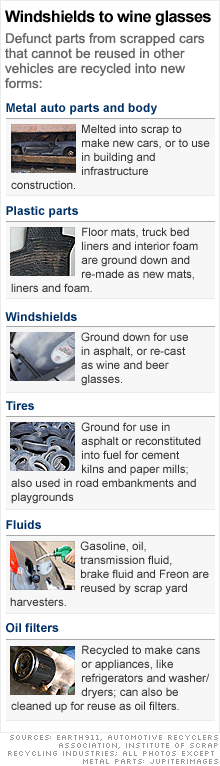
But most of a scrapped car's parts are recycled, including the metal, glass, plastic, tires and even fluids like used motor oil, according to Earth911, a Scottsdale, Ariz.-based environmental services company that focuses on recycling and the proper disposal of trash.
Generally, car parts that still function, such as engines, radiators, wheels and panels are first stripped from the vehicles for reuse in other cars. Then defunct parts are reincarnated as something else.
"Recycling a car completes that product's lifecycle but by turning it into something completely different," said Jennifer Berry, public and strategic relations manager for Earth911.
According to Earth911, tires are transformed into asphalt and mud flaps or reconstituted as fuel. Windshields are turned into wine and beer glasses, as well as lamps and counter tops. Used oil filters are transformed into cans, refrigerators and structural beams, or they're cleaned up and refurbished as new oil filters. Floor mats and truck bed liners are ground down and rebuilt as new versions of their former selves.
"The automobile is the most recycled component in the world," said Sandy Blalock, former president of the Automotive Recyclers Association (ARA), based in Manassas, Va.. "Almost 100% of a car is recycled, except for the fluff, which is going to the landfill."
Blalock was referring to the stuffing used in car seats, which poses a big challenge for recyclers, since some countries -- like Japan -- no longer allow it into landfills.
Even the fluids can be reused, according to the ARA. Transmission and brake fluids, anti-freeze, oil, gasoline, diesel and Freon from air conditioners are harvested at scrap yards for use in other vehicles.
"They twist and turn the vehicle to make sure that they get as much fluid out as possible," said Michael Wilson, executive vice president of the ARA.
Wilson said that plastics are also extracted from the vehicles for sorting and recycling. The remaining scrap metal, which is by far the biggest component in terms of volume, is melted down and fashioned into all types of products, and could wind up as part of a new car in as little as 30 days.
"We end up with the skeleton of the car once it's been dismantled -- the hulk of the car -- and we process it into commodity-grade materials," said Bruce Savage, vice president of communications for the Institute of Scrap Recycling Industries, Inc. (ISRI), a Washington-based association of scrap processors and brokers.
"We send the car through a shredder, which pulverizes it into palm-sized pieces of metal," said Savage. "We turn around and sell those to manufacturers, who use them as raw feed stock. A lot of this material is shipped internationally, particularly to China, for office buildings and infrastructure."
China is the biggest consumer of U.S. scrap, importing $7.4 billion worth in 2008, according to the ISRI, followed by Canada, which imports $4 billion. More than a quarter of the $86 billion worth of scrap that's generated each year is exported.
Like most other industries, the scrap businesses has taken a hit this year due to the slowing economy, said Savage. He added that the vehicles surrendered through the Cash for Clunkers program -- totaling 690,000, according to the Department of Transportation -- could create a glut that drives down scrap prices.
"That's one of the unknowns right now, because a lot of these vehicles are still with the dealers," said Savage.
Wilson, of the ARA, has his doubts about the economic and environmental benefits of Cash for Clunkers. The policy requires the destruction of the engine with a sodium silicate solution, also known as liquid glass.
But still-functioning engines are actually the most valuable part of a scrapped car, according to Wilson, so the fact that the Clunker engines must be killed is a big financial blow to automotive recyclers.
And it might even defeat the program's environmental objectives, he said.
"To produce an engine takes more energy than any other part," said Wilson. "We think that [the program] is going to have a minimal environmental benefit, if any." 



