
Pow! Bam! Are takeovers back?
Walt Disney's acquisition of Marvel Entertainment and a $5.5 billion deal in the oil patch could be a sign that the merger market is heating up again.




NEW YORK (CNNMoney.com) -- Mickey Mouse and Spider-Man may help provide some much needed spark to the sleepy merger market.
Walt Disney (DIS, Fortune 500) is buying Marvel Entertainment (MVL) for about $4 billion, or $50 a share. That's nearly 30% higher than Marvel's closing price on Friday.
But the Disney-Marvel marriage wasn't the only notable merger announced Monday. In the energy sector, Baker Hughes (BHI, Fortune 500) is acquiring oil-services rival BJ Services (BJS, Fortune 500) for $5.5 billion. The transaction values BJ at a 16% premium to Friday's closing price.
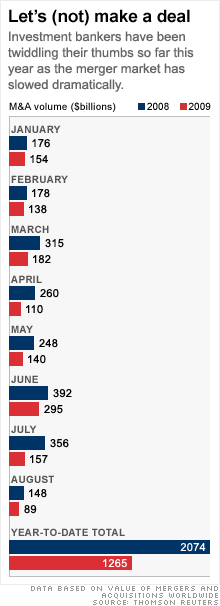
Still, even with those two deals, the pace of mergers and acquisitions is down sharply this year. The dollar amount of announced mergers is nearly 40% lower than the acquisitions announced through the first eight months of 2008.
The dearth of deals is worth noting since the level of takeovers tends to pick up when companies are feeling more confident. So even though the stock market has been on a tear since March on recovery hopes, companies haven't been as enthusiastic about the economy's prospects as investors.
But if Monday's mergers are the start of a trend, that might be an even stronger signal from Corporate America that the worst could be over.
"It has been a slow period for mergers and it's not that different from other recessions. But we're cautiously optimistic about the deal pipeline. Hopefully, Monday's deals portend good things to come," said Mike Shannon, co-manager with the Merger Fund, a mutual fund that invests in stocks involved in takeover situations.
Shannon said that the biggest hindrance to deals this year has been that sellers were unwilling to accept offers they felt were at depressed prices. But with stocks rebounding as much as they have in the past five months though, that has become less of an issue.
"It seems like the for last six to nine months, there has been a disconnect about what targets wanted to sell for and buyers wanted to offer." he said. "As you've seen the market rally, targets are willing to accept smaller premiums since they feel they are getting good value."
Bob Profusek, head of the merger and acquisitions group with law firm Jones Day, added that from a buyer's standpoint, deals are attractive because they are usually a cheaper way for companies to both expand and cut costs -- which should add to profits.
Yet, the merger announcements weren't enough to save the market from a China-induced sell-off Monday. And some experts think that even if there are more mergers after Labor Day, there won't be a flood of them.
"We'll have something of a pickup. There will be an increase but it will be an increase from a low base and not anything to really gladden the hearts of lawyers, bankers and investors," said Antony Page, a professor at Indiana University School of Law - Indianapolis who focuses on mergers and acquisitions and corporate law.
Page said that prospective buyers could take advantage of their surging stock prices to make deals, but that deal volume could remain relatively sluggish because of scarce financing.
"There still is something of a credit crunch. Yes, it's nothing like it was before. But it's not like there's all this cheap money sloshing around like there was two years ago," Page said.
That may be slowly changing though. Matt Toole, deals analyst with Thomson Reuters, pointed out that private equity firms may also start to become more active acquirers -- particularly in banking now that the FDIC has loosened rules to allow more private investors to buy failed banks.
"Private equity firms have been sidelined for well more than a year but they have a lot of money they can deploy," Toole said.
Even banks appear to be slowly wading back into the merger waters, providing financing for would-be acquirers.
Irish drug maker Warner Chilcott (WCRX) agreed to buy the pharmaceutical business of Procter & Gamble (PG, Fortune 500) last week for $3.1 billion after several banks agreed to refinance some of Warner Chilcott's debt.
"All the indicators are that the credit markets are getting better. Warner Chilcott could be the beginning of something," Toole said.
However, Profusek isn't so sure that banks are ready to jump back into the merger financing arena just yet. He agreed that there are reasons to be optimistic about the merger outlook for the fourth quarter and 2010, but said that the continued woes facing banks will limit how strong the recovery will be.
"It's a question of when, not whether, there will be a merger comeback. But it's a little soon to call this an uptick and the reason for that is that banks aren't lending that much no matter what they say," he said. "You're not going to see a full rebound in the merger market until the banks become more active."
Talkback: Do you think there will be many more mergers before the end of the year? And is that a good thing or a bad thing? Share your comments below. 



