
Health insurer tax not what it seems
Sen. Baucus' plan to tax insurers aims to pay for reform and encourage lower spending. Experts say it's an indirect way to cap employer-provided health benefits.



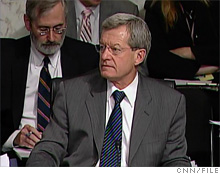 |
| Sen. Max Baucus' proposal to tax insurance plans is among the many items under debate this week. |
NEW YORK (CNNMoney.com) -- It sounds so simple. Insurers that offer very expensive health insurance policies will have to pay a tax and the revenue raised will help pay for health reform and possibly lower health care costs.
That's a key measure in Sen. Max Baucus' health reform proposal being debated by the Senate Finance Committee this week.
The proposed tax would apply in cases where the annual cost of individual coverage exceeds $8,000 or family coverage tops $21,000. Baucus said Tuesday that slightly higher limits would apply to plans covering workers in high-risk jobs and non-Medicare retirees. He also said that he would raise the insurer tax rate to 40% from 35%.
But the proposed tax is not as direct as it sounds. It won't just hit plans considered "overly generous" or "fat." And it's a cost that ultimately will be borne not by insurers but by employees through reduced benefits, a higher share of costs in their employer-sponsored plans or both.
That was the consensus view expressed in CNNMoney.com's discussions with health, tax and corporate benefits experts.
"This is what's known as a fiscal illusion. Congress is deliberately applying a fiscal illusion to get to the right place in a way that's politically palatable," said Ed Kleinbard, former chief of staff at the Joint Committee on Taxation who now teaches corporate taxation the University of Southern California Law School.
Here's what Kleinbard means: Baucus and others had been considering capping how much tax-free money an employer may contribute to a worker's health care costs. Currently that money is tax-free income to the worker and there is no limit on how much an employer can contribute. The tax break for the so-called health care exclusion costs federal coffers roughly $250 billion a year.
Health policy experts applauded the idea of capping the exclusion because it would encourage workers to buy less comprehensive plans to avoid paying tax on some of their employer's contribution. That would both reduce the burden on the federal budget and reduce health spending overall.
But capping the exclusion proved very unpopular with many lawmakers, unions and, not insignificantly, President Obama. The president has said repeatedly that he doesn't want anything to change for workers who currently get health insurance at work. In his health care speech before Congress earlier this month, Obama did, however, endorse the tax on insurance companies.
With an insurer tax, the expectation is that the insurer will pass the cost onto the employer.
"That's going to be built into the base price," said Steve Zuckerman, a senior fellow in health care policy at the non-partisan Urban Institute.
The employer, in turn, will either pass the additional cost on to workers or opt for a less expensive package
There are a few reasons the insurer tax is not as simple as it sounds.
First, the threshold won't apply just to the cost of an employer's health insurance plan. It would apply to the aggregate value of all the health-related benefits an employer offers -- including dental and vision coverage, flexible spending plans, health savings accounts and health reimbursement accounts.
Second, the tax won't just hit insurers who offer overly generous plans, but could be imposed on insurers that offer reasonably cost plans and the administrators of health benefits as well.
That's because it's not uncommon for an employer to use different providers and administrators for each element in its benefits package. So if the aggregate value of all the benefits combined exceeds the threshold, each of those providers would be subject to a part of the tax, even if their plan per se couldn't be considered 'overly generous.'
And even though the tax is intended to capture overly generous plans, "it may in some cases but in some it may not," said Jim Klein, president of the American Benefits Council. That's because the price of a policy is not just about the generosity of the benefits offered, but is based on the age and health status of the policy holders, among other factors. So companies with greater numbers of older or less healthy workers will have pricier policies.
It will be up to employers to do the math, and that will involve a whole new set of administrative processes, said Mike Langan, a principal in the health practice of consulting firm Towers Perrin. If they get the math wrong, they face a penalty.
If employers are self-insured -- meaning they take the risk of paying any claims made -- they would be subject to the tax too if the value of the benefits exceed the threshold.
The liberal Center for Budget and Policy Priorities estimates that only 10% of all employer plans will have family coverage exceeding the $21,000 threshold by 2013. Towers Perrin estimates that half of large companies that are self-insured have health packages that could exceed the insurer tax thresholds in the Baucus plan by 2014.
Presumably those numbers will be reduced a bit given the somewhat higher threshold rates for certain groups that Baucus announced on Tuesday. But because the threshold will be indexed largely to inflation, more and more plans over the years are likely to cross it since health costs rise far faster than inflation.
"Yes, over time, the tax bite will be deeper," Kleinbard said. But indexing the thresholds to inflation could move health costs in the direction they need to go, he added. "Long-term the country needs to bring health care costs down so that they grow no faster than inflation." 



