
Chinese oil demand fueling Iranian defiance
Despite tough talk from Washington, China needs Iran's oil too much to support sanctions that might actually bite.



NEW YORK (CNNMoney.com) -- Don't look for Iran to throw up the white flag anytime soon.
The Obama administration is scrambling to tighten trade sanctions against Iran after the disclosure last week that Tehran was hiding a heavily fortified facility that many believe is designed to make material for nuclear weapons.
But the kind of sanctions that would really hit Iran's economy - sanctions against its energy industry - are thought to be off the table because China and other nations are too reliant on Iran's oil.
"They look to Iran as a major source of future oil supplies," said James Placke, a senior associate at Cambridge Energy Research Associates who specializes in the Middle East. "They'd have to go through a substantial policy reversal, and I'd be surprised if they did that."
The United States and its allies can tighten sanctions all they want - The United States already has extensive sanctions against Tehran. But without the Chinese on board sanctions don't have the official weight of the United Nations Security Council, and are thus taken less seriously by the world community.
Iran is vulnerable to sanctions on both oil it exports and the gasoline it imports.
The oil side is where the country generates serious money, and an embargo could come in the form of restricting oil sales or imports of equipment designed to increase production from the country's aging oil fields.
Iran is the world's fourth-largest crude exporter and holds the planet's third-largest supply of proven oil reserves, according to the Energy Information Administration. The country exported nearly two and half million barrels of oil a day in 2008.
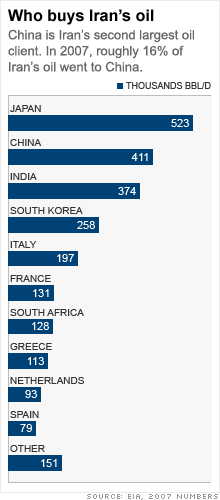
Oil exports account for nearly half the government's revenues and most of those exports go to Asian countries, with China taking a big chunk.
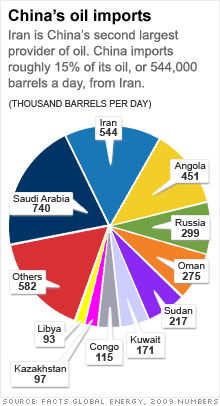
The Chinese rely on Iran for 15% of their oil imports. Moreover, China has been investing heavily in the country as it looks to lock up resources for its growing economy. Meanwhile, interest from Japanese, European and Canadian firms wanes in the face of U.S pressure. State-run Chinese oil firms are now thought to have deals worth over $100 billion with Iran.
And even though the Russians have signaled a recent willingness to step up sanctions - perhaps due to Obama's plans to scrap a missile defense system in Central Europe - it's thought that they're still not willing to go after Iran's energy sector.
"Russia and China aren't yet at the point where they'll be willing to cut off oil and gas investment in Iran," said Michael Levi, a senior fellow for energy and the environment at Council on Foreign Relations.
Squeezing Iran's gasoline imports is another tack sometimes called for by sanction hawks.
Despite being a huge oil producer, Iran lacks the refining capacity to turn all that crude into gasoline. As a result, it imports up to half of the gasoline it consumes.
Much of that gasoline comes from India. But barring a Security Council resolution, India isn't likely to stop these shipments for a few reasons: It's big business; India imports a lot of crude from Iran; India doesn't' want Iran getting any closer to China, India's long-time rival in the region; and India has its eye on getting natural gas imports from a huge field Iran controls under the Persian Gulf.
"I imagine India would find a rational reason in their foreign policy for not doing that," said Placke, who was a deputy assistant secretary of state for near eastern affairs before joining Cambridge.
All of this bodes ill for those in Washington trying to cajole Iran into halting its suspected nuclear weapons program.
So if sanctions don't work, then what?
The military option may have severe repercussions. Facing heavily guarded facilities, a bombing campaign may only succeed in merely delaying any weapons program Iran might have, and bolster the current hardline administration in the process. It may also invite reprisals from Iran's proxies in the West Bank, Gaza Strip, or Iraq.
From an energy perspective, Iran may retaliate by attempting to choke off Gulf oil exports through the Strait of Hormuz or, more likely, strike Saudi Arabia's main oil loading facility at Ras Tanura.
But a nuclear armed Iran could also have severe repercussions. While many analysts say the talk of annihilating Israel may well be political bluster, touching off a nuclear arms race in the Middle East is all but certain. Turkey, Saudi Arabia, and maybe Egypt would all scramble to develop their own bomb.
"Some talk casually about striking Iran and some talk casually about Iran with a bomb, but they're both horrible scenarios," said Steve Clemons, director of the American Strategy Program at the New America Foundation. "We're not investing enough in creating non-nightmare scenarios." 



