2 Americans win Nobel for economics
Governance experts Oliver Williamson and Elinor Ostrom win economics Nobel Prize a year after regulatory lapses led to global meltdown. Ostrom is first woman ever.



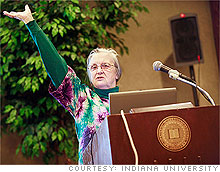 |
| Elinor Ostrom of Indiana University is the first woman to win Nobel Prize for economics. |
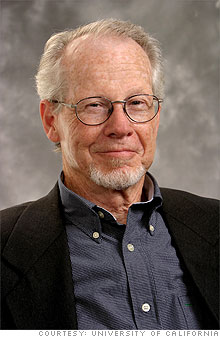 |
| Oliver Williamson, a retired Berkeley professor, was cited for his work about the governance of firms. |
NEW YORK (CNNMoney.com) -- Two American scholars who are experts in how businesses and the economy are regulated won the 2009 Nobel Prize in economics on Monday.
Elinor Ostrom, a professor at Indiana University, is the first woman ever to win the Nobel in economics.
Ostrom will share the $1.4 million prize with Oliver E. Williamson, a retired professor at the University of California-Berkeley.
The issue of government control of the economy has become a significant issue since last year's financial meltdown. The Obama administration and governments of major developed economies around the globe are now working reform their regulatory oversight of businesses and markets.
Ostrom, a professor of political science, was recognized for her work demonstrating how common property, such as forests, can be successfully managed by those who use the resources, rather than government officials.
The award was a "great surprise ... I'm still a little bit in shock," Ostrom said by phone at the news conference announcing the prize.
Ostrom told reporters later Monday that she was particularly proud to be the first woman to win the economics award. She said that when she decided to get her Ph.D. in the mid-1960s, she was warned no major university would even think about hiring a woman, and that she was grateful that Indiana University had bucked expectations to give her a job.
"I appreciate this is an honor to be the first woman, but I won't be the last," she said.
The committee said Ostrom's research shows that local communities often manage common resources better on their own than when outside authorities impose rules.
"Bureaucrats sometimes do not have the correct information, while citizens and users of resources do," Ostrom said.
Ostrom's award was perhaps more of a shock to economists because of her academic background in political science than because of her gender. Some economists said they had little or no knowledge about her work.
"The fact I have never heard of her reflects badly on me, and it also highlights just how substantial the boundaries between social science disciplines remain," wrote University of Chicago economics professor Steven Levitt on his New York Times "Freakonomics" blog. "So the short answer is that the economics profession is going to hate the prize going to Ostrom even more than Republicans hated the Peace prize going to Obama. Economists want this to be an economists' prize."
By contrast, Levitt said he was very familiar with Williamson's work, which he said has long been considered ground-breaking.
The Nobel committee said Williamson's theories show that large private corporations exist primarily because they can be the most efficient way to complete some economic transactions, challenging the belief that markets are always the most rational and efficient way to conduct business.
While such large businesses may abuse their power, he argued, it is better to regulate such behavior directly rather than through policies that limit the size of corporations, according to the committee.
David Wyss, chief economist with Standard & Poor's, said that it shouldn't be a surprise that this year's awards focused on issues of economic governance and regulation, given the financial crisis of the last year.
"Anyway you look at it, we had a failure of governance," said Wyss.
Wyss said that by giving the award to Williamson, the Nobel committee is cautioning policymakers responding to the recent problems that overregulation can cause its own set of problems.
"He argues you should regulate behavior, not size, that big firms are big for a reason," Wyss said. "By artificially splitting them up to make them small, you'll end up with a less efficient system."
Last year's Nobel prize was won by Princeton University economist Paul Krugman, who writes a column on economics and politics for The New York Times. He was awarded the Nobel for his academic study of national trade polices.
-CNN Wires contributed to this report.