
Is the market rally a hoax?
Stocks have soared thanks to 'strong' earnings reports. But some worry that the Dow's move above 10,000 has been fueled by hot air.




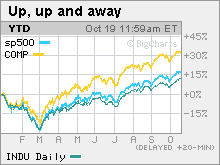 |
| Stocks continue to surge on the back of decent earnings reports. But has the rally from the March lows come too far too fast? |
NEW YORK (CNNMoney.com) -- Powered by a gush of strong earnings reports, the Dow has finally ballooned above 10,000 again. But could this most recent leg of the market rally turn out to be a cruel hoax?
Sure, there's much to cheer in the latest batch of results from major companies. Banking leaders JPMorgan Chase (JPM, Fortune 500) and Goldman Sachs (GS, Fortune 500) reported much larger than expected profits in the third quarter.
Tech kingpins Intel (INTC, Fortune 500) and IBM (IBM, Fortune 500) also surpassed Wall Street's estimates, and -- more importantly -- lifted their forecasts.
Still, there are some significant causes for concern. That means investors may need to be as skeptical of the rally as investigators in Colorado appear to be about this Heene family nonsense.
Bank of America (BAC, Fortune 500) posted a larger loss than anticipated. General Electric (GE, Fortune 500) reported a 20% decline in quarterly sales, and said that orders were down 18%, perhaps an indication of more weak sales ahead.
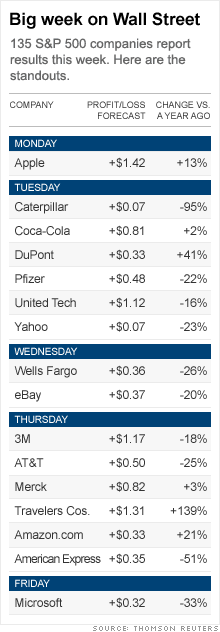
So what's going to happen this week, a period when more than a quarter of the companies in the S&P 500 will announce their latest results? Apple, AT&T, Coca-Cola and Microsoft are all on tap to report in the next few days.
Their forecasts for the coming months will go a long way toward determining whether stocks can keep drifting upward or if all the hoopla about a recovery for Corporate America was really for naught.
John Norris, managing director of wealth management with Oakworth Capital Bank in Birmingham, Ala., said he is not yet convinced that a robust rebound is in the cards.
Norris said it's one thing for companies to be able to beat earnings estimates because of lower expenses and boosts to international profits because of the weak dollar. But until more companies are confident that demand in the United States is improving, he thinks it's a good idea to be wary.
"I have not seen the type of earnings results to think that there is a rampant recovery around the corner," Norris said. "Corporate America needs to get healthy and it's good that companies are cutting costs. But we're not seeing a lot of profitability coming from North American revenue growth."
Eric Ross, director of research for investment bank Canaccord Adams, agreed. He said that the market's huge move since March has largely been fueled by better-than-expected profits that aren't terribly impressive considering how bad things were a year ago.
"Yes, the economy seems to be rebounding and earnings seems to be decent. But on the flip side, you also have much easier comparisons," he said.
Ross is worried that the rally may soon stall once investors realize that although the economy is improving, the recovery may be more slow and gradual than what many currently expect.
As a result, Ross said his firm is recommending more companies in classically defensive sectors such as healthcare and natural gas.
"We still have problems in housing and toxic assets for banks to deal with. But some people are now projecting that unemployment will peak barely above 10% and go back to 9.2 by the end of 2010," he said. "That may be too optimistic. It's going to be a tougher slog."
Norris said he also remains worried about the many headaches that banks still face. Even though JPMorgan Chase and Goldman Sachs continued to demonstrate that they are holding up well, the same can't be said for scores of many regional banks across the country.
For example, shares of BB&T, a big regional bank based in Winston-Salem, N.C., fell more than 4% Monday after BB&T reported that its provision for loan losses nearly doubled from a year ago.
And BB&T, which took over the assets of failed lender Colonial BancGroup in August, is actually considered to be one of the healthier regional banks in the country. Norris said that many smaller regional banks could continue to be hit hard by rising loan losses.
And since many of the hopes of an economic recovery are pinned to expectations that banks will once again start lending more freely to consumers and small businesses, more problems for regional banks will be tough to overcome.
Of course, none of this means that the economy are markets are necessarily heading for another big meltdown. In fact, a recent quarterly survey about trust in the financial system by professors at the Kellogg School of Management at Northwestern University and University of Chicago Booth School of Business showed that investors seem less worried now than a few months ago.
According to the survey of 1,000 households, only 23% of respondents now expect home prices to decline over the next year, compared to 37% in March. In addition, while more than 56% of the respondents in December feared a big drop in the stock market, just 40% think another major sell-off is likely now.
Still, the survey clearly demonstrates that investors aren't completely sold on the notion of a recovery just yet.
Paul Nolte, director of investments for Hinsdale Associates, a money-management firm based in Hinsdale, Ill, sums up the disconnect between Wall Street's elation about earnings and the average American's continued concerns about the economy as a matter of perception.
For now, Wall Street is choosing to look at the fact that while profits and sales may be down from a year ago, they haven't been as bad as some feared.
But sooner or later, investors might have to recognize the obvious. Earnings reports that are simply "less bad" won't be good enough to keep the rally going -- or convince consumers that the economy has really taken a turn for the better.
"If I expect you to fail math and you get a D, I might be excited for a while. But a D still stinks," Nolte said.
Talkback: Is the Dow's move above 10,000 a healthy sign of an economic recovery or another reason to worry that stocks have gone up too far too fast? 



