Bank failures stack up: Now 106 for 2009
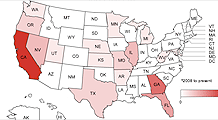
Banks in Florida, Georgia, Illinois, Minnesota and Wisconsin, were shuttered, costing the FDIC an estimated $356.6 million.



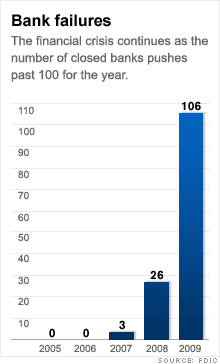
NEW YORK (CNNMoney.com) -- The tally of bank failures easily broke past the No. 100 milestone on Friday night, with regulators announcing the year's 106th closure.
That's more than four times the number that were closed in 2008, and the highest total since 1992, when 181 banks failed.
Earlier on Friday evening the dubious honor of the 100th failure went to Partners Bank, of Naples, Fla., which had $65.5 million in assets, according to the Federal Deposit Insurance Corp.
The 101st failure was American United Bank, of Lawrenceville, Ga., which had $111 million in assets.
The 102nd failure was another Naples, Fla., institution: Hillcrest Bank Florida, which had $83 million in assets.
The 103rd closure was Bradenton, Fla.-based Flagship National Bank, with $190 million in assets.
The 104th was Bank of Elmwood, based in Racine, Wis., which had $327.4 million in assets.
The 105th failure was Riverview Community Bank of Otsego, Minn., with $108 million in assets.
The 106th failure was First Dupage Bank in Westmont, Ill., which had $279 million in assets.
Customers of all seven banks are protected, however. The Federal Deposit Insurance Corp., which has insured bank deposits since the Great Depression, covers customer accounts up to $250,000. This is funded through premiums paid by member banks.
In fact, to reassure borrowers, FDIC chair Sheila Bair posted a video message to the agency's Web site, saying "for the insured depositor, a bank failure is a non-event."
Still, Bair cautioned that "until the healing process is complete, there will be more bank failures."
What happens to the banks. Fort Lauderdale, Fla.-based Stonegate Bank will assume control of all Partners Bank's $64.9 million in deposits. It will also take over Hillcrest Bank's $84 million in deposits. The two branches of Partners Bank and six branches of Hillcrest will reopen on Monday as branches of Stonegate.
Moultrie, Ga.-based Ameris Bank will pay the FDIC a premium of 1.02% to take control of American United's $101 million in deposits. The FDIC and Ameris Bank entered into a loss-share transaction on $92 million of American United's assets, an agreement in which Ameris will share in the losses on the assets covered.
The single branch of American United Bank will reopen on Monday as a branch of Ameris.
Lake City, Fla.-based First Federal Bank will take over all of Flagship National Bank's $175 million in deposits. The four branches of Flagship will reopen Monday as branches of First Federal.
Bank of Elmwood's $273.2 million in deposits are now controlled by Tri City National Bank, based in Oak Creek, Wis. The five branches of Bank of Elmwood will reopen on Saturday as branches of Tri City.
Stillwater, Minn.-based Central Bank will take control of Riverview Community Bank's $80 million in deposits. The FDIC and Central Bank entered into a loss-share transaction on $75 million of Riverview's assets.
First Dupage Bank's $254 million in deposits are now being handled by First Midwest Bank of Itasca, Ill. The FDIC and First Midwest Bank entered into a loss-share transaction on approximately $247 million of First Dupage Bank's assets. The sole First Dupage branch will reopn Saturday as an outpost of First Midwest.
The failure of the six banks will cost the Deposit Insurance Fund an estimated $356.6 million, according to the FDIC.
Why regional banks are failing. While larger financial institutions have received aid from the federal government, smaller banks have found themselves left adrift. Like their larger counterparts, many of these banks made risky loans to individuals and real estate developers during the boom years and are now facing large numbers of defaults as the recession drags on.
Rising unemployment has made it difficult for many individuals to keep up with expenses, and businesses are feeling the crunch of consumers' reduced spending power. As a result, regional banks are left holding loans their customers can't repay.
Problem banks list looms. The FDIC keeps a list of "problem banks," though it does not disclose the names to the general public out of fear that depositors at those institutions may prompt a "run on the bank."
In June, the agency said 416 banks were at risk of failure -- the highest level in 15 years.
It's a whopping figure, to be sure. But even as the pace of failures accelerates, 2009's numbers remain far from what happened during the savings and loan crisis two decades ago. More than 1,900 financial institutions failed from 1987-1991, peaking at 534 closures in 1989.
Federal coffers running dry. An average of 10 banks have failed per month this year, and the federal coffer is thinning under the massive strain. The fund now stands at $7.5 billion, down significantly from $45 billion a year ago.
When the FDIC factors in expected closures, the agency says the fund is in the red and will likely remain there through 2012. Bank failure costs are expected to total $100 billion over the next four years, leaving regulators strapped for cash.
Last month, the FDIC discussed how to raise quick cash to replenish the fund. The agency proposed that banks prepay their deposit insurance premiums for the next three years.