
Jobs will return -- in 2012
Despite the first signs of economic growth in more than a year, many factors will keep a jobs recovery from occurring for a long time.





NEW YORK (CNNMoney.com) -- The economy is growing again. So when are the jobs that go with growth going to get here?
Not anytime soon, unfortunately.
The consensus forecast is that job losses will continue through the end of this year, with many economists not expecting unemployment to peak until next summer. That will add to the 7.2 million jobs already lost in this downturn.
Even with Thursday's report that showed the economy grew at a 3.5% annual rate in the third quarter, the continued job losses are not a shock.
Jobs are what are known as a trailing or lagging indicator, meaning that they change in response to other economic events, rather than predicting changes the way a leading indicator, such as the stock market, does. That's because even after a recession has ended, employers are slow to add staff until they're sure that demand has returned.
The real worry is that the deepest and longest recession since the Great Depression will be followed by a jobless recovery, just like what happened after the recessions in 1990-1991 and 2001.
It took almost two years after the end of the 2001 recession before the economy started adding jobs on a consistent basis. And it wasn't until February 2005 until the job market got back to the employment levels of four years earlier.
Some economists argue that the job losses in this downturn will prompt employers to start hiring at a rapid clip soon after the economy starts to improve.
"People cut so quickly that they cut things they shouldn't have, not just fat but also muscle and bone," said Robert Brusca of FAO Economics.
Many other economists were already looking for a tough labor market for at least the next year.
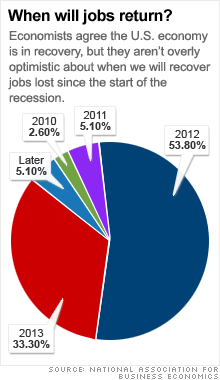
According to a survey by the National Association of Business Economics, the consensus forecast of 44 top economists is for an addition of only 12,000 jobs a month in the first quarter of next year.
The economists surveyed also indicated they don't expect monthly job gains to top the 150,000 level -- which is generally thought of as what is needed to keep pace with population growth -- until the end of 2010.
And in the most troubling sign, more than a half of the economists surveyed said they didn't expect a recovery to pre-recession levels in the job market until 2012 while a third said they didn't believe a full job recovery would occur until 2013 or beyond. There are number of reasons for this pessimism.
Small businesses are typically the engine of job growth, but their access to credit is still severely limited. That means that even if they're confident about their future prospects, many small employers won't be able to afford to add staff.
"Recessions that involve a financial crisis take a much longer time for there to be a jobs recovery," said Heidi Shierholz, labor economist for the Economic Policy Institute, a liberal think tank. "The credit crunch isn't getting worse, but it's still very tight."
Even larger businesses aren't experiencing the kind of growth that might prompt them to start bringing back staff.
Earnings tracker Thomson Reuters is projecting that overall revenue for the companies in the Standard & Poor's 500 will be down nearly 10% in the third quarter compared to a year earlier and that profits will decline 18%.
And even though fourth quarter profits are expected to more than triple compared to a year ago, most of that will be due to lower costs. Revenue is only forecast to be up 6%.
"It typically takes a couple quarters after the upturn in revenue to get an upturn in employment," said Keith Hembre, chief economist with First American Funds. "That takes us to at least the second quarter of next year."
Employers haven't only been slashing jobs in this downturn. They've been reducing the hours of the workers they keep in order to keep a lid on wages . The average work week is now 33 hours, a record low.
A record 9.2 million people that have jobs are working part-time because their hours have been cut or they can't find full-time work. That's more than doubled since the start of a recession.
Experts said before employers go on massive hiring binges, they are far more likely to restore hours to their part-time employees first. That may be good news for those workers, but not for those looking for jobs.
"We expect to see hours rise first before hiring picks up," said Shierholz. "That's a leading indicator. What's scary is that it's still declining."
During all downturns, employers naturally pull back in response to worsening economic conditions. This recession has been no different. Every recession also tends to lead to permanent changes in the job market for some sectors of the economy.
But the structural changes during this downturn have been more severe and widespread than in a typical recession.
The auto industry, construction and finance sectors were major employment engines heading into the recession, responsible for one job out of every 11 in the country. But they have all gone through major shifts.
Together, those three industries have shed 18% of their work force since the start of the recession. By way of comparison, the remaining sectors in the economy have only lost 4% of their workers.
Recovering many of the lost jobs in those sectors will be difficult, if not impossible. In some cases, the jobs lost were only there to begin with because of bubbles that are not likely to inflate again anytime soon.
For example, the drastic restructuring of the U.S. auto manufacturers in response to plunging auto sales is not good news for auto dealers. Dealers, which employ more people than auto plants, have lost 16% of their jobs during this recession. Auto dealers actually gained jobs during the last downturn.
Nonbank lenders, a group that included many of the subprime lenders who helped drive the housing boom, have lost one job in six during the recession. Those jobs are unlikely to return. Likewise, the construction industry shed 20% of its workforce while real estate lost almost 7% of its jobs.
"You may get some recovery in construction as housing turns up, but I think it will be weak for quite a few years," said Hembre. He added that the same is probably true for the financial services sector.
That means that many of the unemployed, from auto workers to mortgage brokers to construction industry craftsmen, will probably find subdued demand for their skills for years to come. 



