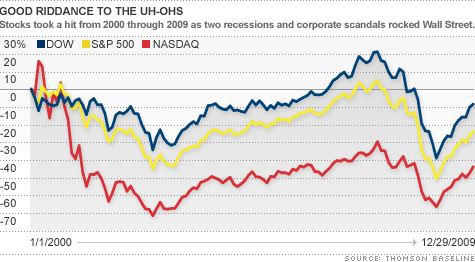
NEW YORK (CNNMoney.com) -- At the start of 2009, who could have imagined that we'd actually have reasons to look back at the year fondly?
It began with much to be worried about -- the health of Citigroup (C, Fortune 500), Bank of America (BAC, Fortune 500), AIG (AIG, Fortune 500) and other big financials; looming bankruptcies at GM and Chrysler; a stock market at its lowest point since 1997; and a labor market hemorrhaging jobs.
But heading into the year's final days, optimism reigns supreme. The S&P 500 is up 23.5% this year, the worst appears to be over for big banks and Detroit and many economists are even predicting growth for the overall economy and job market in 2010.
Still, people should not get overly excited.
As I wrote in late November, many investing experts think that it's unlikely the market will do as well in 2010 as it did this year. This doesn't necessarily mean that there will be another bear run next year. Rather, returns for stocks may be relatively mundane.
There are several reasons why that may be the case. But the biggest one is that there needs to be more compelling evidence that the economy is really improving as opposed to just holding steady after the precipitous plunge in 2008.
And investors may be ignoring some of the risks. First and foremost, it's not yet clear if the economy's 2.2% growth in the third quarter is sustainable.
Some worry that the economic rebound is merely a byproduct of government spending, not consumer spending. After all, retail sales during the holiday season were not exactly robust.
"The signs of underlying demand -- absent federal stimulus -- continue to be pretty soft," said Keith Hembre, chief economist with First American Funds in Minneapolis.
Hembre also fears that the housing market is still incredibly weak, which could dampen any chances of a strong recovery. He argues that the relatively strong sales for existing homes last month was driven by foreclosures. New home sales, on the other hand, fell 11%
Ted Parrish, co-manager of the Henssler Equity fund, agreed that housing is the big wild card for 2010.
Parrish said that he's not sure just yet what will happen to the housing market once the Federal Reserve stops buying mortgage-backed securities early next year. Many credit the Fed's purchases with helping to keep mortgage rates relatively low.
"Right now, the government is buying all these mortgage-backed securities and that is still propping up the housing market. It will be interesting to see what happens to rates after that."
Beyond housing, there are concerns about what impact all of this year's massive stimulus spending will have on the long-term health of the U.S. economy.
John Derrick, director of research with U.S. Global Investors in San Antonio, said that there is the potential for a so-called "double-dip recession", i.e. another economic downturn following a brief period of growth.
Derrick said he is fairly optimistic that there won't be such a dip, but he does think there is reason to be worried about what interest rates at zero percent combined with the trillions of dollars pumped into the system by the Fed could do to the dollar.
"Things don't look too bad for the next 6 to 12 months," he said. "But there is an argument that the Fed and government engineered a stop-gap measure to save the economy and delayed the inevitable. There is a potential for debasing the currency."
Given the dollar's weakness this year, some could argue the greenback is already debased. For that reason, Parrish said one of his key worries is that any more spending that drastically increases the federal budget deficit could lead some foreign investors to bail on the dollar.
Now don't get me wrong. This doesn't mean that the economy is going to have another tailspin next year. It just means that the expectations for a blockbuster recovery may be off the mark.
Hembre said he thinks that growth will be strong in the first half of the year but will taper off a bit in the second half. Overall, he's predicting about a 2% average growth rate for the whole year.
That's not bad, especially when you consider how bleak things were in late 2008 and earlier this year. But it still does show that there is a big disconnect between Wall Street's bullish take on the economy and the more skeptical view many consumers have.
"We're on the right side of the economic cycle right now," Derrick said. "But the average individual may still be looking for jobs or not getting pay raises." 


| Overnight Avg Rate | Latest | Change | Last Week |
|---|---|---|---|
| 30 yr fixed | 3.80% | 3.88% | |
| 15 yr fixed | 3.20% | 3.23% | |
| 5/1 ARM | 3.84% | 3.88% | |
| 30 yr refi | 3.82% | 3.93% | |
| 15 yr refi | 3.20% | 3.23% |
Today's featured rates:

| Index | Last | Change | % Change |
|---|---|---|---|
| Dow | 32,627.97 | -234.33 | -0.71% |
| Nasdaq | 13,215.24 | 99.07 | 0.76% |
| S&P 500 | 3,913.10 | -2.36 | -0.06% |
| Treasuries | 1.73 | 0.00 | 0.12% |
| Company | Price | Change | % Change |
|---|---|---|---|
| Ford Motor Co | 8.29 | 0.05 | 0.61% |
| Advanced Micro Devic... | 54.59 | 0.70 | 1.30% |
| Cisco Systems Inc | 47.49 | -2.44 | -4.89% |
| General Electric Co | 13.00 | -0.16 | -1.22% |
| Kraft Heinz Co | 27.84 | -2.20 | -7.32% |
|
Bankrupt toy retailer tells bankruptcy court it is looking at possibly reviving the Toys 'R' Us and Babies 'R' Us brands. More |
Land O'Lakes CEO Beth Ford charts her career path, from her first job to becoming the first openly gay CEO at a Fortune 500 company in an interview with CNN's Boss Files. More |
Honda and General Motors are creating a new generation of fully autonomous vehicles. More |
In 1998, Ntsiki Biyela won a scholarship to study wine making. Now she's about to launch her own brand. More |
Whether you hedge inflation or look for a return that outpaces inflation, here's how to prepare. More |



