FORTUNE -- There's some good news for those of us who worry that Wall Street hasn't paid a big enough price for being bailed out by the government. It's that the people with stakes in the worst, most-bailed-out firms have lost a ton of money, even though the Street is back to making obscene profits.
Who are these losers? The shareholders of the eight ailing financial firms that were given exceptional help by Uncle Sam. (A ninth firm, GMAC, was privately held.) With one exception -- Bank of America (BAC, Fortune 500) -- the shareholders of these rescued firms have lost essentially their entire investment.
Some of those shareholders were none other than the top executives whose risky bets -- or whose failure to supervise their subordinates' risky bets --drove those firms to the brink of collapse, and shoved the entire U.S. economy into the deepest recession in generations, costing millions of people their jobs.
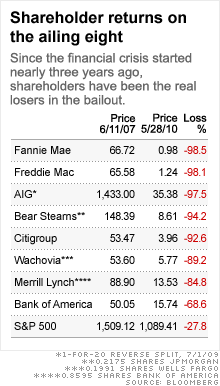
Don't believe me about shareholders not being bailed out, even though their institutions were? You should. Since June 11, 2007, the day before financial markets began imploding on news that two Bear Stearns hedge funds speculating in mortgage-backed securities were melting down, shares of all the giant institutions (except BofA) that got special government assistance have lost at least 85% of their value.
The numbers, assembled by my Fortune colleague Doris Burke, are stark.
Citigroup (C, Fortune 500), the biggest basket case that was allowed to continue as an independent outfit, has seen its stock price fall 93% percent since the world's financial markets began to totter three summers ago. That's pretty close to a total wipeout.
Shares of American International Group (AIG, Fortune 500), Fannie Mae (FNM, Fortune 500), and Freddie Mac (FRE, Fortune 500) -- now wards of the government -- have all lost at least 97% of their value. Shareholders of Bear Stearns, Merrill Lynch and Wachovia, (WB) firms that were kept alive by the government and sold in government-brokered deals, have lost 85% to 95% of their investment. (We're comparing the firms' original prices to Friday's value of the shares that holders got when the firms were acquired.)
The shareholders in our group that have suffered the least, Bank of America's, have lost 69% percent of their money. You could argue that that's not enough, which it isn't. However, it's still more than double the 28% percent drop in the Standard & Poor's 500 index over the same time period.
It's good for the financial system to see holders of bailed-out institutions suffer this kind of pain, because fear of suffering losses is arguably the most powerful tool there is to make institutions act prudently.
As much as I enjoy seeing these firms and their executives pay the financial price for their reckless behavior, though, it's important to remember that a lot of little people got hurt. Small retail investors, especially retirees, who owned Citi and BofA because they paid high dividends have lost the great bulk of their investment and almost all their income. The firms' dividends, which were $2.16 a year for Citi and $2.56 for BofA in 2007, are now zero and 4 cents a share, respectively.
In an ideal world, I'd confine the pain to big, sophisticated institutions and top company managers, rather than also hurting ma-and-pa investors and non-executive employees. But I can't begin to figure out how to do that, any more than I can figure out how to compensate people whose jobs were vaporized by the way these firms messed up.
Maybe the people running the next bailout -- and there will be another bailout -- will manage to make creditors and counterparties, who largely escaped this time, suffer serious pain. That would get them to keep a really sharp eye on the institutions they deal with: a far greater force for prudent behavior than anything Washington could ever legislate.
Sure, the federal government bailed out huge, troubled institutions that should have been allowed to fail. But almost none of their shareholders were bailed out to any serious extent. That's something we ought to keep in mind when we throw the "b" word around. 


| Company | Price | Change | % Change |
|---|---|---|---|
| Ford Motor Co | 8.29 | 0.05 | 0.61% |
| Advanced Micro Devic... | 54.59 | 0.70 | 1.30% |
| Cisco Systems Inc | 47.49 | -2.44 | -4.89% |
| General Electric Co | 13.00 | -0.16 | -1.22% |
| Kraft Heinz Co | 27.84 | -2.20 | -7.32% |
| Index | Last | Change | % Change |
|---|---|---|---|
| Dow | 32,627.97 | -234.33 | -0.71% |
| Nasdaq | 13,215.24 | 99.07 | 0.76% |
| S&P 500 | 3,913.10 | -2.36 | -0.06% |
| Treasuries | 1.73 | 0.00 | 0.12% |
|
Bankrupt toy retailer tells bankruptcy court it is looking at possibly reviving the Toys 'R' Us and Babies 'R' Us brands. More |
Land O'Lakes CEO Beth Ford charts her career path, from her first job to becoming the first openly gay CEO at a Fortune 500 company in an interview with CNN's Boss Files. More |
Honda and General Motors are creating a new generation of fully autonomous vehicles. More |
In 1998, Ntsiki Biyela won a scholarship to study wine making. Now she's about to launch her own brand. More |
Whether you hedge inflation or look for a return that outpaces inflation, here's how to prepare. More |




