NEW YORK (CNNMoney.com) -- The world's largest toothpaste maker reported disappointing sales Thursday, and who's to blame? None other than the country of Venezuela, the company said.
In reporting its second-quarter results Thursday, Colgate-Palmolive's (CL, Fortune 500) net income of $603 million beat the Street, but its worldwide sales of $3.8 billion -- a 2% increase over the year-ago quarter -- disappointed nevertheless. Analysts polled by Thomson Reuters had expected revenue of $3.9 billion for the company.
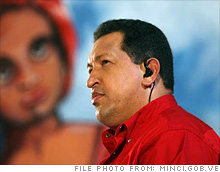 |
| Colgate's sales were disappointing and the company said one reason for that was the devaluation of the Venezuelan bolivar by President Hugo Chavez. |
Colgate partially blamed Venezuela's hyperinflation and currency devaluation for the shortcoming, and even said it expects sales in that country alone to reduce yearly earnings by 10 to 15 cents per share. Colgate executives had previously expected a hit of 6 cents to 10 cents per share from the impact of the weaker bolivar.
But is blaming Venezuela just some superfluous excuse by American companies? Several analysts said no.
While Venezuela was not the only issue hitting Colgate's bottom line, it is nevertheless a big concern for the company and other makers of consumer products, said John P. San Marco, a research analyst with Janney Montgomery Scott.
That's because consumer products companies like Colgate, Avon and Procter & Gamble have been building up a significant presence in Venezuela, seeing an opportunity to match prices with the country's hyperinflation, meanwhile taking advantage of the bolivar's previously fixed exchange rate against the dollar, said Ali Dibadj, an analyst with Sanford C. Bernstein and Co.
But the tide changed on Jan. 8 -- the day when President Hugo Chavez devalued the currency as much as 50% when he created a two-tiered exchange system for imports.
Chavez's system values items deemed essential -- including food, medicine and industrial machinery -- at 2.6 bolivars per U.S. dollar and all other products at 4.3 bolivars per dollar. The bolivar had previously been fixed at 2.15 to the dollar since March 2005.
Consumer products companies began to feel the pain, Dibadj said, after that cut to the exchange rate combined with Venezuela's super high inflation rate of 31.3% -- said to be the highest in South America.
Avon Products (AVP, Fortune 500) also wrote-off charges due to "Venezuelan special items" when reporting its quarterly earnings Thursday. While Avon's worldwide sales came in line with analyst expectations, its revenue in Venezuela declined 27%.
Procter & Gamble (PG, Fortune 500) is also expected to mention the country's falling currency when it reports its earnings Tuesday August 3.
Even though analysts said Colgate's stock wasn't down solely because of Venezuela, investors punished the company, sending shares down 7% in late afternoon trading.
Shares of Avon, on the other hand, were up 2% to $30.14.
Compared with Colgate, Avon showed stronger sales growth and that -- not Venezuela -- was likely the reason the two stocks performed the way they did, Dibadj said. 







| Index | Last | Change | % Change |
|---|---|---|---|
| Dow | 32,627.97 | -234.33 | -0.71% |
| Nasdaq | 13,215.24 | 99.07 | 0.76% |
| S&P 500 | 3,913.10 | -2.36 | -0.06% |
| Treasuries | 1.73 | 0.00 | 0.12% |
| Company | Price | Change | % Change |
|---|---|---|---|
| Ford Motor Co | 8.29 | 0.05 | 0.61% |
| Advanced Micro Devic... | 54.59 | 0.70 | 1.30% |
| Cisco Systems Inc | 47.49 | -2.44 | -4.89% |
| General Electric Co | 13.00 | -0.16 | -1.22% |
| Kraft Heinz Co | 27.84 | -2.20 | -7.32% |
|
Bankrupt toy retailer tells bankruptcy court it is looking at possibly reviving the Toys 'R' Us and Babies 'R' Us brands. More |
Land O'Lakes CEO Beth Ford charts her career path, from her first job to becoming the first openly gay CEO at a Fortune 500 company in an interview with CNN's Boss Files. More |
Honda and General Motors are creating a new generation of fully autonomous vehicles. More |
In 1998, Ntsiki Biyela won a scholarship to study wine making. Now she's about to launch her own brand. More |
Whether you hedge inflation or look for a return that outpaces inflation, here's how to prepare. More |




