NEW YORK (CNNMoney.com) -- The United States racked up a $1.29 trillion deficit in fiscal year 2010, the federal government said Friday.
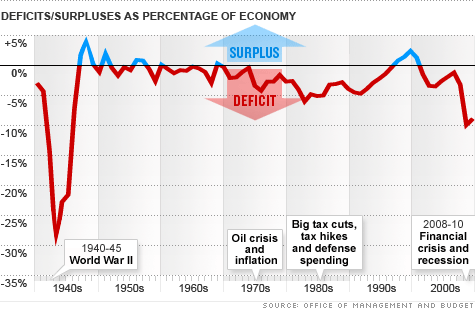
While that is historically high, it's not as high as the $1.42 trillion registered for 2009, which was the largest on record as a percentage of the economy since 1945. In real dollar terms, the 2009 gap was the largest ever.
The deficit for fiscal 2010, which ended Sept. 30, represented 8.9% of the economy. By comparison, at the height of World War II in 1943, the deficit equaled 30.3% of the economy.
Generally speaking, the slight decline in 2010 is due to somewhat higher tax receipts (up 2.7%) and slightly less spending (down 1.8%).
Tax revenue: Corporate tax revenue rose as did receipts from the Federal Reserve, which made money off its investments in housing and other areas of the economy.
In fact, the Fed's payments to the Treasury rose 122%.
Individual income and payroll tax receipts, however, were down, the result of a continued high unemployment rate.
Spending: Overall government spending fell primarily because of declines in the costs of the Troubled Asset Relief Program, which just ended, and payments to mortgage giants Fannie Mae and Freddie Mac. The same is true for funds spent on federal deposit insurance.
Apart from those programs, other spending rose 5.5% because of increased outlays on Social Security, Medicare, Medicaid and unemployment benefits.
Of the three, the biggest jump was the 29% increase in money spent on unemployment benefits.
Interest: Meanwhile, the federal government in fiscal year 2010 paid $414 billion in interest on the country's cumulative debt acquired over the years. Thanks to continued low interest rates, however, that's only 8% more than the interest paid in 2009, even though the country's accumulated debt owed to the public rose by nearly 20% year over year.
Long-term problem: There has been a lot of political hysteria expressed over the annual deficits of the past two years.
Fiscal experts note, however, that the abnormally large deficits incurred in the wake of the financial crisis are not the primary source of the country's biggest fiscal problems.
The biggest source of fiscal concern remains the so-called structural deficit, which is made up primarily of spending on the big three entitlement programs. That structural deficit will continue to balloon faster than the economy grows long after the current downturn has ended.
Indeed, the Government Accountability Office projects that by the end of this decade, the vast majority of all federal tax revenue will be swallowed up by just four things: Interest payments on the country's debt, and the payment of Medicare, Medicaid and Social Security benefits.
The president's bipartisan fiscal commission, charged with recommending ways to get U.S. debt under control, will issue a report in December. 







| Index | Last | Change | % Change |
|---|---|---|---|
| Dow | 32,627.97 | -234.33 | -0.71% |
| Nasdaq | 13,215.24 | 99.07 | 0.76% |
| S&P 500 | 3,913.10 | -2.36 | -0.06% |
| Treasuries | 1.73 | 0.00 | 0.12% |
| Company | Price | Change | % Change |
|---|---|---|---|
| Ford Motor Co | 8.29 | 0.05 | 0.61% |
| Advanced Micro Devic... | 54.59 | 0.70 | 1.30% |
| Cisco Systems Inc | 47.49 | -2.44 | -4.89% |
| General Electric Co | 13.00 | -0.16 | -1.22% |
| Kraft Heinz Co | 27.84 | -2.20 | -7.32% |
|
Bankrupt toy retailer tells bankruptcy court it is looking at possibly reviving the Toys 'R' Us and Babies 'R' Us brands. More |
Land O'Lakes CEO Beth Ford charts her career path, from her first job to becoming the first openly gay CEO at a Fortune 500 company in an interview with CNN's Boss Files. More |
Honda and General Motors are creating a new generation of fully autonomous vehicles. More |
In 1998, Ntsiki Biyela won a scholarship to study wine making. Now she's about to launch her own brand. More |
Whether you hedge inflation or look for a return that outpaces inflation, here's how to prepare. More |




