NEW YORK (CNNMoney.com) -- April 15 could be a lot easier for most American taxpayers if economists get their way.
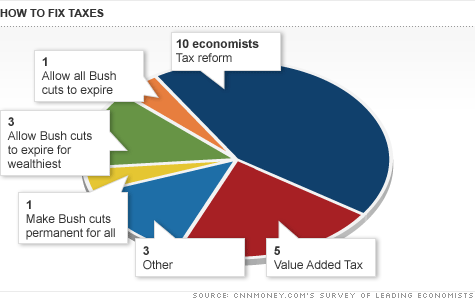
Nearly half of economists surveyed by CNNMoney.com think overhauling the current system would be the best tax policy going forward. Reform would mean lower tax rates but an end to many of the deductions and special treatment enjoyed by certain taxpayers.
"Significantly lower ... tax rates in exchange for reducing tax [deductions and breaks] makes the most sense in terms of increasing growth," said David Berson, chief economist of the PMI Group.
Nearly a quarter of the economists would pick an even more radical change to the tax system -- imposing a so-called value added tax, or VAT, a form of national sales tax common in many other advanced economies.
The tax debate that has dominated in Congress for the last few months -- whether to extend the Bush-era tax cuts, or let rates rise to pre-2000 levels on some or all taxpayers -- had relatively little support among the economists, with only a handful picking those choices as the most effective long-term tax strategy.
Several of the economists favor implementing both tax reform and a VAT.
"Actually, we need a combination," wrote David Wyss, chief economist with Standard & Poor's. "The fiscal outlook is disastrous, and unless draconian cuts in Medicare and Social Security are made, taxes will have to rise."
The idea of reforming the tax code has been gaining greater support in Washington, with both President Obama and Federal Reserve Chairman Ben Bernanke voicing support for tax reform, and several blue ribbon groups looking at the issue of deficit reduction say tax reform should be part of the solution.
There is less agreement among economists as to exactly what tax reform would entail and which tax breaks should be exempted, if any.
While Wyss and some others think tax reform and a VAT should be used to increase tax collections and reduce the federal deficit, George Mokzran, senior economist with Huntington Funds, said he thinks it's important that tax reform be revenue neutral, meaning it doesn't raise the tax burden on taxpayers overall.
Mokzran would like to see a flat tax on all sources of income with no exemptions.
Other economists believe tax reform should keep at least some form of the mortgage interest deduction in place in order to prevent rattling the still-fragile housing market. 






| Index | Last | Change | % Change |
|---|---|---|---|
| Dow | 32,627.97 | -234.33 | -0.71% |
| Nasdaq | 13,215.24 | 99.07 | 0.76% |
| S&P 500 | 3,913.10 | -2.36 | -0.06% |
| Treasuries | 1.73 | 0.00 | 0.12% |
| Company | Price | Change | % Change |
|---|---|---|---|
| Ford Motor Co | 8.29 | 0.05 | 0.61% |
| Advanced Micro Devic... | 54.59 | 0.70 | 1.30% |
| Cisco Systems Inc | 47.49 | -2.44 | -4.89% |
| General Electric Co | 13.00 | -0.16 | -1.22% |
| Kraft Heinz Co | 27.84 | -2.20 | -7.32% |
|
Bankrupt toy retailer tells bankruptcy court it is looking at possibly reviving the Toys 'R' Us and Babies 'R' Us brands. More |
Land O'Lakes CEO Beth Ford charts her career path, from her first job to becoming the first openly gay CEO at a Fortune 500 company in an interview with CNN's Boss Files. More |
Honda and General Motors are creating a new generation of fully autonomous vehicles. More |
In 1998, Ntsiki Biyela won a scholarship to study wine making. Now she's about to launch her own brand. More |
Whether you hedge inflation or look for a return that outpaces inflation, here's how to prepare. More |




