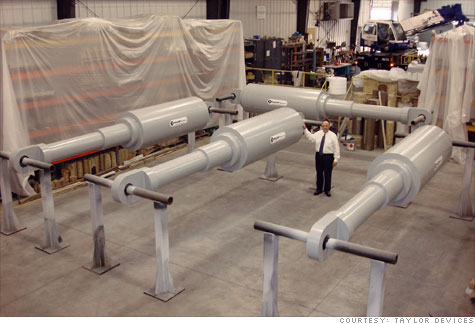
 Douglas Taylor, CEO of Taylor Devices, stands next to earthquake shock absorbers used on the Sutong Bridge in China, a 4.7-mile long cable suspension bridge.
NEW YORK (CNNMoney) -- As Japan recovers from its devastating earthquake, one small company in upstate New York is hoping its innovative technology could help make the country's buildings safer from future quakes.
Taylor Devices, a 100-employee manufacturer based in North Tonawanda, N.Y., sells patented earthquake shock-absorbers, which stabilize buildings, bridges, and elevated freeways during temblors to help prevent them from falling.
Although it will be a while before Japan starts to rebuild, when it does, the company's devices could help create more stable buildings, says CEO Douglas Taylor.
Cold War military technology: Among other things, Taylor Devices sells dampers, or shock absorbers, which dissipate the energy of the earthquake before it bends or damages a building, explained Taylor.
The technology increases the earthquake resistance of a building by threefold, he said. Dampers are based on technology first developed by the military to protect U.S. missile silos against Russian attacks during the Cold War.
Taylor's father started the company in 1955, and through the Cold War, the only customer was the U.S. government. The company still manufactures all of its products in upstate New York.
Because Taylor Devices started developing the patented technology earlier than many of its competitors, it has been able to build strong customer bases in other countries.
Seventy percent of the company's sales are made outside the country, 40% of total sales are from Asia, and 10% from Japan. Taylor Devices has worked on more than 350 building and bridge projects worldwide, including the Guggenheim Museum in New York and the Seattle Mariners' baseball stadium. Generally, its technology is used in large commercial buildings.
Right now, eight of its employees are in a sales office in Yokohama, close by Tokyo; the company has installed its devices in 22 buildings and bridges in Japan. All 22 sites seem to have survived the earthquake without suffering any damage, Taylor said.
The recession trimmed the company's sales last year by 15%, but exports to Asia grew, according to company documents. And Taylor expects exports to continue rising.
"Other Asian countries will look at this and say: 'Oh my gosh! If it happened in Japan, it could happen here! What are we going to do to be sure this doesn't happen to us?' " Taylor said.
The company, which added employees and manufacturing capacity last year, is prepared to expand more if demand warrants, Taylor says.
He isn't the only one betting on the company's ability to make Japan's buildings safer. Investors sent the company's stock surging as much as 33% higher during Friday morning trading but lost half its gains by Friday's close. Monday shares ended at $5.70, up just 1%. 



 How does a florist sell more in this economy? We changed our business to designing weddings and events only, as the everyday flowers are not selling. We had to throw out too much product at the end of the week -- flowers are perishable! More

| Overnight Avg Rate | Latest | Change | Last Week |
|---|---|---|---|
| 30 yr fixed | 3.80% | 3.88% | |
| 15 yr fixed | 3.20% | 3.23% | |
| 5/1 ARM | 3.84% | 3.88% | |
| 30 yr refi | 3.82% | 3.93% | |
| 15 yr refi | 3.20% | 3.23% |
Today's featured rates:

|
Bankrupt toy retailer tells bankruptcy court it is looking at possibly reviving the Toys 'R' Us and Babies 'R' Us brands. More |
Land O'Lakes CEO Beth Ford charts her career path, from her first job to becoming the first openly gay CEO at a Fortune 500 company in an interview with CNN's Boss Files. More |
Honda and General Motors are creating a new generation of fully autonomous vehicles. More |
In 1998, Ntsiki Biyela won a scholarship to study wine making. Now she's about to launch her own brand. More |
Whether you hedge inflation or look for a return that outpaces inflation, here's how to prepare. More |



