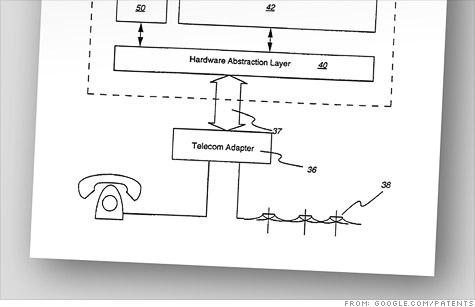
The rapid rise of software patent applications, such as this one from Apple, have led to an unmanageable backlog at the U.S. Patent And Trademark Office.
NEW YORK (CNNMoney) -- Congress on Thursday passed legislation that will reform the U.S. patent system for the first time since the Truman administration.
In an 89-9 vote, the Senate overwhelmingly agreed to accept the bill, dubbed the America Invents Act. It passed through the House in March with a similarly lopsided 304-117 vote.
President Obama declared that he will sign the bill in the next week or so.
The sweeping bill attempts to improve upon the existing patent system by mandating three things:
First, it will transition the country to a "first to file" system, instead of the current "first to invent" approach. The U.S. Patent and Trademark Office says that issuing patents to the first person or company to file will help provide clarity in the patent-granting process. It will prevent inventors from coming out of the woodworks to challenge pending patents.
The first to file system is the predominant rule used by the vast majority of industrialized countries throughout the world.
Second, the patent reform bill will help provide adequate funding to the overwhelmed patent office by allowing it to set and keep its own fees. Currently, all patent-filing fees are sent to Congress, and the patent office is allocated a set amount that is unrelated to how many patents are filed for in a given year.
After the bill is signed, Congress will continue to allocate funds to the patent office, but any fees that the office collects in excess of its allocation would be placed into escrow. The patent office will then need to appeal to Congress to release those funds, allowing Congress to maintain a certain level of oversight.
The patent office currently examines roughly 500,000 applications every year. Under-funding has led to a 700,000-patent backlog and a three-year waiting period for the average patent to receive final approval.
David Kappos, director of the patent office, has estimated that the reform bill would bring in an additional $300 million, which the patent office could use to staff up and invest in much-needed IT resources. Over the course of several years, that could halve the backlog to 350,000 applications, Kappos said.
Finally, the bill will create a post-grant review process intended to clear up legal battles before they start. The reform bill allows inventors or companies to contest the validity of a patent for nine months after it is issued. The patent office will then go back and review the case.
The idea is to keep some of the expensive, lengthy patent fights out of the courts.
When signed into law, the legislation will mark the first significant change to the U.S. patent system since 1952.
Despite the bipartisan support for a patent overhaul, it wasn't easy to get to this point: The bill was the product of more than six years of debate.
And it's not without its critics. Some small business advocates say that the first to file system will impair their ability to beat giants -- and their armies of researchers and patent attorneys -- to the patent office. Academics are skeptical that the bill will do enough to protect inventors from costly, and potentially disastrous, patent disputes.
Even those who support it say the bill is far from perfect and will take years before it results in any kind of significant job creation. At the same time, proponents say that it is an important first step in overhauling a largely broken system.
"The bill may not be exactly what I would have written, nor is it exactly what any member of Congress would have written," Sen. Patrick Leahy, one of the bill's foremost champions, told CNNMoney. "But it is a significant -- and historic -- step forward in updating our antiquated patent laws."