
CNNMoney.com
Companies Economy International Corrections Pre-market Trading After-hours Trading Winners/Losers/Actives Bonds Currencies Commodities World Markets Money Magazine Real Estate Taxes Jobs Ask the Expert Money 101 Autos Mutual Funds The Help Desk Loan Center Best Places to Live Ask the Expert Ultimate Guide to Retirement Retirement Calculators Best Funds Best Places to Retire Fortune Brainstorm Tech Apple 2.0 Blog Big Tech Blog Sectors and Stocks Tech Talk Resource Guide Small Business Makeovers Questions & Answers Small Business Video 100 Best Places to Launch FSB 100 Fortune Small Business Fortune 500 Brainstorm Tech Investing Management C-Suite Rankings Main Create Portfolio Edit Portfolio Create Alerts Edit Alerts

GM tests fuel cell cars in real world

The Chevrolet Equinox Fuel Cell will generate PR and feedback, but is this really the future of personal transportation?

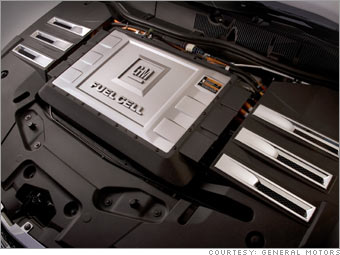
Fuel cell stack
In a hydrogen fuel cell vehicle, power electricity is generated in a "fuel cell stack" in a process mixes hydrogen with oxygen to create water.
Chevrolet Equinox Fuel Cell
Fuel cell stack
The Chevrolet Equinox Fuel Cell vehicle runs entirely on hydrogen. But, unlike some hydrogen-fueled cars, the Equinox doesn't burn hydrogen like gasoline.

The Equinox uses a fuel cell that runs hydrogen across membranes, which combine it with oxygen from the air to create water. Each water molecule that's created pops loose one unneeded electron. That flow of electrons is what powers the car.

But creating pure hydrogen - it's usually separated from water or natural gas - requires power itself. That power usually comes from electricity, so some critics say hydrogen power won't do away with the vehicle's impact on the environment and will instead just shift the problem elsewhere.

Hydrogen fuel cell supporters counter that fuel cells are much more efficient than internal combustion engines, so less hydrogen is needed than an equivalent amount of gasoline. Also, electrical generators are much more efficient, so getting power from electricity - whether its by plugging into an outlet or separating hydrogen - is a big improvement over internal combustion.

Finally, hydrogen power would at least take cars out of the environmental equation, simplifying efforts to reduce emissions.


Project Driveway

Fuel Cell

Power flow

Water

Safety

Future

Challenges
Robocar 2057: 8 visions of the future Car designers show off their ideas for the ultimate robot-controlled cars of the future in the Los Angeles Auto Show's 'Design Challenge' contest. (more)
50 years of Toyota in the U.S. On October 31, 1957, Toyota officially opened for business in the United States. The American auto business hasn't been the same since. (more)
Diesel Audi: Fast and fun but not for you The German carmaker isn't planning to sell its V8 diesel in the U.S. But it shows just how good one can be. (more)
© 2009 Cable News Network. A Time Warner Company. All Rights Reserved. Terms under which this service is provided to you. Privacy Policy
Copyright © 2009 BigCharts.com Inc. All rights reserved. Please see our Terms of Use.
MarketWatch, the MarketWatch logo, and BigCharts are registered trademarks of MarketWatch, Inc.
Intraday data provided by Interactive Data Real-Time Services and subject to the Terms of Use.
Intraday data is at least 20-minutes delayed. All times are ET.
Historical, current end-of-day data, and splits data provided by Interactive Data Pricing and Reference Data.
Fundamental data provided by Morningstar, Inc..
SEC Filings data provided by Edgar Online Inc..
Earnings data provided by FactSet CallStreet, LLC.